A RUNWAY RENAISSANCE?
2026-11-01
ashion weeks are back.
The first Laam Fashion Week (LFW) took place in Lahore earlier this year. It was a razzling, dazzling, fashion-forward show, but one had seen many of those before.
One had also heard promises in the past of sequels that never materialised, so one wasn`t surea second edition would ever take place, especially at a time when the economy is seemingly perpetually in freefall, and wars keep breaking out across the globe.
Therefore, one wondered whether the second LFW would truly manage to arrive on schedule, delivering on its promise.
But the second edition of LFW did arrive, with a four-day-long second season that just culminated last Monday. The glamour of thecatwalk, the red-carpet excitement and collections that inspired, surprised, and set trends in motion were all back. Of course, so were the not-so-good collections. After all, fashion weeks are not without their occupational hazards.
However, in retrospect, the highs of LFW far outweighed the lows.
One remembers that, back when fashion weeks used to be dotted all through the yearly calendar, conversations about how being in the spotlight inspired designers to think out-of-the-box. Those conversations have now returned.
The designer line-up featured the work of retail brands that mostly toed commercial lines but also, occasionally, made successful attempts at innovation.
The `LFW Edit` segment featured the work of emerging labels with fresh ideas and, in many cases, impressive, cohesive collections. Given some time, these brands could become the future heavy weights of Pakistani fashion.
And then, there were the main designer showcases, featuring major veteran names, many of whom delivered work that was genuinely exciting.
FASHION, FOR THE FUTURE It would be fair to say that `The Edit` was possibly the most promising segment at LFW. The established designers have already proven their mettle. One is already acquainted with their aesthetic and knows, to some extent, what to expect from their shows. They already have their clientele sorted, their campaigns mapped out well in advance.
In contrast, some of the new names, curated in `The Edit`, introduced new ideas. There were some not all brands that had well-defined aesthetics and really knew their way down the runway.
Some even went the extra mile withstyling, proving that a thoughtfully put-together show can elevate a collection considerably.
It was quite refreshing: Hath Ghar with its Subcontinental ethos, Sadhbarg Lahore`s play with silhouettes, embroidery and prints, U & I by Umer Imrana`s focus on hand-woven textiles, Dhundli Zameen`s mixing and matching of trendy separates, Kibo bringing Japanese influences into the mix and Dreams by Arthur with his pro-Palestine fashion statement.
Given some time, one could see some of these brands trickling their way to the main designers showcases, gaining popularity and loyal customer bases of their own.
`We are particularly proud of The LFW Edit,` says Executive Director, Designer Experience and Curation at Laam Fashion Week, Maheen Kardar. `LFW as a platform stands very much onthe principle of a united, cohesive, singular voice of Pakistani fashion, and a big part of that is the future.
`The brands in `The Edit` stand for that,` adds Maheen. `The ones you saw on the runway over the last four days were handpicked after much research. Some I had to convince to show! And they`ve done us proud we have seen so much innovation, technique and signature styles. This will be a regular part of all the seasons going forward and we are incredibly excited.
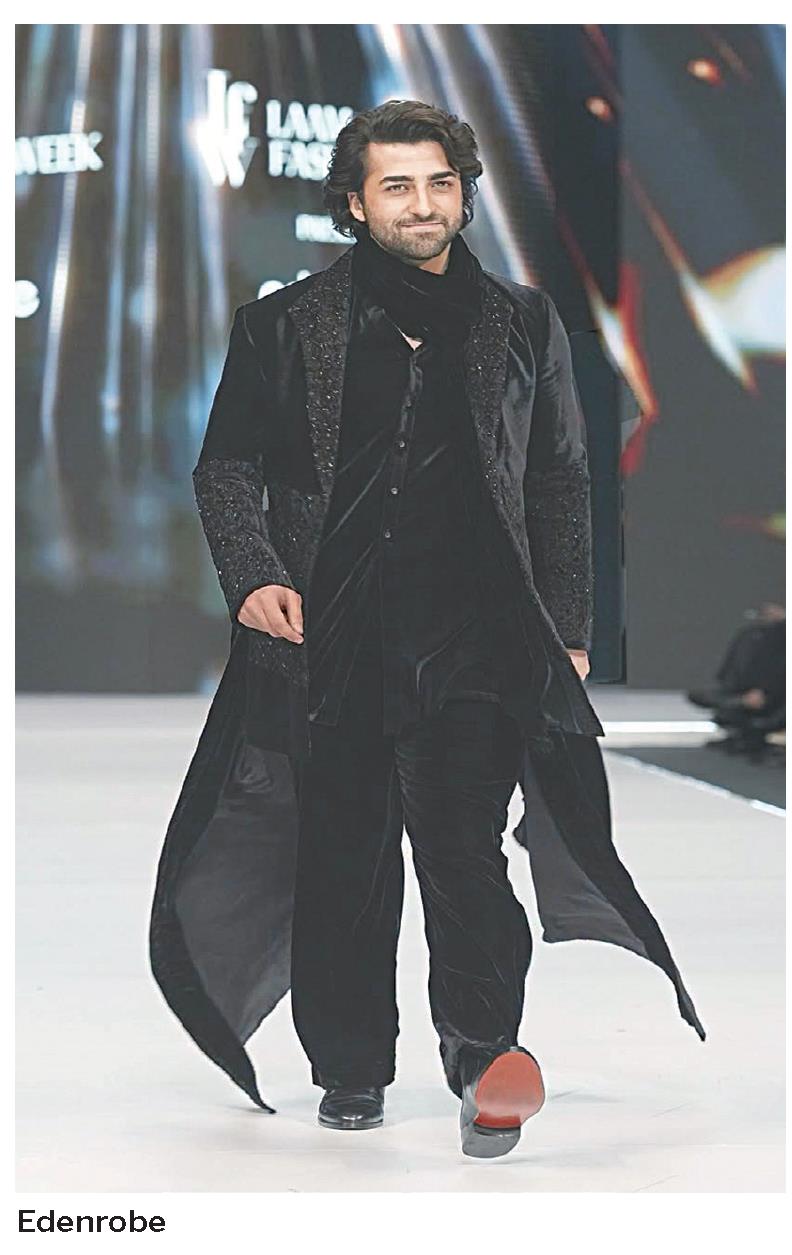
POWER PLAYS Many of the main designer showcases also raised standards: Sania Maskatiya`s experimentation with silhouettes and patterns, Mihha`s delicate embellishments and beautiful garment construction, Duno By Hassan and Yahsir Waheed`s deconstructed,handcrafted garments, Emraan Rajput`s impeccable tailoring, Mo By Mohsin Tawasuli raising the bar with his expert draping and Fahad Hussayn`s intricate, gorgeous embroideries.
And let`s not forget Jugnu Studios` extensive line of standout, head-turning prêt, Deepak Perwani`s fine finishing, Souchaj`s old-world classicism and the finale act by HSY, unfailingly delivering on drama and glamour.
Nilofer Shahid`s `invite-only` showcase was outstanding, featuring treasures from the designer`s extensive archives, updated for the present-day catwalk. There were artisanal florals, embroideries inspired by different historical eras and regal silhouettes on an extensive catwalk that had the audience spellbound.
Many of the collections inspired `trend reports` on social media the next day, with commentators analysing the ins and outs and design innovations.
It is important to note that many of the designers showcasing their work were seasoned veterans who release regular collections at least twice a year. Their businesses are well-established, their operations welloiled and their clientele dependable. Had they continued working outside the fashion week circuit, some might have spent the next few years producing collections that stayed comfortably within their established aesthetic, ticking all the right commercial boxes.
The fashion week runway, though, inspired them to push boundaries.
Saad Ali, the event`s co-founder and CEO of event management company Design651, points out that this competitive element is essential.
`Being part of a runway show with their peers inspires and elevates designers,` he says. `Celebrated designers may have thriving businesses, but when they are showing at a fashion week they will make sure that they put out their very best. They will want to compete and move out of their comfort zone.
He offers an example. `The `Starry Night` showcase at LFW featured designs by some of the country`s most renowned ateliers, inspired by the night sky. One of the designers actually made a new outfit just for the show, instead of sending out something from the archives.
He adds, `I am even intrigued by how many of the manufacturing brands that have participated are trying to raise their own standards. Ignorance is bliss.
While they were working within their own zones, manufacturing millions of units within their factories and earning huge profits, they were complacent when it came to design. Now, when they become part of a fashion week and start creating for the catwalk, they see all that they can do, and everything that they have been missing out on.`They already have the infrastructure and they may eventually decide to collaborate with professional designers, go to institutes, hire students or young designers or partner with brands. It`s a win-win for the fashion industry.
There is also the matter of aspiration. Fashion weeks are not merely about putting clothes on a catwalk; they are about giving a brand a story.
`Ultimately, a fashion week is a marketing platform,` Saad points out. `Like a campaign placed on a billboard, it can establish a brand`s identity, help in building its story, making it aspirational in the consumer`s eyes. I see how so many new brands have come under the LFW umbrella, wanting to stand out with their design and I see how things are changing.
WHEN THE RUNWAY DISAPPOINTS Brands may be becoming more aware of the power wielded by the catwalk but, at the same time, there were also collections at LFW that failed to impress.
The retail brands could be excused for having commerce on their minds, the collections in the LFW Edit could be pardoned considering that they were put out by newbies but quite a few of the main designer showcases, the so-called `veterans` in the fray, also disappointed.
There was a fair share of badly fitted suits, of wedding wear that felt like forgettable imitations of other designers` past creations, of untidy embroideries and substandard fabric choices. These were unfortunate reminders that simply securing a place on the runway does not make a collection worthy of it.
When the council-led fashion weeks were in their heyday, recurring conversations took place on the importance of editing a collection. Considering that LFW is associated with the online portal Laam, a very successful commercial e-store selling a diverse range of design, was the focus just on including whoever wanted to participate and could pay the participation fee? Were collections not vetted and weighed before they were allowed on to the LFW roster?`Laam may be commercial, but LFW`s vision is not commercial at all,` responds Saad. `Our selection committee is currently at daggers drawn with a multitude of brands because they were turned away and asked to come back next time with a better collection. There are others that they have decided to give a chance to. And then there are the brands that were too scared to participate and that we took on board, counselled and gave the confidence to come on to the runway.
WHAT COMES NEXT? Now that they have wrapped up a whopping 43 shows over four days, the LFW crew isn`t ready to take a break. They have a `Couture Weekend` planned for December this year. And a lot more.
Amir Iqbal, COO and Co-Founder at Laam, outlines the plans. `We have a minimum of four and a maximum of six events planned out for next year, he says. `There are the LFW Flagship shows [fashion weeks featuring collective designer showcases], the LFW Presents shows, featuring solo designer shows or events such as the recent Kaleidoscopic Karachi, and other interesting things in the pipeline. The key is to make fashion exciting again. When the industry grows, every single player benefits.
Has LFW made Pakistani fashion exciting again? Yes, for sure. With its second season, it has also ironed out the timing issue that persisted the first time around, with shows ending around a sensible 10pm this time.
A QR-code system eliminated the need for hard copy invites. Like last time, a digitised passageway led to the main event. It was very Instagrammable and very cool. The catwalk was lit up by zigzagging lights, providing a grand stage for the shows.
The fashion wasn`t always great but, after a long time, there were conversations on fashion: discussions, debates, critiques and praise.
Are fashion weeks back, then? Yes. Let`s hope the fashion is worth coming back for.
The writer is afashion and entertainment journalist with over two decades of experience. She can be reached at maliharehmanl @gmail.com