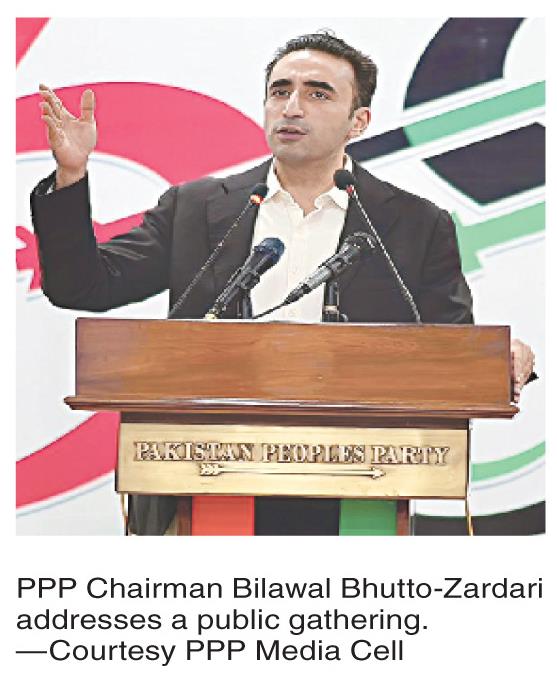
No judge can revoke 27th Amendment: Bilawal
By Mohammad Hussain Khan
2025-12-01
HYDERABAD: PPP Chairman Bilawal Bhutto-Zardari has said 27th Amendment lies exclusively within parliament`s authority and cannot be struck down by any judge or institution, while also declaring that his party would oppose any attempt to alter the National Finance Commission (NFC) Award or 18th Amendment.
`Past intrusions into parliament`s domain had harmed the federation, he warned while addressing party workers on the eve of the PPP`s 58th foundation day through the party`s digital platform on Sunday evening.
He said no judge or judicial forum could overturn the 27th Amendment and the PPP would not allow any institution to interfere in parliamentary authority.
The PPP chairman touched uponkey subjects including the PakistanIndia conflict of May, the NFC Award, the 18th Amendment, and the government`s proposal to revise the formula for resource distribution under the NFC.Questioning the concept of a `federal share` within NFC, he said multiple `fault lines` could only be addressed by winning hearts and minds, connecting people with the state through soft power, alongside necessary hard power measures.
He urged all political stakeholders to lower political temperatures and engage constructively.Mr Bhutto-Zardari said the PPP was aware that attempts to revise the NFC formula would continue, butthe party would not support any step that weakened the federation or provincial rights.
Discussing the government`s intentions regarding the 27th Amendment, he said the Shehbaz-led administration had sought the restoration of executive magistracy, the return of provincial education and population control subjects to the federation, and the removal of constitutional protection for provincial shares in the NFC. `I ensured this protection remained intact. Had it been withdrawn, Punjab would have suffered first, followed by Sindh, Balochistan and Khyber Pakhtunkhwa,` he said.
Mr Bhutto-Zardari said 27th Amendment had fulfilled a longstanding Charter of Democracy (CoD) commitment by establishing a Federal Constitutional Court (FCC) with institutional parity a task that could not be achieved during the passage of the 18th Amendment dueto political resistance at the time.
Judicial execution Recalling the judicial execution of Zulfikar Ali Bhutto, he said there had been no concept of an FCC at that time, and judicial decisions that toppled elected governments and protected dictators had scarred the federation. Now, he added, the FCC would take up all constitutional matters, while the existing Supreme Court would focus on criminal matters directly concerning the public.
He expressed the hope that the judiciary would regain public trust, resolving longstanding judicial `fault lines` instead of undertaking actions such as building dams, demolishing houses, or disqualifying prime ministers over procedural matters. Attempts to make the FCC controversial would fail once the court demonstrated its character through performance, he said.
Some elements wished to curb parliament`s legislative authority, but across the world it was parliament not judges that held the right to legislate, he added. The 27th Amendment, he stressed, was passed by majority vote, and only parliament could revisit or amend it.
He insisted that PPP believed fault lines existed in the country, but parity in economic rights ensured through the 18th Amendment and the NFC Award had strengthened the federation. Criticsattacking these provisions, he warned, were `playing with fire`, especially at a time when foreign powers had historically exploited separatist sentiments.
He also referred to a recent provocative statement by an Indian minister about Sindh, urging all political forces to jointly address internal vulnerabilities.
He rejected the notion of a `federal share` in the NFC. `What is this wifaq 1(a hissa?` he aslced. `Gas from Sui or Ghotki, businessmen in Karachi, people in Lahore all contribute to the economy. Taxes paid by the people are their direct sacrifice for the country.
He noted that when provinces were empowered to collect sales tax on ser-vices, they outperformed the Federal Board of Revenue (FBR). `We should talk about more decentralisation, not centralisation,` he said, urging the government to develop economic solutions that address the country`s challenges.
Reflecting on the PPP`s legacy, he recounted how Zulfikar Ali Bhutto framed the 1973 Constitution and gave representation to the downtrodden, and how Benazir Bhutto continued her father`s mission before being martyred in Rawalpindi in 2007. He said Asif Ali Zardari, as president, furthered this mission by restoring the Constitution, launching the Aghaz-iHaqooq Balochistan package, renaming NWFP, redefining the NFC formula,devolving power, and implementing the BISP programme for the poor.
Armed forces lauded He praised Pakistan`s armed forces for the `ignominious defeat` inflicted on India by downing seven fighter jets, warning, however, that India continued to conspire by orchestrating terrorism in Balochistan and Khyber Pakhtunkhwa.
Mr Bhutto-Zardari said tensions with India, deteriorating Pak-Afghan relations, and rising threats made unity essential.
Internal disagreements, he said, must not weaken Pakistan against external adversaries.