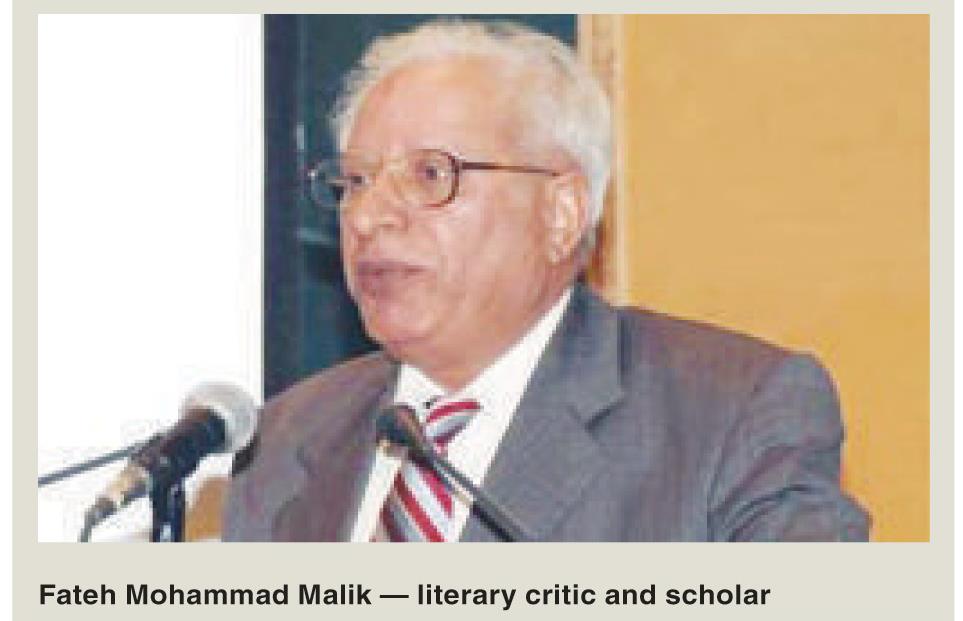
FROM MY BOOKSHELF Iqbal`s Masjid-i-Qurtaba still holds relevance`
2016-12-14
Q: What books are you currently reading? A: Everyone reads books that they buy, but when you get old like I have, writers begin sending you their books, so a lot of my reading [material] is sent to me by the writers.
Right now I am reading Muslim Shamim`s book on Mohammad Ibrahim Joyo, Zaat-o-Sifat. Muslim Shamim has been associated with the progressive writers association for some time. Joyo is a Sindhi writer and intellectual who [promoted] Sindhi culture and traditions and worked on literature. The book is a compilation of articles on Joyo; an account of the circumstances of his life, his thinking and his work.
Also on my reading list is Merey Jewan KiKuch Yaadein which is an autobiography of Dr Z.A. Ahmed who was a very popular progressive writer involved in leftwing politics and in this book, has written down his memories.
Altaf Hassan Qureshi sent me his book Malagatein Kiya Kiya. Mr Qureshi was the editor of Urdu Digest. This is an important book on the political history of Pakistan because it is a series of interviews conducted from the 60s to the recent past, with some very big names. The people he has interviewed include Maulana Maududi, Justice S.A. Rehman, Zulfikar Ali Bhutto, Gen Ziaul Haq, Sheikh Mujeebur Rehman, Shah Faisal, Khan of Kalat, Qudrat Ullah Shahab among others.
Mr Qureshi leans to the right, but there is a need to understand the right as well, and I think that in order to understand the politics and political history of Pakistan, this book is important and by including some literary names, he has also touched on the literary history of Pakistan.
Q: Which books do you return to again and again? A: I mostly re-read poetry, especially Iqbal`s works. His Masjid-i-Qurtaba is an excellent piece of work which talks about a mosque in Cordoba, Spain, which was under Muslim rule for centuries. When Iqbal went to Spain, at that time Muslims were being ruled over wherever they were. In this poem he has talked about the past and the present of the Muslims and has debated their future as well. This poem still holds relevance today and can give us a way to get out of this decline that we have been in for so long now. The poem is such a great artistic creation, so well constructed, that I always remember it now and then. It helps you understand the rise, fall and rise again of nations.
One of his later works include /blis ki Majlis-i-Shora. At that time, the League of Nations existed and the United Nations was to be formed. In a way, this poem is a satirical look at the league and he says in the poem that Iblis`s agenda is to enslave the East and to stop them from independence.
In the poem, Iblis` minions have gathered from all corners of the world at a conference and everyone is giving a performance report of sorts and they identify the challenges to their `empire`.
Q: Who do you think is an underrated writer? A: This is the age of PR and I am not saying that those writers who are getting attention are not producing good work, but it means that a lot of great names are not focused on as much as they deserve.
For instance, in the Karachi Literary Festival, a lot of authors were remembered. The 100th birth anniversary of Intezar Hussein was observed, and I liked Intezar Hussein and the latest book on him is mine. Ahmed Nadeem Qasmi was also celebrated, but it is strange that Sibt-i-Hassan was not remembered, who would also have been 100 were he alive.
Sibt-i-Hassan was among the more popular progressive and Marxist writers. He was among the founders of the Progressive Writers Association and the Communist Party of Pakistan. He wrote in English and Urdu and he left a legacy. He migrated to Karachi and lived there and it is strange that he was not remembered at a literary festival in Karachi because we consider literature entertainment now.
Q: Is there a great Pakistani novel? A: Though not many people will agree with me, I think Khadija Mastoor`s Angan is one of the best books written in Pakistan. The book is on the partition seen through the eyes of the women of a house. And it is so realistically portrayed. Women of that time would not go out usually and did not interact a lot with outsiders. But the movement for Pakistan that the younger generation believed in, the Caliphate movement supported by the older generation, who also supportedthelndianNationalCongress,wassorealformeandsowellexplained.
Q: Has a character from a book ever stayed with you? A: I think that would be Zard Katta from Intezar Hussein`s story by the same name, which was written during Ayub Khan`s regime.
Zard Katta is a personification of greed, expectation and lust and the story is about how pious people and saints compromise on their ideals and rules for the world and the writers says that the Zard kutta appears when they compromise what they believe in.
By Sanam Zeb