Dubai Unlocked: Pakistanis` $12.5bn property empire
By Atika Rehman in London & Naziha Syed Ali in Karachi
2024-05-15
OFFICIALS in Pakistan have tried in recent years to unearth details of Pakistani citizens who own assets in Dubai with an aim to bring undeclared assets and income into the tax net. But they have made little headway. Dubai authorities are reluctant to share information about something as simple as the number of Pakistani citizens with Dubai residence visas, commonly known as iqamas or Emirates IDs.
There is also a political element to the stonewalling: Pakistan doesn`t have the geopolitical clout to demand this information. Today, those details-anastoundingvolume of leaked property data that includes over 23,000 properties listed as belonging to Pakistani nationals up to the spring of 2022 are at the fingertips of journalists from scores of media outlets around the world.
The leaked data provides a detailed overview of hundreds of thousands of properties in Dubai and information about their ownership or usage, largely from 2020 and 2022. It was obtained by the Center for Advanced Defence Studies (C4ADS), a non-profit organisation based in Washington, D.C., that researches international crime and conflict.
It was then shared with Norwegian financial outlet E24 and the Organised Crime and Corruption Reporting Project (OCCRP), which coordinated an investigative project with media outlets from around the world. Titled `Dubal Unlocked`, the collabo-ration includes 74 partners from 58 countries. Dawn is part of that collaboration.
A mere mention in the data is not evidence in itself of financial crime or tax fraud.
Nor does the data contain information such as residence status, sources of income, tax declarations of rental income or capital gains. In fact, several of those approached by Dawn for comment on their proper-ties said they were declared to the tax authorities. But it does paint an astonishing picture of contrasts. Pakistan, a developing country teetering on the edge of economic collapse, begging international lenders and friendly countries for lifelines in single digit billions, features prominently in the data.
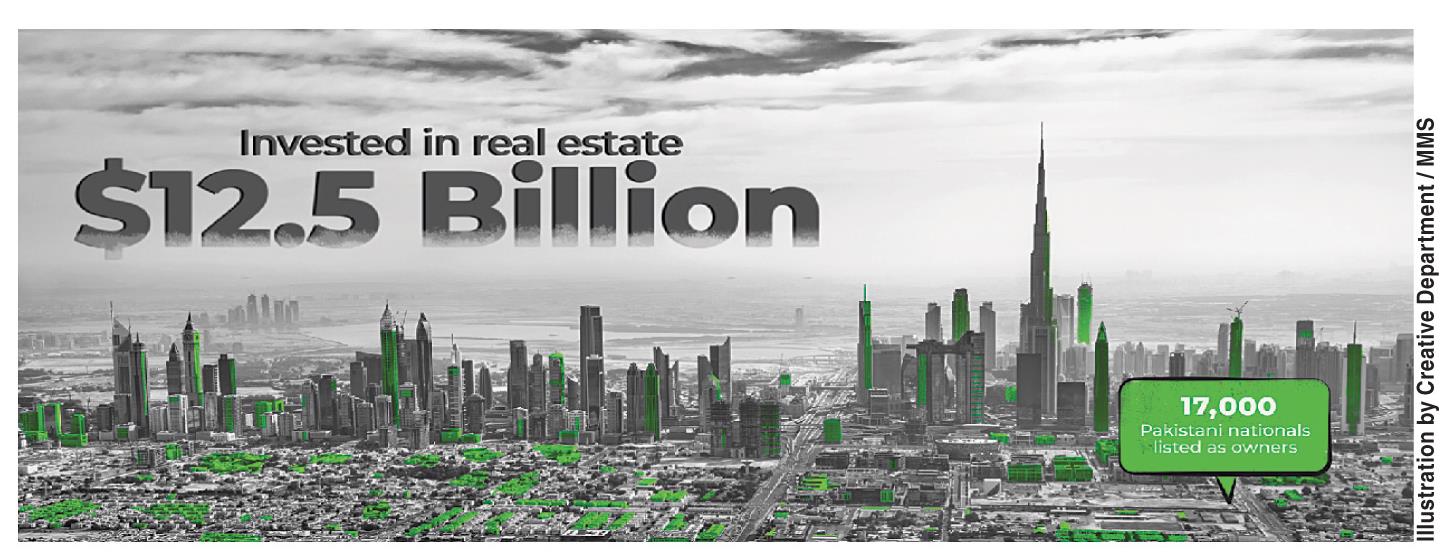
While 17,000 Pakistani citizens are listed owners in the 2022 leak, academics using the data and additional sources put the actual number of Pakistani owners of residential property in Dubai at 22,000. They further estimate that the apartments and villas may have been worth more than $10 billion at the start of 2022, but with the more than 25 per cent increase in property prices over the last two years, the real worth of Pal(istanis` residential properties in Dubai could now be well above $12.5bn.
`If we have the data you are which is among the most expensive owned by Pakistani nationals. Dawn has verified that Ms Asif currently owns a two-bedroom apartment in Vida Residences at Dubai Hills estate. Bought in 2015, its rental income from 2019 till 2024 amounts to $174,792. The couple also had joint ownership of a five-bedroom villa in the upscale Mohammed Bin Rashid District One neighbourhood until recently, but they appear to have sold it a few months ago.
According to the transaction data, it was purchased for $3.17m in 2015 and sold for $5.58m in early 2024.
Hussain Nawaz, son of former premier and PML-N president Nawaz Sharif appears as a listed owner in the leaks. In response to questions sent by Dawn, Mr Nawaz confirmed that he owns `a very small one bedroom property in Dubai...
[which] was bought as a personal investment in 2002/3 during exile days. .
[for] AED 299,999.` He added that as an overseas Pakistani, he is exempt from filing tax returns.
PML-N MNA Ehsanul Haq Bajwa is unabashed about his wealth, and his X (formerly Twitter) bio reads: `By grace of Almighty richest parliamentarian of Pakistan, former MPA and current MNA from Bahwalnagar`.
The statements of assets and liabilities filed by lawmakers with the ECP show him to be indeed the wealthiest parliamentarian with over Rs5.46 billion in assets, including Rs4.58 billion worth of assets abroad. He appears in the Dubai leaks data as a listed owner of dozens of properties in the 20202022 period. Dawn can confirm that as of early 2024, he still owns a villain Nad al Sheba First which was purchased in Aug 2016 for $1.08m; a one-bedroom apartment in Emirates Gardens bought in April 2011 for $184,749; and two more one-bedroom apartment s in Emirates Gardens bought the very next day for about $184,000 each.
According to his statement of assets for the year 2020, Mr Bajwa declared nine properties in Dubai, purchased for a sum equal to Rs36.15bn. His business capital in Dubai amounts to Rs4.9bn and the total worth of his assets comes to over Rs4 billion, excluding liabilities in the UAE.
Mr Bajwa did not respond to a request for comments.
In a stark reflection of the vast chasm between the haves and the havenots in Pakistan`s poorest province, former chief minister of Balochistan Sardar Sanaullah Zehri, his wife and daughter Izbal Zehri have invested a significant amount in Dubai`s luxury real estate sector.
Sardar Zehri, who occupies a preeminent position in Balochistan`s tribal hierarchy, was elected MPA from his native Khuzdar district in the 2024 election while Ms Zehri was elected to the National Assembly on a reserved seat.
Residential skyscraper The lealced data shows that his wife owned a double storey, six-bedroom villa in the exclusive Mohammed Bin Rashid Al Mal(toum City District One. Each residence here is said to overlook Crystal Lagoon, the largest such manmade feature in the world. The villa was purchased in 2018 for $4m and sold in 2023 for $6.2m; the rental income generated from it between 2019 to 2022 was a little over half a million dollars. Mr Sanaullah`s wife presently owns a three-bedroom apartment in the residential skyscraper 23 Marina, bought in 2020 for $383,882. The sardar and his daughter are owners of a couple of two-bedroom apartments in The Lofts Central project in the Burj Khalifa area. One was purchased in 2014 and theother during the following year. All told, the Zehris put down $1.5m for these two properties. Mr Sanaullah did not respond to a request for comments.
Another sardar from the same district, Sardar Akhtar Mengal, head of his own faction of the BNP, owns a one-bedroom apartment that he bought in 2009. The property has been rented out since at least 2013, and would be worth around $364,831 today. In his statement of assets for 2020, he declared it was gifted to him by an undisclosed individual.
According to a World Bank report of 2023, the poverty rate in Khuzdar district is 71.5 per cent.
In the property data leak, former PTI leader, Senator Faisal Vawda (spelt in the data as Fesal) appears linked with two properties. But as of January 2024, he owned a studio apartment bought in 2013 in Escan Marina Tower, Dubai Marina.
Another property for which he is a listed owner, a unit in Atlantic Tower 1 bought in 2014, is owned by his daughter in the DLD system. In the leaked data, Ms Vawda is a listed owner of a second property for the 2020-2022 period but the property is not currently owned by her. Mr Vawda has declared his ownership of an apartment in Dubai`s Atlantic Tower, two units in a resort in Malaysia and multiple properties in the UK, including 19-20 Hyde Park Place, 292 Elgin Avenue and 177 Quadrangle Tower near Edgware Road. The value of these assets on the handwritten statement are mostly illegible. In response to questions, Mr Vawda said he and his family own several properties outside Pakistan, but that he does not lcnow `which specific property` is in question. He added that his properties and income are declared with the tax authorities and that they are declared with his nomination papers.
Two million-dollar apartment Former prime ministerand one-time finance minister Shaukat Aziz and his wife are listed owners of two properties in the leaks. DLD data shows that, as of September 2023, they still own one of these properties, a threebedroom apartment in downtown Dubai`s Burj Vista Tower. Bought offplan in 2013 for $1.33m, the property is worth around $2m today. Rental data obtained by E24 and OCCRP from 2019 till 2024 shows an income of nearly a quarter million dollars. The other property for which they are listed owners is located in luxury neighbourhood Lakes Hattan IL It was purchased in 2010 for $2.2m. It is not clear if the couple still owns it. Mr Aziz did not respond to a request for comments.
The family of property tycoon Malik Riaz, owner of Bahria Town Ltd, is well represented in the Dubai leaks. His wife Bina Riaz was listed as owner of dozens of oneand two-bedroom apartments in the HDS Sunstar building in the Al Warsan area in late 2019/early 2020. These have since been sold. Ms Riaz is also a director in Bahria Town, which was found by the Supreme Court in 2018 to have illegally acquired thousands ofacres ofland in Karachi. The court ordered NAB to investigate andinitiatelegalproceedings against those involved in the mega scam. In its findings, NAB accused 34 people, Ms Riaz, her son Ahmed Ali Riaz and son-in-law Zain Malik among them, as being culpable. However, the bench set up to implement the 2018 apex court verdict ordered that no reference be filed against the suspects `for the time being`. It also ordered Bahria to pay Rs460bn nearly $3bn at the time in installments as land dues for 16,896 acres on which to develop its Karachi project. In November 2023, the SC found Bahria to be in default of its payment schedule.
Ahmed Ali Riaz andZain Malik both appear as listed owners of Dubai real estate from the 2020 period. Mr Ali Riaz owns at least seven properties currently, mainly shops and office spaces. His two minor daughters own two properties in Jumeirah Park at present and his sister Pashmina Malik one, a residential unit in Dubai Sports City that appears to have been purchased in 2015. Neither Mr Ali Riaz nor Ms Bina Riaz responded to arequestfor comments.
Son of retired Gen Qamar Javed Bajwa, Saad Siddique Bajwa`s name appears in the leaks connected to a property in Dubai. In a detailed response shared with a media partner in the collaboration, Ali Iqbal Bajwa confirmed he is the owner of an apartment in Building 5, City Walk, Dubai and that the apartment is currently mortgaged.
`The apartment was initially purchased, via a mortgage with Mashreq Bank Dubai, by my brother Saad Siddique Bajwa in February 2020. In December 2020, this apartment was transferred to me and since then I have been occupying it.
He added that the property was declared in his brother`s tax returns with FBR in 2019-20, and since the property was transferred to his name in the second half of 2020, he has been declaring it in his tax returns with FBR from 2020-21 onwards.
Other prominent individuals whose names appear in the leaks include former Balochistan chief minister Sardar Aslam Raisani, MNA Amer Ali Magsi, MPA Sheikh M Mugheri, Farhat Shahzadi aka Farah Gogi, former MPA Sardar Khan Chandio, former minister Marvi Memon, Lt Gen (retd) Muhammad Afzal Muzaffar (NLC scandal), IG police AJK Tajik Sohail Aziz and media house owner Salman Iqbal.
Additional reporting by Iftikhar A.Khan. AS may be expected, several elected officials and Politically Exposed Persons (PEPs) have a significant presence in the Dubai leaks, that cover property ownership up to the spring of 2022. Many are household names; some are no strangers to controversy; a few have been embroiled in mega financial scandals.
Surprisingly, however, there are some Pakistani families (both political and from the business world) who are widely known to have a base and family homes in Dubai, but are conspicuous by their absence in the property leaks. This underscores that the data, though robust, is neither a historic account of property ownership nor is it a complete picture of all properties bought by Pakistanis there. Many owners remain undetected, especially those who purchased property via a lesser known third party, or lesser known company.
It is important to note that a mere mention in the data is not evidence in itself of financial crime or tax fraud. Nor does the data contain information such as residence status, sources of income, tax declarations of rental income or capital gains. Names of properties linked to senior political or military officials have been mentioned in the public interest.
Among the A-listers on the political landscape are President Zardari`s children, two of whom are elected representatives.
Bakhtawar Bhutto-Zardari, a Dubai resident, and MNAs Bilawal Bhutto Zardari and Aseefa Bhutto Zardari are listed as owners of four properties between them.
The three siblings are joint owners of two apartments, one in Al Saffa and another in Jumeirah. PPP chairman Bilawal BhuttoZardari has declared these two properties in his statement of assets and liabilities submitted to the ECP. (According to the Election Act, 2017, each year before Dec 31, every parliamentarian is required to submit a statement of their assets and liabilities as well as that of their spouse and dependent children as held on the last day of the preceding fiscal year.) Ms Bakhtawar`s real estate portfolio also includes a four-bedroom penthouse in 23 Marina, an 88-storey residential skyscraper that is among the tallest such buildings in the world. Transaction data obtained by Norwegian financial outlet E24 and the Organised Crime and Corruption Reporting Project (OCCRP) reveals that the property was purchased in 2014 for AED 11,500,000 or $3,130,972 (calculated at the current exchange rate of 3.6 dirham to a dollar). The Dubai Land Department (DLD) systemshows that it is still owned by Ms Bakhtawar, and is being rented. It should be noted that as a non-resident Ms Bakhtawar is not liable to be taxed in Pakistan on her overseas rental income.
The 23 Marina property in the leaks was mentioned in the JIT report of the `fake accounts` case that pertained to 29 `suspicious` accounts through which Rs35 billion was alleged to have been laundered. The report stated that Mr Zardari in a revised wealth statement to the FBR in January 2018 declared he had received it as a giftin the tax year 2014 and that he had gifted the same property onwards in tax year 2016.
The report also claims a Karachi businessman, Abdul Ghani Majid, declared granting a gift of almost exactly the same amount in his wealth statement for tax year 2014. It alleges that he was a close associate of Mr Zardari. In the data, Mr Majid is listed asowner of a five-bedroom villa at Emirates Hills, purchased in 2014.
It should be noted that in a 17-page response to the JIT report, Mr Zardari denied any wrongdoing. `The statements recorded by witnesses and the [accompanying] documents were not provided to us, the reply stated. `The JIT is being used as a means of political victimisation.
The OCCRP contacted President Zardari and his children with requests for comment.
In a response through her lawyers, Aseefa Bhutto-Zardari said that all assets owned by her in Dubai have been `duly declared to the relevant authorities in Pakistan, including the ECP`.
In their response to Dawn`s questions, Mr Ghani`s lawyers said that their client had declared his property at Emirates Hills to the FBR.` With reference to the allegations in the JIT report, they denied that Mr Ghani had ever owned the 23 Marina property and that `the question of gifting it, therefore, is incorrect and fallacious [...]. [T]hat report has till date remained a fiction of JIT`s imagination, including and not limited to the allegations relating to this property`.
More PEPs connected with the so-called `fake accounts case` as laid out by the JIT show up as listed owners in the Dubai leaks.
Among them are Ghulam Abbas Zardari and Hamid Samoo. Two properties are linked with his name in the Dubai leal(s: a five-bedroom villa in Al-Furjan and a threebedroom apartment in Palm Jumeirah.Both these properties also find a mention in the JIT report. Purchase and rental data obtained by E24 and OCCRP show that the villa was purchased in 2014 for $1.36 million and will have generated a rental income of $329,500 from 2015 till the current contract ends later this year. Dawn has verified that Mr Abbas still owns the Al-Furjan villa, while the apartment was sold some months ago.
Mr Samoo, meanwhile, is listed as owner of an apartment in the pricey Hadaeq Sheikh Mohammed Bin Rashid area in late 2019/ early 2020 which was bought for $1.89m and sold later that year. At present, he owns a two-bedroom apartment in Glo bal Golf Residence 2. It is further alleged in the JIT report that he is employed as a driver and `has no other means of subsistence` Neither Mr Abbas nor Mr Samoo responded to a request for comment.Though the JIT allegations are yet to result in a conviction, the name of Haji Haroon, director at H&H Exchange Pvt Ltd and former president Exchange Companies Association of Pakistan, has cropped up as a vital cog in the wheel in some of the biggest dirty money investigations in the country.
And there`s a long history. In September 2004, the State Bank suspended thelicence of his exchange company for having allegedly attempted to export undeclared currency worth $1.72m from the country.
Among top five real estate investors Appearing as listed owner of at least 250 properties in late 2019 and early 2020, Haji Haroon comes in the top five on the list of Pakistanis owning the most real estate in Dubai in that period; he purchased at least two villas in the emirate by early 2022.
Among his investments was Silicon Heights, a nine-storey residential building completed in 2011. Each unit in this building sells for between $114,349 and $313,099.
His other principal investment in Dubai in late 2019/ early 2020 was the 42-unit Building 13 in the Dunes Village apartment complex, where one unit is sold for an average price of $122,517. It is not confirmed what properties he owns at present.
Haji Haroon has figured in the Axact saga, which involved the selling of fake degrees and certifications across the world, although the allegations against him went nowhere. He does not appear on any globalsanctions list. In July 2015, he was detained on charges of abetting political and business personalities in laundering their money to send abroad. Haji Haroon mysteriously disappeared that same year, reportedly at the hands ofintelligence personnel, and resurfaced some 11 months later. No FIR was lodged over the disappearance. In 2018, investigations into the fake accounts case dredged up Haji Haroon`s name again.
The FIA in its report alleged that he had used a UAE-based company for the transfer of funds. That case has still not come to a close. By all accounts, he continues to do a roaring business. Haji Haroon did not respond to a request for comments.
`Underworld`s equivalent of Goldman Sachs` In the history of money laundering, however, the massive hawala operation run by the Pakistan-based currency traders Khanani and Kalia International is considered the biggest of its kind: one news report described it as `the underworld`s equivalent of Goldman Sachs`. Moving illicit funds for organised crime groups including drug cartels and violent terrorist organisations raked in an estimated turnover of between $14 billion to $16bn annually. Altaf Khanani, the international face of the organisation, was ultimately convicted and spent nearly six years in a US prison; he was blacklisted by the US on money laundering charges along with his son Obald Khanani and nephew Hozaifa Khanani. In Dubai, a country where, reportedly, investing in real estate with bags of cash raises few questions, the Khananis are listed owners of a massive real estate portfolio. Mr Obaid himself is linl(ed to around 30 properties, while the family as a whole were listed owners of 85 properties in early 2020, including around a dozen villas. The exact number of properties still owned by Mr Khanani today is not known, but Dawn`s preliminary investigation shows that Khanani family members Mr Obaid, Anis Khanani and Abdul Qadir Khanani own at least seven.
Atif Abdul Aziz Polani was also deeply embroiled in the same money laundering operation. In fact, he was placed on the US sanctions list along with the Khanani men for having acted as an `agent` `acting for or on behalf of the Altaf Khanani organisation`. He is listed as the owner of eight Dubai properties, including four villas.
Industrialist and PPP MNA Mirza Ikhtiar Baig is listed as owning around two dozen properties, many of them jointly with his brother Ishtiaq Baig and spouse. Dawn veriSed that at least 15 of these properties, ranging from oneto three-bedroom apartments, are still listed as being owned by Mr Baig by early this year, according to the DLD. The purchase value for the still-owned properties ranges between $137,915 and $329,430. The two siblings are chairman and vice chairman of the Baig Group which bills itself as a multinational conglomerate with diversified interests in IT, textiles, power generation and real estate. Inresponse to questions, Mr Baig said, `My company and properties... are declared in my tax returns and tax paid on the rental income.
Million-dollar villa The wife of Interior Minister and former caretal(er chief minister Mohsin Raza Naqvi, is also listed as owner of a high-value property in the leaks. Data shows that, till the spring of 2022, Ms Ashraf owned a fivebedroom villa in the Arabian Ranches Palma community. According to the transaction data, the villa in the luxury estate was bought in 2017 for $1.18m and sold in 2023 for $1.23m. The DLD system still shows Ms Ashraf as an owner; however, it is not clear what properties she owns in the emirate, if any. In a statement, she acknowledged that she did indeed own the villa which she said was acquired through savings. Ms Ashraf added that it was sold in 2023 for the price mentioned above, and was declared in her tax returns.
Interestingly, she confirmed that she still owns property in Dubai, and that the property was purchased in January 2024. In a response to questions sent by Dawn, Ms Ashraf said that the newly acquired property would be declared in the current tax year, as well as to the ECP.
Sindh Information Minister Sharjeel Inam Memon, one of the richest members of the provincial assembly with properties within and outside the country, and his wife appear in the leaks with five properties, with two belonging to him and three to his spouse. Ms Memon is still the owner of an office space in Burlington Tower (along with another individual) which she bought in 2018, as well as a four-bedroom villa in The Meadows bought in 2012 for $1.17m and worth between $2.5m and $3.5m today, but the third property, an apartment at Address Fountain Views in downtown Dubai, has since been sold. Mr Memon currently owns a three-bedroom apartment boughtin 2015 that had generated a rental income of nearly a quarter million dollars ($245,036) until 2023. He also owns a onebedroom apartment that was bought in 2014 and which has brought in rental income of at least $116,823. Mr Memon`s statement of assets for financial year 2020 declared his and his wife`s ownership of these properties.
In his response to questions sent by Dawn, Mr Memon, said: `All our assets locally and internationally plus any incomes derived from such are duly declared as per the legal and regulatory frameworks applicable in Pakistan. ...All properties listed and any income derived from these properties have been fully declared to the FBR. Taxes have been duly paid in accordance with the laws applicable to foreign income and asset ownership.
Owais Muzaffar, better known as Tappi, and his spouse Ms Asif figure in the leaks as listed owners of two properties one of talking about, as well as the information on residence status, we will make sure those who are eligible to pay tax in Pakistan on rental income or capital value are doing so,` Malik Amjed Zubair Tiwana, chairman of the Federal Board of Revenue (FBR) tells Dawn. `It may be a sensitive matter, and perhaps the law will have to change, but with political will we will go all out against tax evaders. The government is prepared for this.
He added that `citizenship has no importance in tax law` as taxation is linked to residence status. `We have been trying to get information from the immigration department of Dubai to determine tax status, but it has not materialised.
Past outreach from Pakistani officials to Dubai`s tax counterparts, too, has delivered little. Both the incumbent FBR chairman and former FBR chairman Shabbar Zaidi tell Dawn the Dubai authorities are not forthcoming about sharing information on igamas, for instance, despite the existence of a tax treaty between the UAE and Pakistan to avoid double taxation.
In 2019, the FBR in a strongly worded handout expressed its frustration at the silence of Dubai authorities on this issue, and threatened to terminate the treaty.
And yet, the Dubai authorities remained tight-lipped.
Speaking to Dawn, Mr Zaidi shares a revealing incident from the time he was FBR chairman.
`[In December 2019] I asked my director of taxes to get igama details from Dubai authorities to identify which Pakistanis have Dubai igamas, because those who own property in Dubai typically have iqamas.` Soon after, he said, he was contacted by a senior diplomat who suggested he should not pursue the matter.
`I told him, `I am asl(ing for my own people`s information, what is the problem?` Mr Zaidi continues, `He left unhappy and then went to Shah Mahmood Qureshi [then foreign minister]. He complained to Qureshi, and Qureshi rang me. I told him `Leave this, it`s my issue not yours`. Then the UAE diplomat went to Imran Khan [then prime minister]. IK called me and asked what I was doing. He said `Haath haula rakho, they just gave us $1bn.
Mr Khan was referring to the $3bn bailout package pledged by the UAE to Pakistan in January 2019.
Mr Zaidi adds, `Because of Pakistan`s bankruptcy and financial dependency on countries like the UAE, it cannot ask for this information. Dubai thrives on non-trans-parency, and doesn`t want to share this information.
Tax, blackmail and vanishing files Ali Rahim, tax lawyer and former Karachi Tax Bar Association president, explains how tax laws apply to Pakistanis with overseas assets.
`The entire world income of resident Pakistanis is liable to be taxed in Pakistan, but they can get creditagainst their total tax payment for any taxes paid abroad.
Pakistani residents (those in the country for more than 183 days per year) with assets abroad have to value them at the current exchange rate and pay one per cent tax on that if the value of the asset is more than Rs100 million. This law is being challenged in the high courts and the Supreme Court.
Non-resident or overseas Pakistanis are only liable to pay tax on income generated in Pakistan.
They are not required to file a wealth statement or declare overseas assets.
Mr Rahim shares a troubling anecdote. `Six or seven years ago, somegovernment officials on a private visit to Dubai obtained details under false pretexts from various developersof propertiesownedbyPakistanis.
They brought back CDs full of information and then began blackmailing those individuals for money.
He adds. `Legally speaking, the same laws apply to politicians and PEPs (politically exposed persons) as well but we all know the factualposition. I know of instances where PEPs` files have been put on the backburner and their cases have vanished into thin air.
According to the Atlas of the Offshore World, compiled by the EU Tax Observatory and Norway`s Skatteforsk Cente for Tax Research, offshore financial wealth (equities, bonds, mutual fund shares, and associated bank deposits) owned by Pakistan has declined from nearly 17 per cent in 2001 to 2pc in 2022.
This is largely on account of the increasing transparency in the global banking system. Consider that in 2001, Pakistan`s offshore financial wealth stashed away in Switzerland was $11bn. In 2022, thatfigure was down to $1bn. On the flip side, the growing transparency in the banking system incentivises a shift towards real estate. And Dubai is the favoured destination by far.
Data gathered for the Atlas of the Offshore World shows that London, with $740 million, comes in a distant second behind Dubai ($10bn plus) for Pakistanis looking to invest in offshore real estate. Singapore is third, with $120m.
The dark side of Dubai Dubai is a global financial hub often described as a playground for the world`s rich. It prides itself on being an open economy for companies and individuals who want to make investments. But the glamorous emirate has a darker reputation as a tax haven, and top destination for murky sources of cash and money laundering often through real estate transactions. In 2019, Transparency International dubbed the emirate a `money laundering paradise`, highlighting that individuals with questionable sources of income are able to invest in Dubai without restrictions.
A number of individuals that journalists with the OCCRP interviewed, including a former governor of a central bank in the region, spoke about parallel systems being in place.
Two Arab lawyers with representative offices in the UAE told a journalist with OCCRP that there are two economic, financial and security systems running in parallel at the same time. One is formal where all rules and guidelines apply and which conforms to international requirements. The other operates outside the formal system; it survives on cuts from criminals, sanctioned persons and entities shady investors and millionaires who don`t like to be aslced where they got their money.
One of the lawyers said, `Private jets full of money are landing frequently in Dubai. No one can ask who the money is for. It`s taken out and deposited in special accounts..
In early March, Diamant Salihu from Swedish Television did an inperson undercover interview for this project with a salesperson working with Damac, the property development company, at their sales office in Dubai. When discussing the options for payment, the Damac employee at one point told Mr Salihu they can accept crypto currency as well as `full cash payment`, explaining, `If you bring bags of cash we can accept that[...] .
There is no limit on cash actually` He added that `zero questions` would be asked about the cash.
In response to the OCCRP`s questions, Damac Properties denied that it was their policy to propose cash payments by customers. `If a customer wishes to settle by cash, suchpayment would trigger and be subject to an enhanced due diligence and local declaration and reporting actions. Had your undercover reporter proceeded further [...] they would have witnessed the scrutiny and the heightened measures we apply to transactions that trigger red flags.` (excerpt) The OCCRP reached out to UAE authorities for their response. An official from the UAE embassy in Norway issued the following statement: `The UAE takes its role in protecting the integrity of the globalfinancial system extremely seriously. In February, the Financial Action Taskforce (FATF), the global standard-setter for measures to fight money laundering, praised the UAE`s significant progress. In its continuing pursuit of global criminals, the UAE works closely with international partners to disrupt and deter all forms of illicit finance. The UAE is committed to continuing these efforts and actions more than ever today and over the longer term.
To support its contention, the embassy cited the following figures: `The UAE has issued fines of more than AED 115 million in relation to money laundering` and `seized assets of more than AED 925 million in relation to breaches of AML practices and procedures`.
Dubai was added to the FATF`s grey list in 2022 but was taken off in February 2024. Some experts, however, have expressed concerns that the move was premature and driven by geopolitical concerns.
According to the EU Tax Observatory`s Global Tax Evasion Report 2024: `Real estate is a particularly serious blind spot in international information exchange. Justlike financial assets, there are many legitimate reasons for holding real estate abroad, but there are also concerns that offshore real estate, in some cases, may be used for money laundering, tax evasion, escaping international sanctions, or other financial crimes. The attractiveness of real estate as an asset class lies in its relatively stable value over time, the possibility to manipulate prices, and possibilities for anonymous ownership in countries with weak property registers.
That is what makes the Dubai property leaks so fascinating, because they give us a glimpse into how well-heeled Pakistanis play the real estate market in their favourite offshore investment destination.
The level of detail contained in the leaks is astonishing. There are names, dates of birth, igama numbers, expiry dates, passport information, telephone numbers and emails of Pakistani passport holders who are listed as having invested in single or multiple Dubai properties.
There are also details of purchase and rental transactions. The properties owned by Pakistanis range from studio apartments and commercial properties to entire buildings and six-bedroom villas. Pakistanis are listed as owners in some of the most expensive districts of Dubai, including Dubai Marina, Emirates Hills, Business Bay, Palm Jumeirah and Al Barsha.
For the purpose of this investigation, Dawn reporters examined data linked to public office holders, elected politicians, military personnel and PEPs and undertook a rigorous verification process. The process involved running checks on listed owners by putting their information through the Dubai Land Department (DLD) system. Many of the checks yielded a positive match for ownership, which means that many of the individuals mentioned in this story are still listed as owners in the DLD system today.
The data shared with Dawn reporters is a snapshot of Pakistanis` investment in Dubai property during a specific period. It is not a historic account of property ownership.
It is also not a true picture of all properties bought by Pakistanis (elected or unelected), as many owners remain undetected. Those who purchased property via a lesser l
`Every elite family [in Pakistan] armed forces, politicians, business people everyone rich has property in Dubai. This business of taxing them is a small matter; the largerissue is the lack of transparency and the close ties between the elite in Pakistan and the UAE, Shabbar Zaidi told Dawn.