After life
2014-03-16
Sometimes relatives insist on burying their dead among the graves of their other family members. So if, while digging, we come across old bones, we put them in a separate grave,` says Mohammad Raf`ig, a gravedigger in Tando Yousuf graveyard, Hyderabad. According to Raf`ig, the graveyard is around 200 years old and a new grave can only be made by digging up an old one. It is quite possible to find another person`s gravestone when you go looking for the grave of a dear one after some time.
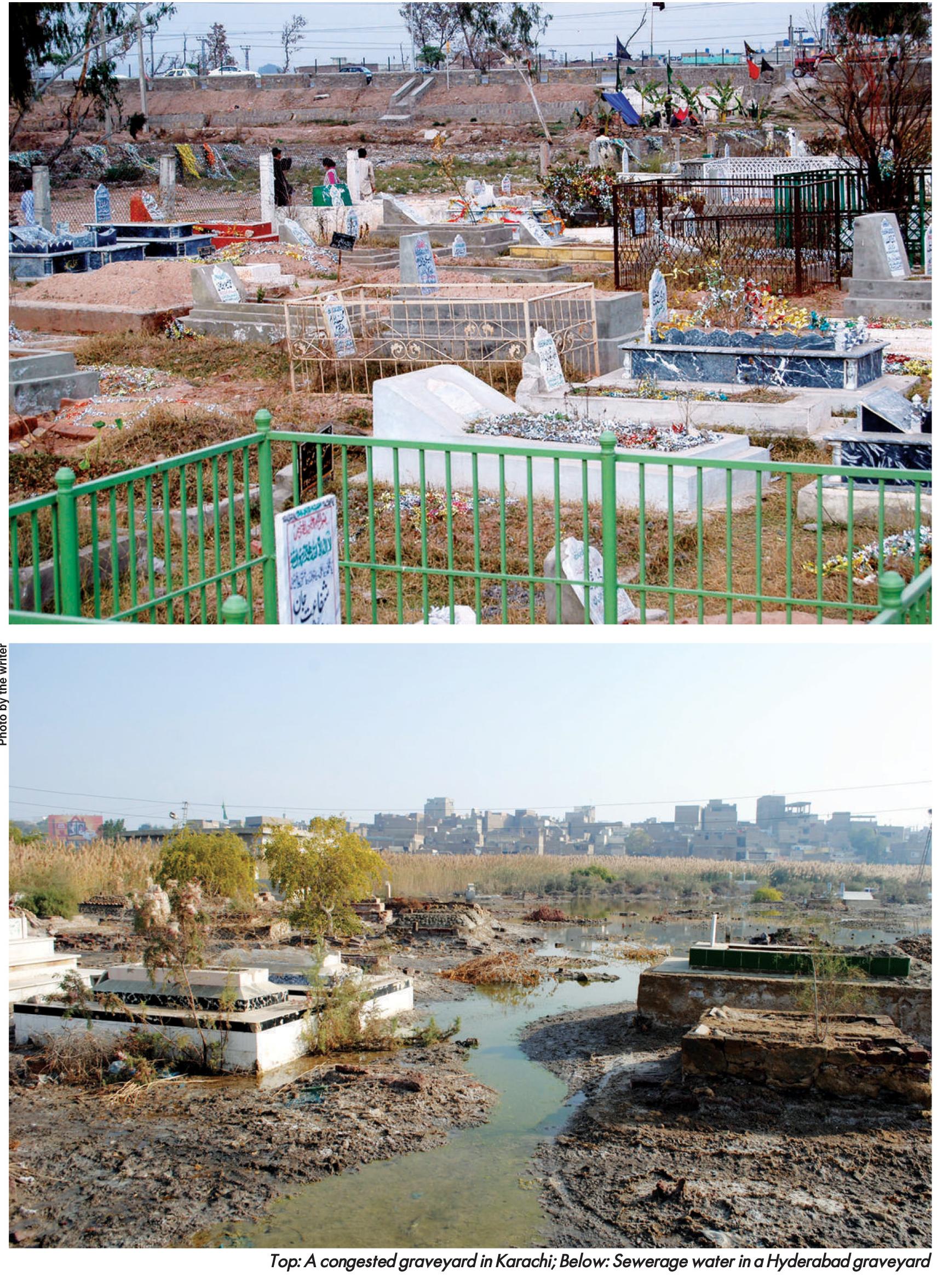
While the situation is more or less the same throughout the country, we take Hyderabad as a case. It has more or less 25 big and small Muslim graveyards besides a few for the Christian and Hindu communities. Graveyards located within the limits of Hyderabad Municipal Corporation (HMC) are hit by insufficient space, sewerage, and drainage and lighting issues. The Tando Yousuf graveyard, located within the limits of HMC, has the largest number of graves. It`s still being used for burial as authorities have not been able to allot land for new graveyards in other areas.
Finding space is not the only problem that the bereaved have to face.
When a body is brought f`or burial, the family has to arrange wooden tracks, soil and bricks f`or preparing the grave.
It also has to get an entry done in the record book of` the HMC available with the chowkidar.
`We are not employees of the HMC, so we charge the families for our labour,` says Raf iq.
`Edhi`s volunteers pay us Rsl,000 for the burial of unclaimed bodies and we don`t object to it though we charge a little higher for labour charges from others,` adds Abid, a junior gravedigger.
They`re not the only ones digging the ground; stray dogs can be seen roaming around the graveyard, pawing at the soil. It`s impossible for the few chowkidars to keep them away, especially at night when the graveyard is shrouded in darkness.Seven years ago, high light towers similar to streetlights were constructed in some major graveyards of the city.
However, their upkeep is difficult.
`Drug addicts cut their wires and then we have to arrange for repairs to somehow keep the system going,` remarks Abid.
The drainage system is simply nonexistent and sewage water accumulates in the graveyards as these are mostly surrounded by densely populated areas or industrial units.
Adjacent to the Tando Yousuf graveyard is a graveyard reserved for the scheduled castes. Dalits or scheduled caste community bury their dead after symbolically burning a thumb of the deceased. Upper caste Hindus, however, cremate the corpse, barring those of infants, which are buried.
`Sewage is deliberately released there so that Dalits find some other place for burial,` claims M.
Parkash, a local community leader.
He adds that the community has been running from pillar to post to fix this problem but in vain. `It is not impossible, but just needs a few million rupees to put a drainage system in place and ensure the upkeep of the graveyard,` he says.
Besides the HMC graveyards are the three Cantonment Board Hyderabad (CBH) graveyards. But the CBH runs only the Cantonment one for which it issues permission. Non-CBH residents can be buried there but the process is painstaking. If you have contacts within the garrison or at a senior level of the army, then the sitting Station Commander issues permission.
The CBH charges Rs20,000 for noncantonment residents, Rs3,000 from its taxpayer residents and Rs10,000 from residents of katchi abadis. `People living in Katchi Abadis do not pay taxes, but they bury their dead in our graveyard so we charge them Rs10,000, says a board official.
A former CBH councillor Mohammad Farooq points out that it is unfair that, despite being CBH resi-dents, they pay Rs10,000 besides incurring burial expenses of an equal amount. `It is really difficult for a resident of a katchi abadi to arrange such an amount in a hurry. Why doesn`t the CBH recover a fixed amount, say Rsl,000, from us annually? We are ready to pay it over a period of time in instalments,` says Farooq.
Ironically, Katchi Abadi residents of CBH are part of the constituencies of the board. They get representation in CBH too, but do not get any share in the development works like sewerage, sanitation and road infrastructure. One needs a contact in CBH to have a suitable place for burial otherwise the dead are buried towards the farther end of the graveyard. A portion of land on the left side of the entrance is earmarked exclusively for those serving in the army.
The land in the Cantonment graveyard is waterlogged, and sewage water seeps in here as well. Someone with contacts in CBH even established a buffalo pen within the graveyard which was later dismantled, but buffaloes can still be seen roaming in the graveyard.
Another problem is encroachment, especially in Hayat Shah Baba graveyard located in CBH limits where the land-grabbers are quite active. The CBH doesn`t maintain the graveyard nor issues permission for burial. Although it had previously removed encroachments, the residents say that the situation is back to square one and extended portions of bakeries have been built over the graveyard`s land.
Some time back the Hyderabad district government allocated a 200-acre piece of land for a new graveyard on Ganju Takkar hills. Due to the ubiquitous lack of funds and some other requirements the project never materialised. Now land-grabbers can be seen to be at work there. The Hyderabad Development Authority has not come up with another site for a new graveyard to keep pace with the increasing population of the city. E