Sindh woos Chinese investors
Dawn Report
2026-10-16
SHANGHAI: Sindh Chief Minister Syed Murad Ali Shah has made a strong case for Chinese investment in the province, highlighting its strategic location, extensive sea and air connectivity, competitive labour costs and skilled workforce.
Addressing the second Sindh Investment Conference, held in Shanghai after a 12-year hiatus, Mr Shah said the moot would usher in a new era of Chinese investment, job creation, and industrial modernisation in the province.
Mr Shah also presented the Dhabeji Special Economic Zone as a flagship opportunity for Chinese and other international investors seeking a cost-effective base for manufacturing and export-orientedbusinesses.
The proposed industrial clusters at Dhabeji include automotive and auto parts, light engineering, chemicals and pharmaceuticals, consumer electronics, steel and foundries, warehousing, construction materials, textiles and garments.
The day-long moot was attended by around 400 delegates, including investors, business leaders and representatives of Chinese companies and financial institutions.
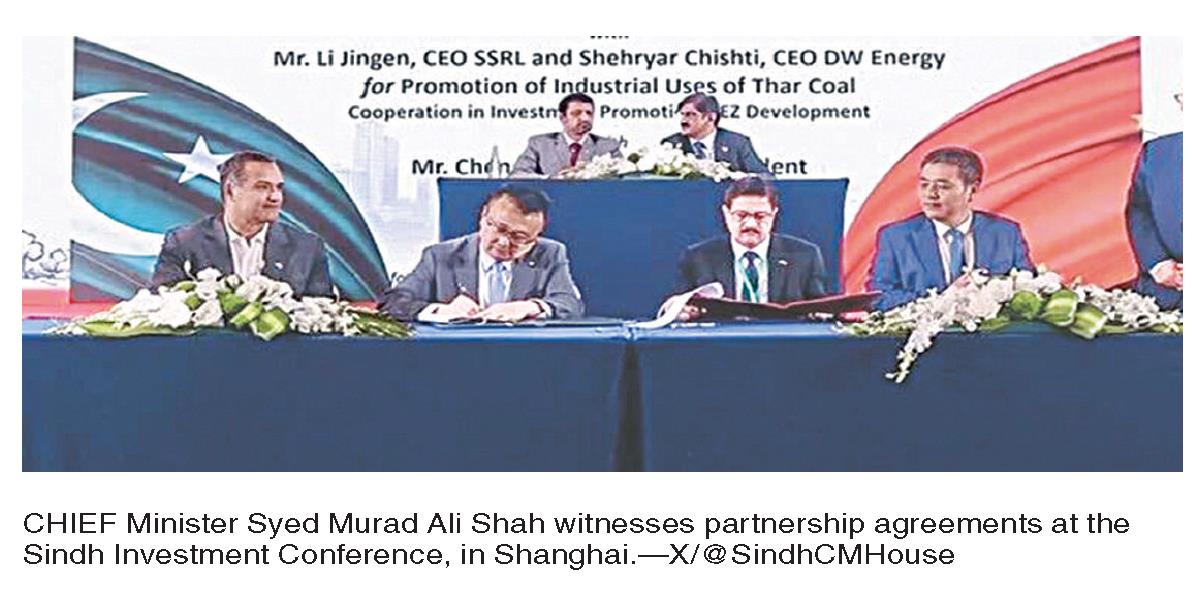
The conference featured presentations on major sectors, networking sessions and the signing of 34 memoranda of understanding involving government-togovernment (G2G) and business-to-business(B2B)cooperation.
The chief minister said Sindh was ready to become a natural partner for Chinese investors seeking scale, connectivity and government-backed support.
He said the provincial government was committed to facilitating foreign investment and ensuring that agreements translatedinto practicalprojects.`Sindh offers a cost-effective environment for investment that compares favourably with many countries around the world,` Mr Shah said, emphasising the province`s potential to attract foreign direct investment and strengthen international trade partnerships.
He said Sindh combines Pakistan`s largest commercial city, two major seaports, extensive industrial capacity, substantial energy and mineral resources, a large agricultural base and several investment platforms linked to the China-Pakistan Economic Corridor.
Speaking to the media after the conference, Mr Shah said the 12-year gap was used effectively to prepare Sindh`s infrastructure, policy framework, and workforce to absorb high-value international investment s.
Highlighting the tangible outcomes of the five-day visit to China, Mr Shah announced that Sindh government entities and Chinese enterprises have signed 34 memoranda of understanding (MoUs), alongside numerous agreements between private-sector business entitiesfrom both sides.
He emphasised that these MoUs are not merely symbolic but are underpinned by rigorous prior groundwork, ensuring their swift translation into operational projects. Major sectors identified for enhanced bilateral cooperation include Thar Coal utilisation, electric vehicle (EV) manufacturing and the establishment of charging stations, renewable energy (wind and solar), modern agriculture, and digital transformation.
Unveiling futuristic economic plans, the chief minister noted immense potential for cooperation in Artificial Intelligence, large data processing, and establishing state-of-the-art data centres.
The chief minister said Chinese manufacturers could produce goods in Sindh, use the province`s energy and industrial inputs, and transport finished products through Karachi Port and Port Qasim.
He also highlighted Sindh`s 350-kilometre coastline, access to major trade routes, and proximity to markets in Central Asia, the Middle East, and Africa.