Security issues warrant greater freedom of expression, seminar told
By Peerzada Salman
2016-11-16
KARACHI: If there are security issues then there should be more freedom of expression, because putting restrictions on people means you will be taking decisions with a limited mindset.
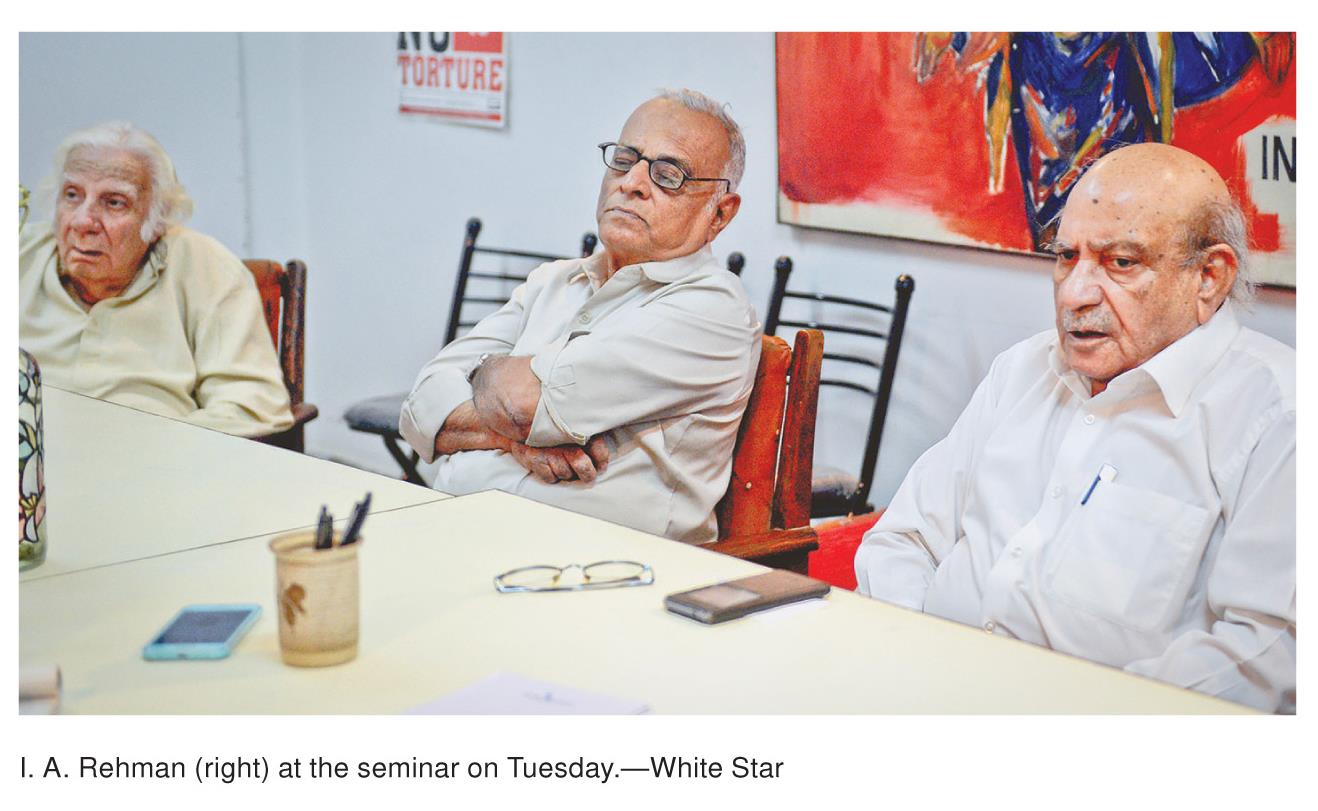
This was said by eminent journalist and human rights activist L A. Rehman while speaking at a seminar on challenges to freedom of the press at the Human Rights Commission of Pakistan`s office here on Tuesday.
Mr Rehman was responding to a question on the recent issue of a Dawn report that generated a heated debate in the country in light of Article 19(A) of the Constitution.
He said the situation needed to be analysed in a particular context. He said for a long time civil liberties (shehri azadian) were being contained and laws were made without taking the due process into consideration. He said there were parts in the country where civil society could not work and was depended on the DCOs. He said in some areas of Punjab, in order to hold a meeting one needed the DCO`s permission. He said now committees had been made in which there wereindividuals representing the DCO and investigative agencies who sent all the applications to the home secretary, and the home secretary seldom had the time to look into those applications.
Mr Rehman said the problems were more to do with the government than journalists. He said the more worrying factor was that the situation had divided the journalist fraternity. He said people from our own fraternity had unsheathed their swords. He said it was regrettable that the treatment meted out to Geo did not face resistance. The way it was repressed encouraged those who did it. He said the silence maintained by the newspaper industry caused great harm.
Mr Rehman said it was a collective issue. He said freedom of the press was a `trust`; today`s journalist would be replaced by tomorrow`s, therefore, we should not be usurping their (future journalists`) right. He said not protecting their right would render future journalists helpless. `We have a responsibility to pass on to the next generation.
Mr Rehman said the situation did not occur all of a sudden. He said the 1960s was the high point of our journalism when a dictator made a law, against which all gathered (journalists, newspaper owners etc) and the dictator had to change that policy. Af ter that, he said, the decline began and we never got united on issues (wage board award, the delay in formation of the press council etc).
Responding to blogger Akhtar Balouch`sstatement on the different groups among journalists, he said professional jealousies should not be pushed to the stage where one would find difficult to breathe. He said people should sit together and hold seminars on the subject. He said laws should be made with due deliberation, consultation and representation. He said those journalists who toed the government`s line should realise that if this kept happening without due deliberation then it would create a grave situation. He said he was reading somewhere that Donald Trump`s election was not a problem; rather the problem was that America had regressed 10 to 15 years and now generations would be required to clear the mess. `There will be more Trumps,` he remarked.
Replying to Dr Tauseef Ahmed Khan`s question about the JITs, Mr Rehman said he had never seen a JIT before. He said only the police should investigate such a matter. He said avoiding the law was not confined to the newspaper industry alone. `We have no rule of law.
Answering a question about the `end-result` of the Dawn report saga, Mr Rehman said some damage had already been done because an atmosphere of fear had been created. He said free press could not function in an environment of fear. He said self-censorship was more dangerous than censorship.
On the question whether TV anchors could be considered journalists Mr Rehman said every profession had enough room (to include all). He said, for example, medical profession had suc-cessful physicians as well as atai (quacks). So, having atai in journalism was no big deal, he said.
Mr Rehman said it was often said that there were security issues. He said in such a state there should be more freedom of expression because if you put restrictions on people thenyou would be taking decisions with a limited mindset which enhanced chances of that decision going wrong. There would be more consultation, he said. He added that freedom of expression was a human right not just of the journalist community but was to do with every person.
`Everyone should have freedom of expression.