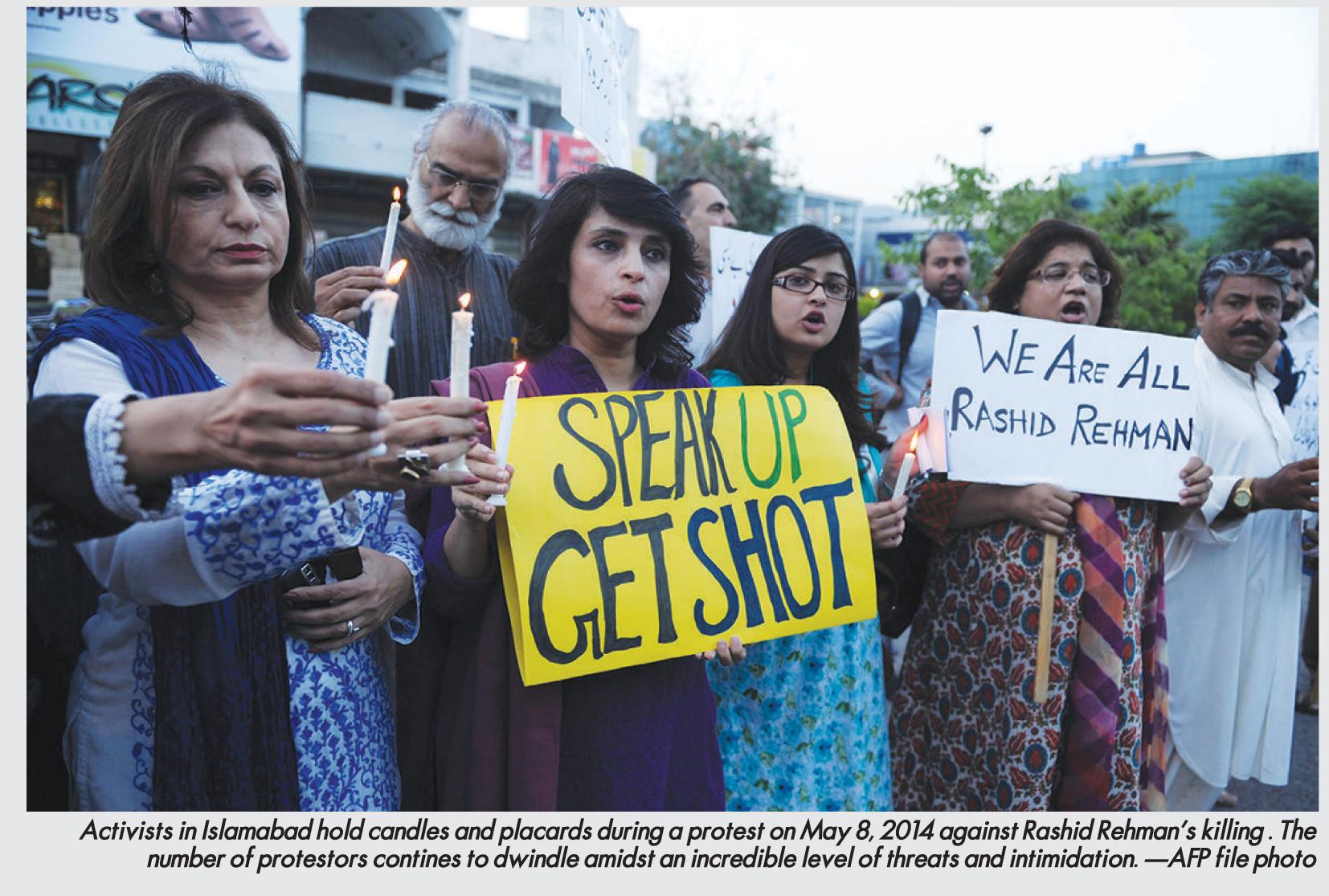
Rashid Rehman: the underdogs` comrade
2014-05-18
ashid Rehman, an advocate and the Human Rights Commission of` Pakistan`s (HRCP) Multan taskforce coordinator, was not just another lawyer and rights activist. Rehman was a beacon of`hope f`or the many who could not afford or obtain counsel for one reason or the other.
`Across Multan Katchery, it was known that Rashid Saheb would take up a case even if a litigant did not have a penny with him or her. Even other lawyers used to send such cases to Rashid Saheb,` said a close aide to Rashid Rehman, who worked along him for many years but wanted to remain anonymous. He said Rashid used to remain in office until late night, something his close friends would warn him against, especially after he received threats. But he was a workaholic and truly dedicated to his cause and so he ignored any such advice.
`Rashid Saheb was on the forefront of the struggle to ensure rights for peasants and bonded labourers. Last year, his book was published on the rights of land tenants, titled Zamino Ki Bandar Baant (Unjust Distribution of Land), and it describes the situation of tenants and the injustice meted out to them,` he says, adding that Rashid Saheb remained active with Anjuman Mazareen in Multan, Sahiwal, Okara and the whole of south Punjab throughout his career. It was this spirit that made him take up the case of Junaid Hafeez who had been accused of blasphemy.
`His opposing lawyers said to him right in front of the judge during the proceedings of the case that he won`t live to appear at the next hearing. Rashid Saheb complained to the judge, who did not take notice of the threat. His killing is a big loss to the poor and the downtrodden of the region Rehman`s close aide said.
Ghulam Fatima, secretary general of Bonded Labour Liberation Front (BLLF-Pakistan), says Rehman remained involved in working f or bonded labour for decades. `Whenever we had any issue in southern Punjab, we always sought help from Rashid Saheb, and he was always available without taking any fee,` says Fatima.
The BLLF chief recalled that one time, she managed to get some bonded labourers released through a bailiff with the help of Rashid Rehman, but then started receiving threats from kiln owners. `When I called him to tell him about the threats I was receiving, he said `it`s okay, even I am also receiving threats from the same people`,` she narrates.
Fatima says that when the Bonded Labour Liberation Act 1992 was being formulated, Rehman gave his recommendations for it which were incorporated in the Act. `Recently, before the 18th Amendment to the Constitution, the federal government again sought our recommendations, and Rehman, on our behalf, pointed out flaws and gave his legal input in the matter,` she says.
Rights activist and lawyer, Asad Jamal, says that nobodywas willing to take the case of Junaid Hafeez, especially after the case of Shafgat and Shagufta Masih. After another lawyer, Mudassar, who Junaid`s father had hired to defend his son, gave in to the threats issued by hardliners, someone else was needed to pursue the case; someone with commitment.
`That`s when the HRCP and Rashid Rehman came forward to pursue the case, which was not moving forward for more than a year. However, he started receiving threats after that, Jamal says, alleging that besides receiving threats from other lawyers, Tahaffuz-i-Namoos-i-Risalat also held a protest in front of his office.
Deploring the state of justice in the country, Jamal says: `Rashid Rehman objected when, while indicting Hafecz, the judge referred to the books of a famous Urdu fiction writer that were recovered from his room. However, his objection was ignored.
Jamal says that the FIR mentions that Junaid Hafecz was operating two groups on Facebook: `So-Called Liberals of Pakistan` and `Mullah Munafiq`. Even though it was so easy to trace out where the groups were being operated from, the police did not probe the ownership issue. The ridiculous part is that both groups remained functional and continued with updates even when Junaid Hafecz was in jail.
`After receiving threats, he looked concerned and while discussing the issue with me he said it was getting too serious. But he was never reluctant as he had a strong character, Jamal says.
Reminiscing about Rashid Rehman`s past, he says, `He has been working for the downtrodden f or more than last 20 years and faced threats many a time. He worked in the 1990s for brick kiln workers and received threats f`rom the kiln owners.
Besides, he pursued rape and honour killing cases but threats never f`rightened him.
Asad Jamal says that though Rashid Rehman had demanded the government provide him security, which it failed to do as it does in most cases but threats and persecution of the innocent cannot be countered by providing personal security to individuals.
`It is something larger, harming the whole social fabric and the root of the issue is this law which is being misused on a large scale. The state will have to deal with it,` argues Jamal.
Talking about Rashid Rehman, HRCP Secretary General I.A. Rehman says the killing of Rashid is a big loss for the commission as he used to take care of the whole region of southern Punjab up to Rahim Yar Khan. `After he received threats, we wrote to the government and the police and, despite acknowledging the gravity of the situation, they did not do anything to provide him security,` he says.
I. A. Rehman says the people cannot do anything to stop such happenings. `The state and the government will have to step in to stop the menace or the whole country will be in a big trouble, in fact it already is in a big trouble.` E