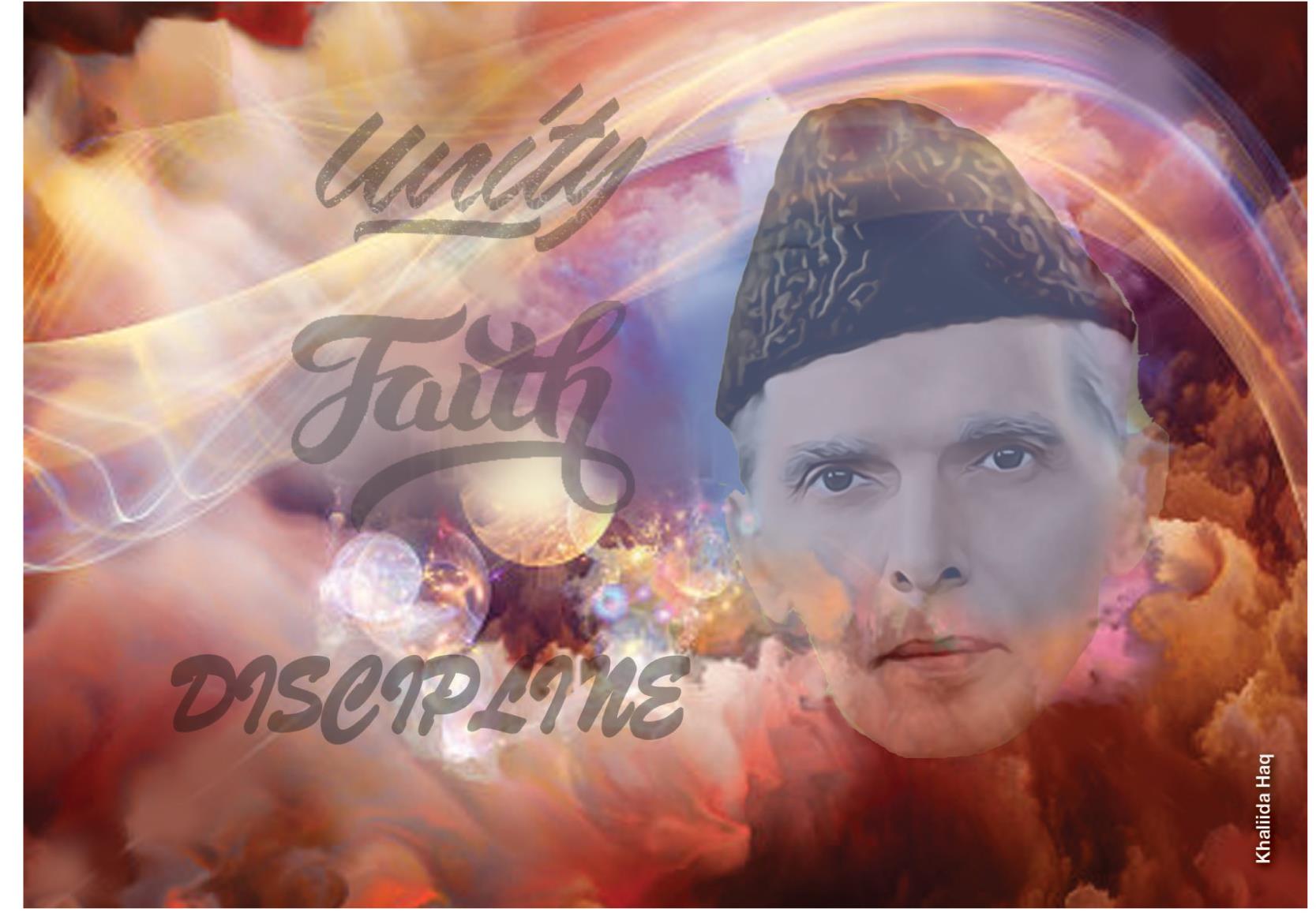
Jinnah reborn
By Javed Jabbar
2016-12-25
UST as we sit inside a darkened cinema theatre to willingly suspend our disbelief and become part of a twohour dream, so too today, on the 140th birth anniversary of the Quaid-i-Azam, let us use a thoroughly unreasonable premise at least on the face of it to speculate on what M.A. Jinnah would do when faced with the harsh realities of Pakistan in 2016.
If he, by a reordering of time, space and logic, was reborn in 1986 and decided to enter the political realm in 2016 at the age of 30, would he be able to ultimately rejuvenate and reconstruct Pakistan? Would his qualities of character, capability and courage be relevant and effective in the next 42 years? Would the fundamental difference in adversaries then the colonial British, a hostile Congress and potentially now two dominant political parties widely perceived to be led by corrupt leaders, other power-monopolising elites permit a new formidable challenger to displace them? Mixed, mixed-up Pakistan Fortunately, the one who puts forth such unreasonable questions is neither obliged nor able to answer them. But, with impunity, one isdetermined to venture briefly into the speculative dimension.
M.A. Jinnah is part of a mixed and mixed-up Pakistan in 2016. Where there are sources of pleasure and pride, there is also sharp pain.
Founded on the basis of religious identity, there is now rampant religiosity.
Yet, religious political parties have little electoral support. In response to the laudable adoption in November 2016 by the Sindh Assembly of an Act which rightly prohibits the forced religious conversion of any person aged below 18 years, all religious political parties threaten to besiege the Assembly in which they do not have a single seat. And the party o power seems to be on the back foot.
Religiosity has also bred murderous extremism, gravely damaging the nation internally, and totally distorting its image overseas.
The country is in the global middle-income category. While in human development, it is ranked among the `least-developed`inpast decades,and in the present, the country demonstrates extraordinary technological capacity which often meets global standards. Over two decades ago, the Heavy Mechanical Complex, Taxila won the international competition to fabricate the casing for the path-breaking, highly sophisticated Hadron Space Collider at CERN, Switzerland.
The Pakistan Air Force is the only air force in the world with its own,in-house I manufacturing capacity to produce a well-rated jet multi-role aircraft, the JF17, with Chinese collaboration. The aircraft is also being purchased by other friendly countries.
In response to India`s needless introduction of nuclear weapons into South Asia, Pakistan quickly reciprocated with its own ability to produce deterrent equalisers. Sialkot remains a prime, globally-known production hub for items as varied as World Cup quality footballs to the largest volume of inimitable Scottish bagpipes. Yet, large-scale manufacturing in 2016 is in comparative decline.
Several misperforming state institutions, which require enormous subsidies, co-exist with islands of excellence such as the Pakistan Atomic Energy Commission, NADRA and others.
A grim view The outgoing Chief Justice of Pakistan, Mr. Justice Anwar Zaheer Jamali, with great sadness, observed in December 2016: `Not only foreign powers but our follies too are responsible for the deteriorating law and order and terrorism in the country. The people had not learnt any lesson from their past mistakes which resulted in the dismemberment of the country. Today anarchy, sectarianism, bigotry, hatred, nepotism, favouritism, maladministration and social injustice are rampant and have become the order of the day thus promoting despondency and helplessness among the people a situation that may, God forbid, lead to a bigger tragedy.
Ten challenges Drawing confidence from the country`s strengths, M.A.
Jinnah is also convinced that the blights identified by the Chief Justice require to be urgently addressed. He identifies 10 fundamental challenges. Political, ethical, educational, women`s emancipation, healthcare, the civil-military imbalance, religious extremism, illicit arms and weapons, environmental degradation/climate change, and the regional, global geo-political context. He is conscious that only a new holistic political approach can be effective. The two major political parties are well-entrenched electoral power-machines. But they are also dynastic. Despite their presence in all four provinces, one has become Punjab-dependent, the other has become Sindhcentric. The third new challenger has admirably developed as a possible alternative but, in turn, is erratic and unpredictable while being a potential future ally. M.A. Jinnah is unable to join any of these three options. Reluctantly he decides that only a new, fourth option will meet the people`s needs.
A new political party Over the next two decades, by dint of his rock-solid integrity, his universalist human values, his abhorrence of rhetoric that stokes ethnicity, sectarianism, parochialism and exclusion, his singularist, all-inclusive vision, his refusal to make and break alliances for short-term electoral gains, his willingness to face transient reduction in popular support, his decision to establish a Pakistan National League (PNL) as an all-embracing, unifying platform proves to be correct. His traits and actions steadily generate enormous credibility and respect, from Gwadar to Gawalmandi, from Kharadar to Qissa Khwani, from Chakwal to Chakiwara, he is able to engage diverse communities and identities because his actions embody values idealised by all, yet virtually wholly missing in the other political options.
An ethical reform movement Simultaneous to the inception and expansion of a new political party, M.A. Jinnah believes it is equally vital to build a social reform movement. This movement for ethical renewal must be owned by every citizen. Every organisation has to take responsibility. So extensive is the decline in ethical standards that even the Pakistani people`s generous, unrivalled giving of charity cannot compensate for the plunge. The fact that almost all countries around the world also suf fer from varying degrees of corruption does not detract from the need to address it in Pakistan on an intensive, full-scale basis.
M.A. Jinnah`s unshakable integrity becomes the sustaining, and eventually decisive force for ethical transformation. He surrenders all his assets and income to a public trust over which neither he nor any of his relations or friends have control. All senior PNL office-bearers take identical steps. As long as they are in politics, they cannot own or acquire any financial assets whatsoever.
Primary sources of support come from the newly-activated silent majority, the many millions of people comprising those who had either never voted or those who had lost hope in the political process. But who were now irresistibly drawn to a credible magnet. There are also crossovers from other parties but I none with questionable backgrounds. PNL is entirely funded bypeople`s donations with accounts reported on the internet.
Single, integrated education system Numerous priorities in development await pursuit. M.A. Jinnah believes education at all levels must receive the highest attention.
Both during his political struggle and soonest after achieving elected office, he advocates and then ends the apartheid of young Pakistanis being schooled in isolated silos i.e. Government Matric schools, private Cambridge system schools, madrassas, and in multiple languages. Formulated after wide consultation inside and outside the country, the new unified school system integrates all children into a singular e ducative experience even while recognising the importance of multiple mother tongues across provinces and regions .This basic change stimulates reform at the college and university levels as also spurring a knowhow higher education system to empower a knowledge-driven economy.
Civil-military relations M.A. Jinnah recognises the indispensable role of the military in the 21st century to protect territorial frontiers, combat internal threats, and support State stability. At the same time he firmly believes the military must serve as a disciplined institution subject to civil, political authority and direction. While being aware that the political sector often fails to develop the conceptual, strategic capacity to adequately prepare for the subtle as also the visible challenges on the geo-strategic, geo-political levels, he believes the military should contribute its valued, specialised input s as a contributory element but not the decisive one. In turn, the new maturation and restraint exercised by the military leadership onward of 2008 are strengthened by the unrivalled honesty and impeccable financial transparency of Mr. Jinnah.
The few notable exceptions are also respected by the military but Mr. Jinnah alone combines in his personality qualities that set him in a class of his own. Some elements of the military leadership chafe at being subject to civil, political authority.
But the principle of civil supremacy is accepted.
The 21st century is also a time when Pakistan`s own intelligence agencies operate without parliamentary oversight. As part of his unyielding assertion of civil, political authority, Mr.
Jinnah defines the parameters within which a country`s own intelligence agencies should operate while directing an effective strategy to counter and significantly reduce the setbacks instigated byforeign agencies.
Foreign relations In foreign relations, be it India or USA, he asserts a new self-reliant dignity and determination. He is neither awed nor intimidated by any country. Carefully calibrating policy, he ends the subversion of national interests committed in the past by militants, in and outside the country. Limitations of space do not enable further elaboration at this time.
An inner fatigue After about 30 years of tireless work, he develops an inner fatigue compounded by the loneliness that also affects many exceptionalleaders. Copingwithinvidiousinternalandexternalthreats, he is sometimes seized by despair, a condition of self-doubt he never shares with another person. He summons up new energy. He delegates work to colleagues and conducts study tours of overseas countries to learn from their experiences. But he is soon overwhelmed by demands for his return. By the time Pakistan celebrates the centenary of its independence on August 14, 2047, he is able to demonstrate visible, measureable redirection for the country.
Yet adversaries at home and overseas persist with their attempts to undermine his progressive vision by pandering to xenophobia and paranoia among those who are still dispossessed, or are conditione d by morose news me dia to focus only on grievances. However, he is confident that the momentum may slow down but the progressive direction cannot be changed. He has nurtured and encouraged a second and third line of leadership, collective, committed and clear-headed about sustaining his mission.
While retaining his core democratic practices over four decades, M.A. Jinnah also believes elected institutions require continuous improvement. He is sometimes tempted to be authoritarian if only to quell poisonous partisanship. Local Bodies become the lynch-pins of his radical changes.
But does his rebirth and success indicate that only a brook-nononsense messiah can replace our flaws with strengths? Further reflection is required.
He passes away peacefully in 2058. Pakistan enters a new era marked by both stability and new uncertainties. E The writer is a former Senator & Federal Minister as well as author of `Pakistan unique origins; unique destiny ?`