LITERARY NOTES A rainbow of knowledge: letters by seven luminaries
By Rauf Parekh
2026-10-26
IT MAY sound a bit odd today as letter writing is a dying art now, but it is a fact that letters -written on paper with a pen and delivered in what is mockingly retronymised as `snail mail`have played vital roles in shaping many lives. Rhetoric, eloquence, prosody, poetics, orthography and literary debates concerning these branches of knowledge were what used to bother Dr Arshad Mahmood Nashad in his student days. Letters proved to be a panacea for him.
Dr Nashad`s `semi-urban town of Attock`, as he puts it, did not offer much for those seeking knowledge or guidance some 40 years ago when he was departing on his literary journey. So, he turned to letter writing, asking scholarsquestions that he had no answers to. And many scholars replied quite graciously, writing back to him and explaining literary issues, with words of encouragement as well.
Later on, he came in contact with some more literary icons and remained in touch with them through letters. But seven of those scholars who responded were especially kind and attentive, guiding him on numerous issues and giving useful tips.
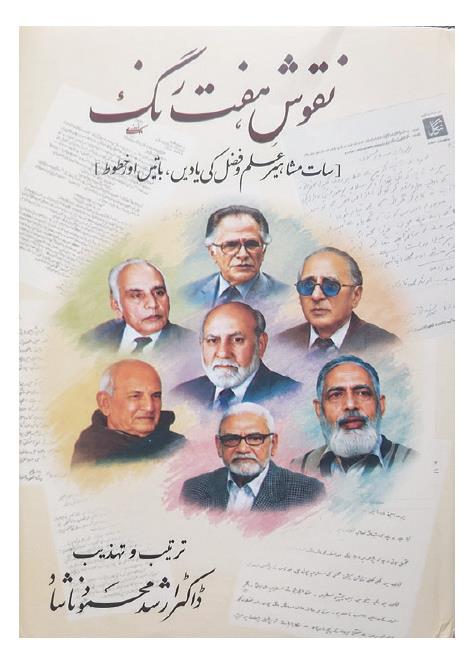
The correspondence with these seven prominent scholars slowly developed into an association that made Dr Nashad, by his own account, proud and learn much. Nashad has now collected and annotated selected letters of these seven literary personalities with introductory articles on them in his latest book Nugoosh-i-Haft Rang, or the seven-coloured motifs, allud-ing to the seven colours of the rainbow. In his preface, Nashad says these seven personalities are seven academic dimensions and sharing some glimpses of their thoughts through their letters is meant to present the distinctive literary atmosphere back then and the aura these towering figures carried.
Subtit led Saat Mashaaheer-iIlm-o-Fazl Ki Yaaden, Baaten Aur Khutoot, the 222-page book, published by Attock`s Sarmad Academy, reenacts cherished memories, replays erudite conversations and reproduces some select letters, which were addressed to Dr Nashad. The seven literary figures are: Ahmed Nadeem Qasmi (1916-2005), Farman Fatehpuri (1926-2013), Abdul Aziz Khalid (1927-2010), Ameen Rahat Chughtai (19302021), Mazhar Mahmood Sherani (1935-2020), AslamAnsari (1939-2024) and Muhammad Iqbal Mujaddidi (1950-2022), and each of them had his own distinct vibes, aesthetic norms and literary credos. This makes the book a kaleidoscope of ideas that attimes invites the reader to stop and think before going onto the next shiny piece.
Some letters included in the book record some historic facts. For instance, in one of his letters Nadeem Qasmi Sahib when Nashad asked why he had never written in the Punjabi language recalls the era when he began composing poetry and says that in those days the literary milieu resonated with Iqbal, Josh, Zafar Ali Khan, Hafeez Jallandhry and Akter Sherani and most of the young poets from Punjab like me [Qasmi Sahib] followed them, writing poetry in Urdu. Even Ahmed Rahi [a prominent Punjabi poet] would write in Urdu and had composed hardly a few poems in Punjabi till then.
The introductory articles by Nashad not only present some rare biographical and bibliographical info on these liter-ary bigwigs but in some cases also reveal the less-than-ideal situation often experienced these days at literary gatherings as people are more interested in taking selfies with literary celebrities rather than listening to them. Nashad has narrated such an incident: in the launching ceremony of Aslam Ansari`s collected poetic works in Persian, audience kept on talking among themselves during the discussions and seemed indifferent, which indeed annoyed the speakers. But as soon as the proceedings concluded, almost everyone rushed to the dais to have photographs and selfies taken, with the same personalities they were reluctant to listen to.
Some letters proffer an invaluable insight into prosodic matters, the ones penned by Abdul Aziz Khalid, for instance. Many of the lettersthat Nashad received from these luminaries are not only packed with knowledge but in some cases they unknowingly offer a peep into some events of their lives, too.
Dr Arshad Mahmood Nashad is associate professor at Islamabad`s Allama Iqbal Open University and heads its Urdu department. Born into an agrarian family on Jan 1, 1970, in a village near Pindigheb, a far-flung and underdeveloped tehsil in district Attock, Nashad could hardly dream of getting any education, writes Muhammad Hameed Shahid in his intro.
But Nashad overcame all difficulties, graduated from Government College, Attock, and did his PhD in Urdu from Punjab University, Lahore. A poet and researcher in essence, Dr Arshad Mahmood Nashad has numerous literary works to his credit.