THE RISE AND FALL OF A RAILWAY JUNCTION
By Khurshid Ahmad Khan Marwat
2020-07-31
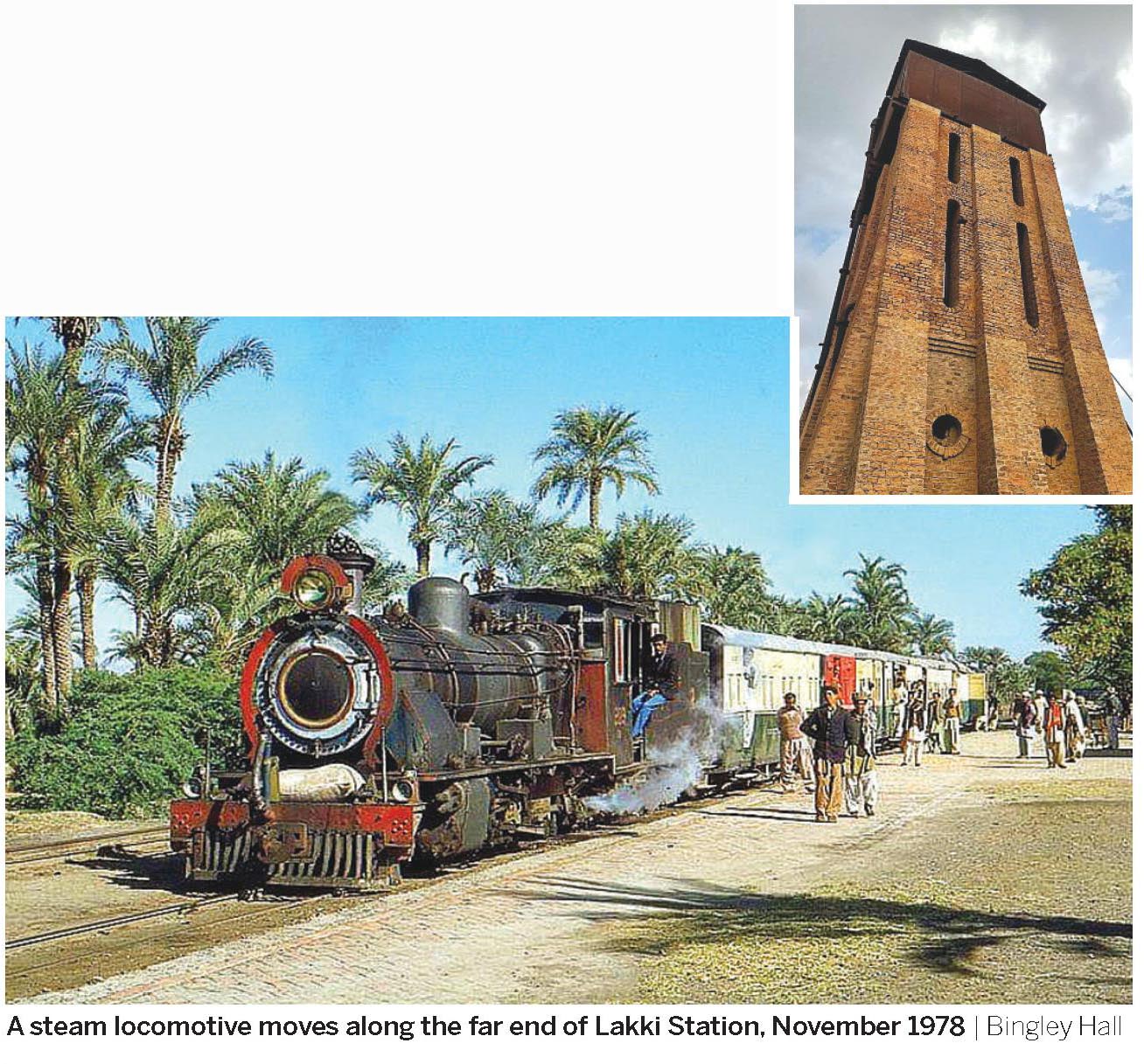
The famous Trans-Indus Railway line was constructed by the British in 1913 to provide safe and quicker transport to their military personnel beyond the natural boundary of River Indus and deep inside the unpredictable terrain of the formidable Pakhtuns. Initially owned by the North Western Railway (NWR) of Britain, it was locally known as the Mari Indus Railway and its initial run from Daud Khel in Mianwali district, Punjab till Lakki Marwat in Bannu, Khyber Pakhtunkhwa was 92 kilometres. It was the first-ever narrow-gauge track two feet and six inches in the ægion.
This `chhoti rail` [small rail] as it was called, started fmm the outskirts of a big military depot near Mari Indus Station and halted at Lakki Marwat Junction and was soon extended up to the important garrison towns of Bannu and Tank.
This engineering spectacle was, however, unceæmoniously done away with by Pakistan Railways in 1995. Many whistle-blowing steam locomotives had negotiated its curved lines for 82 years. These aesthetically beautiful engines were either manufactured at Glasgow or in Germany and weæ meticulously maintained by the railway engineers for almost a century Many youngsters today don`t know as to why the British laid such extensive railway lines in far-flung areas of the Subcontinent and, that too, at a time when even common bitumen roads were nonexistent in this area. The colonial masters of undivided India not only had grand ambitions to expand their empire deep intothe Afghan territories, but also wanted to stem a constant threat fmm the north-western tribesmen. So, they used their technological superiority in putting together ambitious railway pmjects to connect their fmntier stmngholds via rail to safer military hubs in the mainland.
It`s astonishing that all of this happened more than a 100 years ago, whereas the current mad connectivity in the entire expanse of Lakki Marwat is in absolute tatteis. The strategic importance of this landscape has, in fact, increased over the years but, sadly, the southern region of Khyber Pakhtunkhwa is now worse off in terms of routes connectivity than what it was almost a century ago under British rule.
I was lucky to have undertaken a return journey on this railway track in 1982. I was very young then, but can easily evoke the memory of that rail plying on those lonely tracks in a vast sandy expanse, with the ambling gait of a mare. The chhoti rail started fmm Mari Indus in Punjab and crossed the mighty Indus via the historical dual-purpose iron bridge of Kalabagh.
After passing through Kamar Mashani, Trag and Isa Khel, it reached the dual-purpose GambilaRiver Bridge at Darra Tang. From here onwanis, the sandy plains of Khyber Pakhtunkhwa and the fun part of the journey started.
Many enterprising youngsters disembarked and started to run along the train until their own steam ran out. Since there weæ no lavatories in any of the four train compartments, some daring passengers also answered nature`s call on the sides of the track and managed to hop on boani again. The speed of the chhoti rail was purposely kept slow as was the common routine.
The train transited through Thanedar Wala, Wanda Arsala and eventually reached Lakki Marwat Junction.
In later years, whenever I visited my village, I alwayssatiatedmynostalgiceravingsbyvisiting Lakki Station. To this day, despite all sorts of neglect, the fort-shaped, symmetrical building of the station still stands tall. Back then, it was at a little distance from the municipality, but now it has been completely surrounded by the growing town.
Being a small and conservative town, Lakki Marwat had no proper eateries until the late 1990s. Therefore, for a long period, even after the closure of the railway service, the station`s canteen remained popular for its affordable, delicious food. Its famed custard was one of the few luxuries available to the locals, and a must-have for any visitor from out of town. I still remember munching on the cake chunks hidden inside that delectable custard. However, once this rail line was formally closed, the state conveniently forgot its stations.
Since then, the sturdy colonial-era infrastructure and façade of the Lakki Station has steadily decayed. But the turrets on both corners of the main station are still fully intact, and so is the signature Britishera, brown water tank used for filling the engines, etc. This water tower has beautifulGothic supports to mitigate the effects of occasional earthquakes.
A glance at the various structures of this station is a reminder of how thorough and pmfessional the British were as they considered every minor detail well in advance. On the contrary, looking at the obvious indifference of Pakistan Railways towards these vital assets, many ungrateful local thugs have started to steal its rusted tracks in broad daylight. Whena few worried locals complained to the state to save this heritage from vandalism, Pakistan Railways responded in its own strange way and auctioned off these priceless railway tracks for peanuts before the start of the 21st century, to get rid of the issue once and for all.
For someone who has seen this railway line operational, I had tears in my eyes when I saw the famous Gambila Bridge of Darra Tang in its current truncated shape. The dismantled and stolen iron from the tracks was presumably sold to the steel foundries of Punjab, as if the British had laid down this raw material as a gift for Pakistani factories a century ago. Even when the Gambila Bridge was operational and was used by trains and vehicles alike, its maintenance was always a bone of contention between the Highways S Department and the Railway Department.
Presently, most of the iron part of Gambila Bridge is still there, as the clueless contractors probably didn`t have the wherewithal to dismantle it. Additionally, a few metres of derelict tracks may also exist here and there, covered by sand. However, the precious land of those removed tracks, which passed inside Lakki town, has already been conveniently gobbled by powerful locals for constructing private properties.
If Pakistan Railways can commendably pæserve its Golra Railway Station and convert it into a museum, then why did it fail to do so with this century-old railway line with its beautiful colonial structures? At a baæ minimum, they could have sanctioned a fortnightly or a monthly safari train for adventurous people. Many would have loved to travel in small wooden compartments, pulled by a quixotic engine, and experience a scene akin to those in black and white classic Westerns.
Currently, in addition to the disappearance of the entire length of tracks, both the stops at Thanedar Wala and Wanda Arsala have also been leveled to the ground, and the entire tract is now privately cultivated to grow seasonal crops. However, the main building of Lakki Marwat Junction is still standing against all odds. It is being used by the personnel of Lakki Police under an unknown arrangement, but most of the moms in the main building seem to be intact.
Efforts should be made to conserve structures such as the Lakki Marwat Station. Wherever possible, Pakistan Railways must convert them either into small museums, commercial æst houses or æstaurants. Like any civilised society, we must look after our historical assets. Absence of swift damage control will lead to the razing of these surviving remnants of the once great Trans-Indus Railway and also open the way for other illegal usage of precious state land.
The writer is a civil servant