
HE World Economic Forum (WEF) in Davos is far more than an annual gathering of political and business leaders; it is where nations shape perceptions, forge partnerships, and position themselves within an increasingly interconnected global order.
In an era defined by geopolitical uncertainty, technological disruption, economic realignment, and the search for sustainable development, countries that successfully communicate a coherent national vision are better placed to attract investment, influence policy debates, and build lasting international partnerships.
For more than two decades, the Pathfinder Group has remained at the forefront of this effort. The group is the principal architect of Pakistan’s presence at the World Economic Forum (WEF) in Davos, transforming what began as the Pakistan Breakfast in 2004 intoone of the country’s most enduring platforms for international engagement.
Over the last 22 years, the initiative has evolved into the Pakistan Pavilion, a globally recognised forum for economic diplomacy, investment promotion, policy dialogue, technological innovation, entrepreneurship, and cultural diplomacy.
The Pakistan Breakfast and associated Pavilion events have welcomed an extraordinary array of national leaders over the years, starting with President Pervez Musharraf in 2004, 2006 and 2008.
PM Shaukat Aziz in 2005 and 2007 followed by Prime Ministers Nawaz Sharif, Shaukat Aziz, Yousaf Raza Gillani, Imran Khan, Shahid Khagan Abbasi, Anwaar-ul-Haq Kakar, and Shehbaz Sharif with also Deputy Prime Ministers and senior cabinet members including Ishaq Dar, Muhammad Aurangzeb, Bilawal Bhutto Zardari, Sherry Rehman, Sartaj Aziz, Miftah Ismail, and numerous federal ministers, diplomats, military leaders, and provincial representatives.
Distinguished international participants have included senior World Economic Forum officials Mirek Duek, Olivier Schwab, Alexandre Raffoul, Jeremy Jurgens, Maria Basso, and Kelly Ommundsen, alongside globally renowned business leaders such as Ross Perot Jr., Arsen Tomsky, FredKempe and experts from the Wilson Center, Quincy Institute, AWS, the World Bank, and other leading institutions.
Throughout its history, the Pakistan Pavilion has consistently highlighted Pakistan’s strategic location, economic reforms, investment opportunities, digital transformation, entrepreneurship, financial inclusion, healthcare, education, women empowerment, startup innovation, and cultural heritage.
It has also showcased landmark national initiatives such as the Special Investment Facilitation Council (SIFC), Asaan Mobile Account (AMA), Raast digital payments, Pakistan’s growing IT exports, artificial intelligence, fintech innovation, and the country’s expanding startup ecosystem.
The traditional ‘Inspiring Pakistan’ Lunch at the famous SCHATZALP on the ‘Magic Mountain’ every year brought togetherleadinginternationalanalysts and policymakers, including Michael Kugelman, Adam Weinstein, Muhammad Farid Alam, Dr Urs Lustenberger, Prof (Dr) Ying Zhang and others, to elaborate on Pakistan’s resilience, strategic importance, youth dividend, digital economy, and investment outlook.
For the flagship Pakistan Breakfast at Davos 2026, Prime Minister Shehbaz Sharif was theChief Guest, Senator Muhammad Aurangzeb, Federal Minister for Finance and Revenue, presented Pakistan’s macroeconomic recovery, fiscal reforms, digital economy, and export-led growth strategy. International perspectives were offered by Ross Perot Jr. and Mirek Duek of the World Economic Forum, while Deputy Prime Minister Ishaq Dar reinforced Pakistan’s commitment to international cooperation.
In his concluding remarks, Ikram Sehgal reflected on more than two decades of Pakistan’s presence at Davos and reaffirmed the importance of private-sector leadership in advancing economic diplomacy.
Recognising inclusive development as a national priority, the Sessions were organised to discuss Women Empowerment, Financial Inclusion and Family Healthcare.
Distinguished international experts were assembled, including Dr Ying Zhang, Prof Linda Zangwill, Hend Alhinnawi, Dr Salma Malik, Alina Timofeeva, and technology leaders to explore women’s economic participation, digital inclusion, healthcare innovation, and the transformative role of artificial intelligence. Empowering women is not merely a social imperative but an economic necessity for sustainable national growth.
The ‘Investment in Pakistan’Lunch showcased Pakistan’s improving macroeconomic environment before international investors. Moderated by Muhammad Farid Alam and hosted by Ikram Sehgal, the session featured Michael Kugelman, Sameer Chishty, Abu Bakar, and Dr Sania Nishtar. Digital transformation remained a central pillar of Pakistan’s narrative.
The Digital Pakistan Breakfast brought together Maria Basso (WEF), Muhammad Salman Ali, Arsen Tomsky (inDrive), Khalifa AlShamsi (e& Group), Farhan Ahmed, Imran Jattala, and other technology leaders to discuss financial inclusion, artificial intelligence, digital infrastructure and startup incubation.
The remarkable success of the Asaan Mobile Account (AMA) initiative and Pakistan’s expanding digital ecosystem were widely acknowledged as models of inclusive innovation.
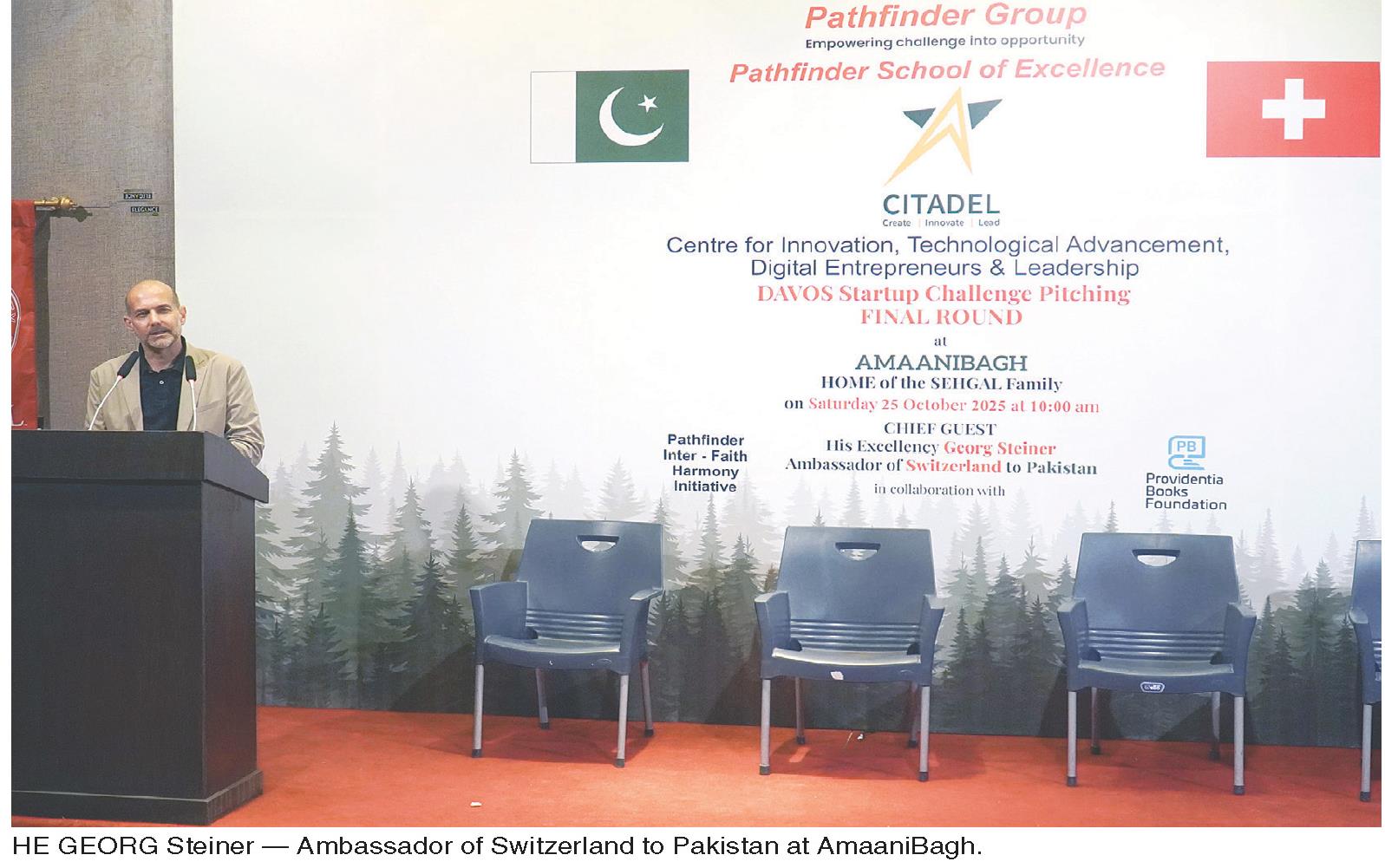
The Pathfinder CITADEL Start-Up Session moderated by Air Cdre (retd) Farhan Ahmed demonstrated the growing maturity of Pakistan’s innovation ecosystem by presenting eight promising startups selected from more than 200 applicants.
The Session highlighted Pakistan’s young talent and entrepreneurial capacity while reinforcing the country’s emergence as a competitive innovation desti-nation. Among others Pakistan’s talent was showcased to the world by Global Shapers Community Pakistan.
The Pakistan First Session concluded the policy discussions by bringing together Michael Kugelman, Abu Bakar, Usman Sheikh, Muhammad Farid Alam, and former Prime Minister Shahid Khagan Abbasi.
Complementing these policy discussions, Pakistan Night introduced the spiritual tradition of Pakistani Sufi music to an international audience through a memorable performance by Numan Haider and his Q awwali ensemble, demonstrating that Pakistan’s cultural diplomacy is as powerful as its economic diplomacy in fostering international goodwill and understanding.
The Pathfinder Group’s continued presence at Davos embodies this vision, one that projects Pakistan with confidence, celebrates its achievements, acknowledges its challenges with realism, and presents its immense potential to the world.
The journey that began more than two decades ago has matured into one of Pakistan’s most enduring instruments of economic diplomacy, connecting global investors with Pakistani innovators and positioning the country’s youth as drivers of sustainable economic growth and global competitiveness.