
WASHINGTON: Democrats seized control of both chambers of the US Congress in Tuesday’s midterm elections, sweeping aside Republican candidates in traditionally conservative states and delivering a stunning political setback to President Donald Trump, halfway through his second term.
In the Senate, Democrats se cured a 54-44 majority, including two independents who caucus withthem, with two races yet to be decided.
In the House of Representatives, Democrats had won at least 231 seats against 141 for Republicans, according to preliminary results, as counting continued.
The sweeping victory gives Democrats control of Congress for the final two years of Trump’s presidency, and marks the first time in nearly two decades the party has control of both houses under a Republican president.
A Democrat-led Senate meansthat the party will have more power to launch investigations into the Trump administration, and can stymie his nominations to cabinet posts and federal judgeships.
The scale of the defeat was reflected in the contrasting reactions from the two parties.Trump sought to distance himself from the outcome, telling Politico in a telephone interview: ‘I wasn’t on the ballot, and we didn’t get the people out, but I wasn’t on the ballot. If I was on the ballot, we would have won.’ He also complained that voters ‘didn’t like the candidates in most cases’.
‘Congratulations to the Democrats. They did a good job. They’ve been looking for this one for 11 years and they finally got it,’ the president said. ‘But I don’t view it as a hit on me,’ he told Fox News.
The White House, however, sought to remind Americans that Trump was still president, tweeting a picture of a glaring Trump looming over the Resolute Desk in the Oval Office.
Vice President JD Vance was more circumspect, attributing the defeat to the Iran war, as he sought to distance himself from the conflict ahead of a possible 2028 White House run. ‘The reason we lost is the war. The president himself said so last night,’ Vance said in a lengthy post on X.
Democraticleaders,meanwhile,celebrated the results as a mandate for change.
House Democratic leader Hakeem Jeffries told supporters: ‘We made it. House Democrats have taken back control of the United States Congress.
The victory puts Jeffries in line to become the first African American Speaker of the House when the new Congress convenes.
Inroads in the south The results also marked an extraordinary breakthrough for Democrats in states that have long favoured Republicans. In Kansas, voters elected a Democrat to the Senate for the first time in 94 years. Texas elected a Democratic senator for the first time since 1988, while South Carolina chose a Democrat for the first time since 1998.
Democrats flipped seven Republican-held Senate seats in Texas, North Carolina, South Carolina, Ohio, Kansas, Iowa and Maine, giving them control of the chamber.
In Texas, James Talarico defeatedRepublican Ken Paxton, ending a decadeslong Democratic losing streak.
In South Carolina, Annie Andrews defeated Republican Darline Graham, the sister of the late Senator Lindsey Graham.
In Kansas, Adam Hamilton defeated incumbent Republican Roger Marshall. The result ended a Republican hold on the Senate seat dating back to the Great Depression.
Democrats also won in Iowa, where Josh Turek defeated Ashley Hinson; North Carolina, where Roy Cooper captured an open seat; Ohio, where former senator Sherrod Brown defeated Jon Husted; and Maine, where Troy Jackson defeated fiveterm Republican Senator Susan Collins.
Democrat Jon Ossoff won re-election in Georgia, while Chris Pappas retained a Democratic-held seat in New Hampshire.
The party also captured more than two dozen Republican-held House seats, including districts in states and constituencies that Trump had carried comfortably in 2024.
The election also produced historic victories in gubernatorial races. Georgia elected Keisha Lance Bottoms as the country’s first Black woman governor, while Texas elected Gina Hinojosa as its first Latina woman governor, while Florida chose Byron Donalds,to be the first Black Republican governor.
Muslim representation The election also saw a significant expan-sion of Muslim representation, with 11 candidates winning legislative seats across Congress and state legislatures, including seven elected to the US Congress.
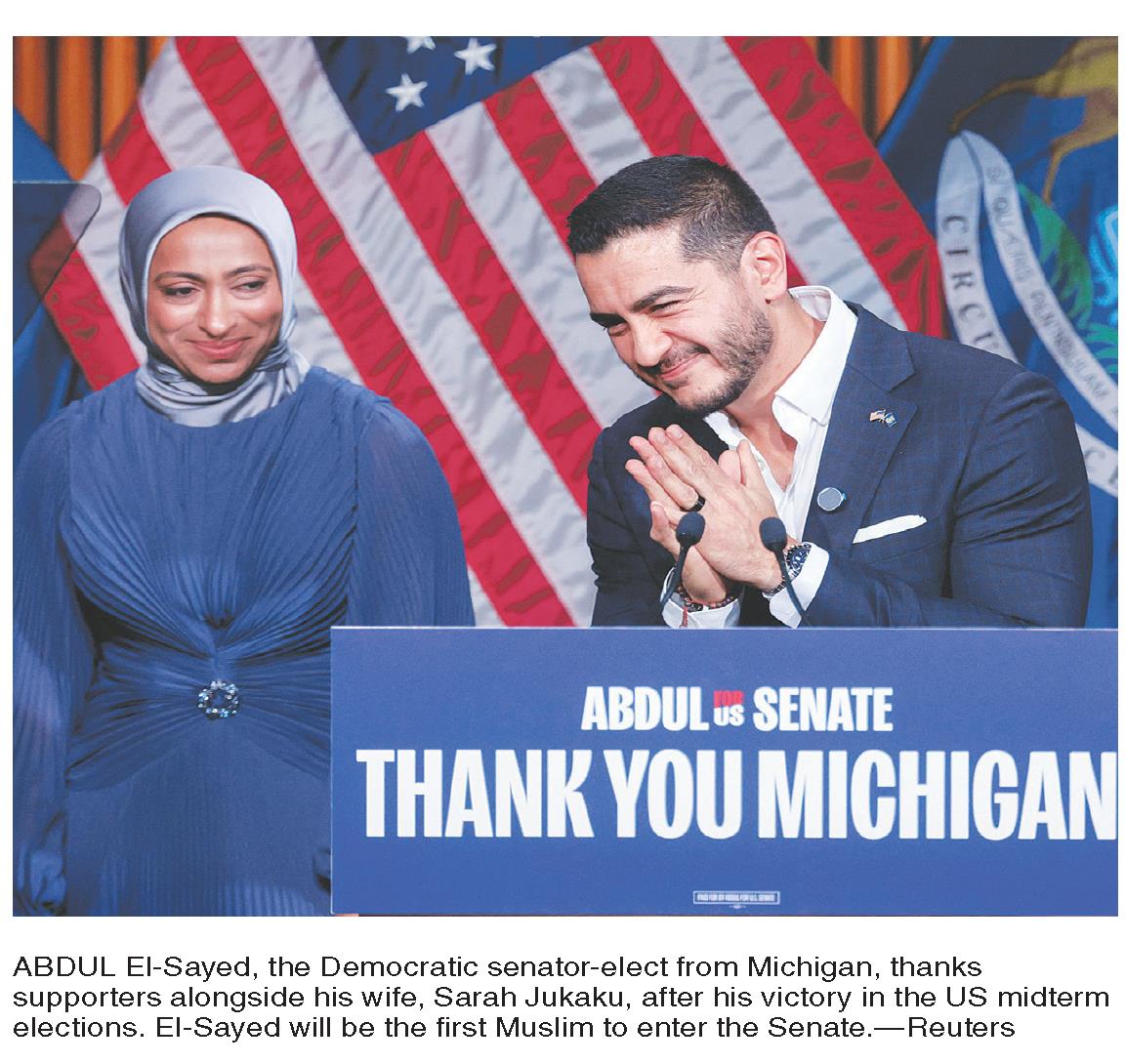
The most prominent victory was in Michigan, where Democrat Abdul El-Sayed defeated Republican Mike Rogers to become the first Muslim elected to the US Senate. The 42-year-old physician and former state public health official won the seat vacated by retiring Democratic Senator Gary Peters.
His opposition to unconditional US military assistance to Israel and his description of Israeli actions in Gaza as genocide made him a target of Republican attacks.
Trump and other Republicans sought to portray El-Sayed as a security threat, invoking the Sept 11 attacks and accusing him of links to the Muslim Brotherhood. Minnesota Congresswoman Ilhan Omar, another frequent target of Trump’s attacks, also won a fifth term.
Other Muslim winners included incumbent representatives Rashida Tlaib of Michigan, André Carson of Indiana and Lateefah Simon of California, along with newcomers Adam Hamawy of New Jersey and Darializa Avila Chevalier of New York.
Muslim candidates also won state legislative races, including Palestinian-American organiser Aber Kawas in New York, Pakistan-origin journalist Meriam Sabih in Pennsylvania, and Nabeela Syed in Illinois.