
EV ERY year, many Pakistani families celebrate the admission of their children to famed universities in foreign lands.
These stories are told as proof that hard work always gets rewarded, and that talent inevitably rises to the top. Yet, these stories obscure a deeper reality. Long before these university applications were ever submitted, students had already been divided and sorted into vastly unequal systems of education that differ in quality as well as opportunities, networks and the culturalcapitalthey provide.
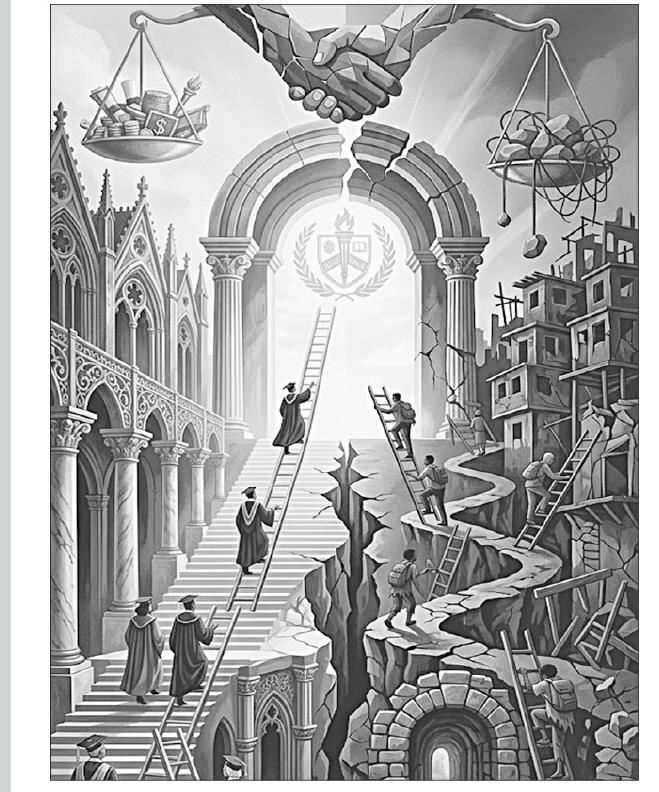
Pal(istan’s elite schools do more than just educate the country’s privileged; they reproduce privilege itself. By converting inherited social and economic advantages into credentials that appear meritocratic, they reinforce class divisions while masking them as individual achievement.
In fact, Pal(istan’s elite schools have become perhaps the most effective machinery for transforming inherited privilege into the appearance of individual success.
Pal(istan’s elite education provides far more than academics; it provides students with certain social assets, such as the right accent and dialect, fluency in the English language, confidence in interviews, debating, Model United Nations (MUN), internships, alumni networks, recommendation letters, guidance, counselling, exchange programmes and leadership opportunities.
This is only the tip of the iceberg. This cultural capital equips students to navigate elite institutions and social spaces in ways their equally talented government-school counterparts often cannot.Before even applying to universities, their educational trajectories have already been shaped by their unequal access to opportunities.There is a clear educational apartheid in Pal(istan where parallel school systems separate children by class long before they enter their adulthood. This includes elite international schools, expensive private schools, low-cost private schools, and state-run public schools. These systems rarely intersect, and the children that come out of them speak differently, read different books, build different networks, and imagine different futures.
These children stand segregatedlong before they enter the job marl(et. Imagine two students from two different schooling backgrounds.Eveniftheyhave both earned distinguished grades, which student, you thinl(, appears more ‘meritorious’ on paper? Which one of these students, you thinl(, would be rewarded appropriately? This matters because when leadership positionsin the country are repeatedly filled by people drawn from the same narrow education system and social class, policymaking becomes socially insulated and exclusionary. Institutions become less representative, public trust declines, and ultimately innovation suffers because diverse perspectives are excluded.
Educational inequality turns into political inequality.
Pal(istan’s education system requires structural reforms that reflect the realities of its socioeconomic inequalities. This includes increasing focused investment in high-quality public schools to reduce disparities in educational resources. We should reduce the premium attached to the Englishlanguage by strengthening multilingual education, and ensuring institutions value competence over accent.
Finally, it should create pathways that bring students from different educational systems into shared academic and extracurricular spaces.
Merit should measure what students accomplish despite their circumstances, not the advantages they inherit before they ever enter a classroom. Until Pakistan narrows the vast inequalities between its education systems, meritocracy would remain less a reality than a comforting national myth. Celebrating the occasional successstory doesnotchange the rules of the game; it blurs the uneven playing field.
Alishba Syed Imran Orlando,USA