
Perhaps we all carry memories that return to us almost like dreams. We remember the feeling of a place without being able to recall exactly what it looked like; a colour survives while a face disappears.
With time, experience begins to blur with imagination, until it becomes difficult to know where one ends and the other begins.
‘Playground’, recently on view at the Vasl Gallery, entered this uncertain space. The exhibition brought together artists whose works move between experience, memory and imagination, allowing familiar forms and places to become slightly strange in the process.
What made the exhibition interesting was that it did not treat memory as something we simply possess. Instead, memory seems to constantly alter the things we believe we know. Ammar Faiz’s works were among the most compelling in this regard. The open field and familiar patterns of Lahore’s terrazzo floors in Fragments in Motion carried a sense of recognition, but they also felt slightly out of reach.
Looking at them, one wondered what remains of a place when memory begins to reshape our experience of it. How much of what we remember actually belongs to the place itself and how much have we unknowingly invented in the act of looking back? The work sat beautifully within this uncertainty, somewhere between what was experienced and what continues to live in the mind.
This instability appeared differently throughout the exhibition.
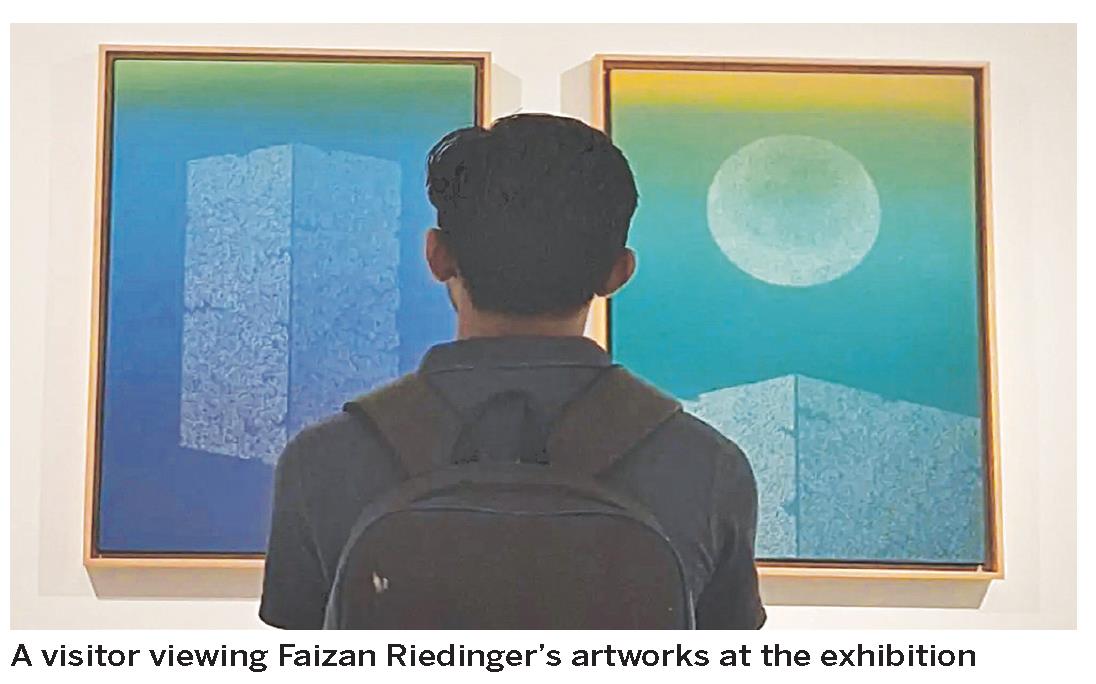
Rabia Ali’s enamel painting A Life That Happened Somewhere Else moved closer to the fragile and unreliable nature of recollection, while Faizan Riedinger’s abstractions found meaning through rhythm and repetition rather than narrative. In Riedinger’s series Ancient Ruins, repeated marks felt almost like a thought returning to itself, creating a meditative space where interpretation is left open.
Together, these works suggested that not every experience can be remembered or communicated as a clear story. Sometimes it survives only as a feeling, a pattern or an image, without a beginning or end.
Izzah Awan’s small, imagined worlds evoked the strange intimacy of childhood, where the boundaries between imagination and reality begin to blur. Her unnamed character, described by the artist as a kind of inner child, wanders through spaces shaped by emotion, memory and play. These miniature environments carried the seriousness with which childhood imagination once transformed the ordinary a piece of cardboard could become a kingdom, as in King of Cardboard Kingdom, and a corner of a room, an entire world.
Anum Ashraf’s water colours offered a contrast. Their soft pigments, birds and foliage asked the viewer to slow down and pay attention. The works were beautiful in their stillness, and their vibrant atmosphere offered a moment of rest within the exhibition. Yet, compared with the more unsettled works around them, they remained grounded in contemplation rather than entering the more surreal territory of memory and imagination. This created an interesting distance within the exhibition itself.
‘Playground’ allowed these different approaches to remain unresolved. Imagination here was not simply an escape from reality and memory was not a faithful record of what had happened. Both became ways of remaking experience.The exhibition left us somewhere between recognition and invention, where the past returns in fragments and the familiar can suddenly shift.
Like a dream that begins to disappear the moment we wake up, what remains is not always a complete image, but sometimes only a feeling that we carry with us long after we have left.
‘Playground’ was on display at Vasl Gallery in Karachi from August 18-28, 2026 The writer is a Karachi-based visual artist currently pursuing an MPhil in Visual Arts at the National College of Arts (NCA), Lahore