
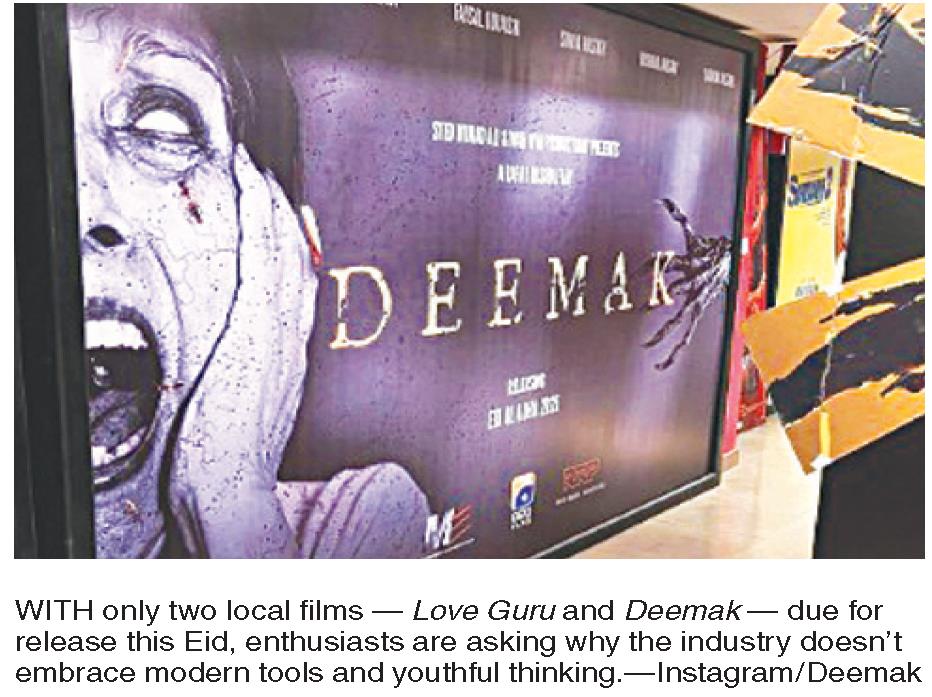
WITH a shift from big cinemas whose prices were more affordable to a larger segment of society to high-end multiplexes, a dearth of quality films and the rise in overthe-top streaming services, it feels like the curtain is falling fast on the silver screen industry.
This is not just the story of one industry, rather a cultural loss, where avenues of community entertainment have dwindled over the years.
Sixty-seven cinemas have been closed all over Pakistan in the last seven years, known film distributor, Sheikh Abid told Dawn.
‘Across Punjab, only 39 cinemas are leftafter the closure of as many as 37 cinemas.
Even Film star Shaan Shahid regretted there were no films to run the cinema halls.
Only two Pakistani movies, Deemak and Love Guru, are being released this Eid.
On the list of top 11 highest-grossing Pakistani films within local cinemas, there were four movies in 2018 and two in 2022 but none afterwards indicating the waning flow of quality content.
At the same time, the affordability and diversity offered by Over-The-Top (OTT) services have increasingly pulled audiences away from cinemas.
In Shaan’s words: ‘Cinema perhaps is getting outdated, but not the content. Good films are always the outcome of good content.
He says no attention had been paid to filmmaking over the years. ‘Young filmmakers should have been given a chance and should be financed to come up with films having good content. [In such case] The atmosphere of cinema cannot be replaced with social media platforms.
Growth of OTTs However, streaming has already globalised Pakistani content, with Sunn Mere Dil, Dili-Nadan, Churails, Rukhsaar, Aik Jhooti Love Story and Barzakh gaining traction in the Middle East, India, and among the diaspora.
Net f lix’s Jo Bachay Hain Sang Samait Lo starring Fawad Khan and Sanam Saeed is slated for later this year, signalling a leap in international visibility.
Creative freedom and afford-films are always the outcome of good content.
He says no attention had been paid to filmmaking over the years. ‘Young filmmakers should have been given a chance and should be financed to come up with films having good content. [In such case] The atmosphere of cinema cannot be replaced with social media platforms.
Growth of OTTs However, streaming has already globalised Pakistani content, with Sunn Mere Dil, Dili-Nadan, Churails, Rukhsaar, Aik Jhooti Love Story and Barzakh gaining traction in the Middle East, India, and among the diaspora.
Net f lix’s Jo Bachay Hain Sang Samait Lo starring Fawad Khan and Sanam Saeed is slated for later this year, signalling a leap in international visibility.
Creative freedom and afford-ability are the main reasons for the growth of OTT platforms such as Netflix, Amazon Prime, Zee5 and iflix, drawing not only audiences but also artists away from mainstream cinema in Pakistan, which has strug-gled to evolve beyond formulaic storylines due to cultural or commercial constraints.
Film producer Kanwal Khoosat says, ‘Local and international are two different scenarios when it comes to films. Itseems to us cinema has become old fashioned whereas OTT for its outreach and visibility is one of the essentials, but it’s a misconception.
In Europe, she said, it is considered derogatory to screen films on OTT. ‘We in Pakistan have no diplomacy with [such] platforms, we need to rely on our own cinema for its revival.
Regretfully, cinema is no more an entertainment for the ordinary man; modern cinema halls are for the elite.
Govt support, fee cut However, Yasir Nawaz, a noted director and producer, was of the opinion that cinema was experiencing a downfall across the world. He said OTT or AI were not the issue, what matters for cinema’s revival was ‘big support from the government’ and ‘fee cut by exhibitors and distributors’.
He said no strategies had been laid out to revive the industry. ‘Expensive cinemahalls led to less buying of tickets,’ he said, adding even they did not offer discounts.
Noted film director Nadeem Baig, who directed films such as Punjab Nahi Jaoon Gi and Jawani PhirNahi Aani, said OTT platforms did give competition, but cinema could only be revived when filmmakers produced around 12 films a year.
He said government support was vital. ‘It is good Punjab and Sindh governments haverealised spending on filmmaking is important,’ he noted.
Humayun Saeed believes OTT platforms can’t affect cinema, asserting they could not create the effect that cinema had. But industry’s revival depended on supply chain and government support, he said.
Production of more and diverse films was the mantra, he said.
Mentorship For veteran actor Nayyer Ejaz, improved content is key to revive cinema. ‘Why OTT isbeing considered top of the line? Because they choose the best and different content,’ he said. Government patronage is important, but young writers must learn screenplay from seniors, he said, adding the industry also needed to adopt modern techniques.
Film writer Pervaiz Kalim was of the opinion young filmmakers could help revive cinema, while also underlining the need for mentoring budding filmmakers by seniors to boost film production.
If Pakistani content can get awards and nominations in international film festivals, there’s no dearth of talent or scarcity of original content.
Actor Wahaj Ali, however, thinks OTT and AI had nothing to do with the revival of cinema. ‘We need to enhance our productions. Pakistani dramas have a great international audience. If producers invest properly in films without fear of recovery, quality films can bebeing considered top of the line? Because they choose the best and different content,’ he said. Government patronage is important, but young writers must learn screenplay from seniors, he said, adding the industry also needed to adopt modern techniques.
Film writer Pervaiz Kalim was of the opinion young filmmakers could help revive cinema, while also underlining the need for mentoring budding filmmakers by seniors to boost film production.
If Pakistani content can get awards and nominations in international film festivals, there’s no dearth of talent or scarcity of original content.
Actor Wahaj Ali, however, thinks OTT and AI had nothing to do with the revival of cinema. ‘We need to enhance our productions. Pakistani dramas have a great international audience. If producers invest properly in films without fear of recovery, quality films can beproduced.
Screenwriter, actor and host Vasay Chaudhry, too, believes OTT or any other social media platform could not replace cinema. ‘Cinema’s popularity just cannot be replaced,’ he reiterated. People used to say after Covid that cinema wouldn’t survive, but many films were screened, he remarked.
Many film enthusiasts, however, question if our known filmmakers, artists, distributors and exhibitors are prepared to take up the challenge, embrace innovation and hone the potential of young techsavvy minds or still in denial mode, resorting to blame game and awaiting some external help to turn the tide.
Indeed, when the brightest minds are empowered with the experience of yesteryears and the tools of tomorrow, miracles can happen.
Hassan Sheerazi in Karachi also contributed to this report