
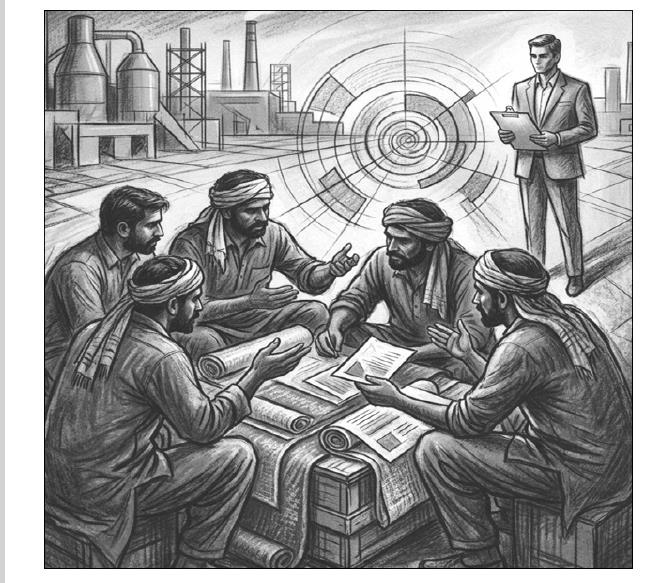
IN the early 1970s, trade unionism was encouraged in Pakistan to protect workers and to improve industrial relations.
However, limited maturity on both sides put pressure on industries to explore third-party employment. What began as a simple manpower supply mechanism evolved into professional service-providers handling recruitment, payroll, statutory benefits, records and workforce management. Today, the question is not whether third-party employment exists, but how responsibly it operates.
The distinction between workers hired ‘through a contractor’ and services that are delivered ‘by a contractor’ is fundamental.
If a client recruits workers and controls their attendance, leave, discipline, deployment and supervision, the contractor may be little more than a payroll intermediary. Genuine service contracting means purchasing an outcome, for example, packing services to agreed standards, while the provider decides staffing, recruits, employs, supervises and pays workers.
The client monitors output, quality, safety and performance.
A worker serving at one factory for years may understandably identify with it. Yet, the service-provider may be the actual employer when it issues appointment letters, pays wages, manages Employees Old Age Benefits Institution (EOBI), social security and employment matters, and genuinely execute all these responsibilities. An employer cannot exist only on paper.
Neither can a written service agreement override actualpractice: contracts, operating arrangements and day-to-day conduct must match, because authorities examine who really controls employment.
Without this separation, long-serving workers understandably become confused about whom to approach for grievances, employment decisions and legal entitlements, weakening their trust in the overall system.
The third-party status must never mean second-class treatment. Workers deservelawful wages in line with their skills, EOBI, social security, gratuity, leave, bonuses, Workers’ Profit Participation Fund (WPPF) where applicable, insurance, safe working conditions, freedom of association, dignity and job security. Service-providers should also offer training, career development, documentation and employment continuity.
Client organisations must verify timely wages, statutory contributions, leave, safety and legal compliance rather than disclaim responsibility.
Industrialrelationsitselfis changing from confrontation, discipline and union handling towards worker engagement, grievance resolution, compliance, development and stability. However, uncertainty remains around the boundaries of labour supply and service contracting. Clearer Pakistani laws should assign responsibility for attendance, leave, discipline, deployment, benefits and records, giving workers, providers, industries and labour departments consistent expectations, and thereby reducing disputes.
As such, workers, service-providers and industries are interdependent. Workers need fair treatment and security, providers need viable businesses, industries need flexibility, productivity and continuity.
Responsible contract management must balance these interests. Direct employers must meet their obligations, genuine providers must act as employers, and paper-only contractors must be identified.
Rather than dismantling third-party employment, lawmakers, labour authorities, industry and service providers should simplify rules, strengthen oversight, and protect legitimate models that support investment, jobs and growth.
Ultimately, the choice is not simply direct versus third-party employment, but responsible versus irresponsible employment. Every worker deserves protection, every employer must accept accountability, and every industry needs room to grow.
Muhammad Khurram Khan Karachi