
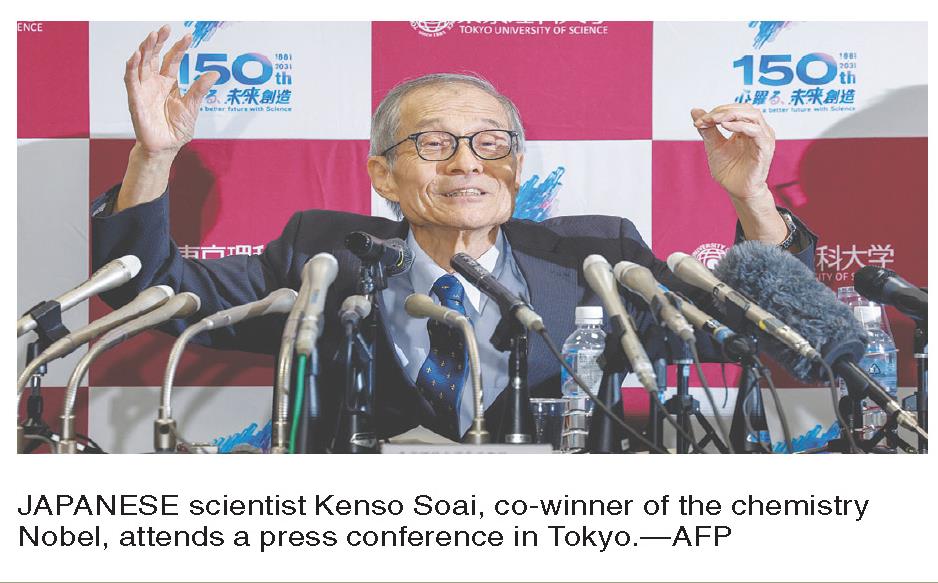
STOCKHOLM: France’s Henri Kagan and Japan’s Kenso Soai on Wednesday won the Nobel Prize in Chemistry for discovering how to manipulate forms of key molecules, a crucialbreakthroughfor drug manufacturing.
Like hands, molecules such as amino acids exist as two mirrored variants, but only one of them is found in the proteins in the body’s cells a phenomenon known as ‘homochirality’.
‘Henri Kagan and Kenso Soai have provided a solutionto a chemical mystery that is over a century old: how homochirality can emerge spontaneously,’ Heiner Linke, chair of the Nobel Committee for Chemistry, told a press conference.
Kagan, 95, is professor emeritus at the Universite ParisSaclay in France while Soai, 76, is a professor at Tokyo University of Science. Soai said he had received the call while out shopping for groceries.
He said he was ‘extremely happy’ to be honoured together with Kagan. French President Emmanuel Macroncongratulated Kagan on his prize on X, calling his achievement ‘a tremendous source of pride for the country’.
‘Truly wonderful people’ The academy in a separate statement likened the chirality conundrum to a locksmith creating keys to order but whenever they produce them they get two mirrored variants. ‘Only one of them fits the lockand the lock can be damaged if your customers try to unlock it with the other key.’ One example of the potential danger of using thewrong key, or version, was the thalidomide scandal in the late 1950s and early 1960s, when thousands of children were born with birth defects.
‘When researchers analysed what had happened, they realised that it was the active substance’s mirror image that caused the harm,’ the academy said. Phillip Broadwith, an editor at the Royal Society of Chemistry’s Chemistry World magazine, said the duo’s work ‘goes to the very fundamental level of understanding how we can control which’hand’ of a molecule we make’.
Controlling ‘is crucial for making things like drugs or even flavours and fragrances’, Broadwith said.
‘It also helps to explain a possible way that all the chiral molecules on earth our proteins, sugars and biomolecules, settled into one specific handedness rather than the other,’ he said in an email.
In the 1980s, Kagan found a new way of manipulating chemical reactions to create an excess of one of the mirrorimage forms.-AFP