
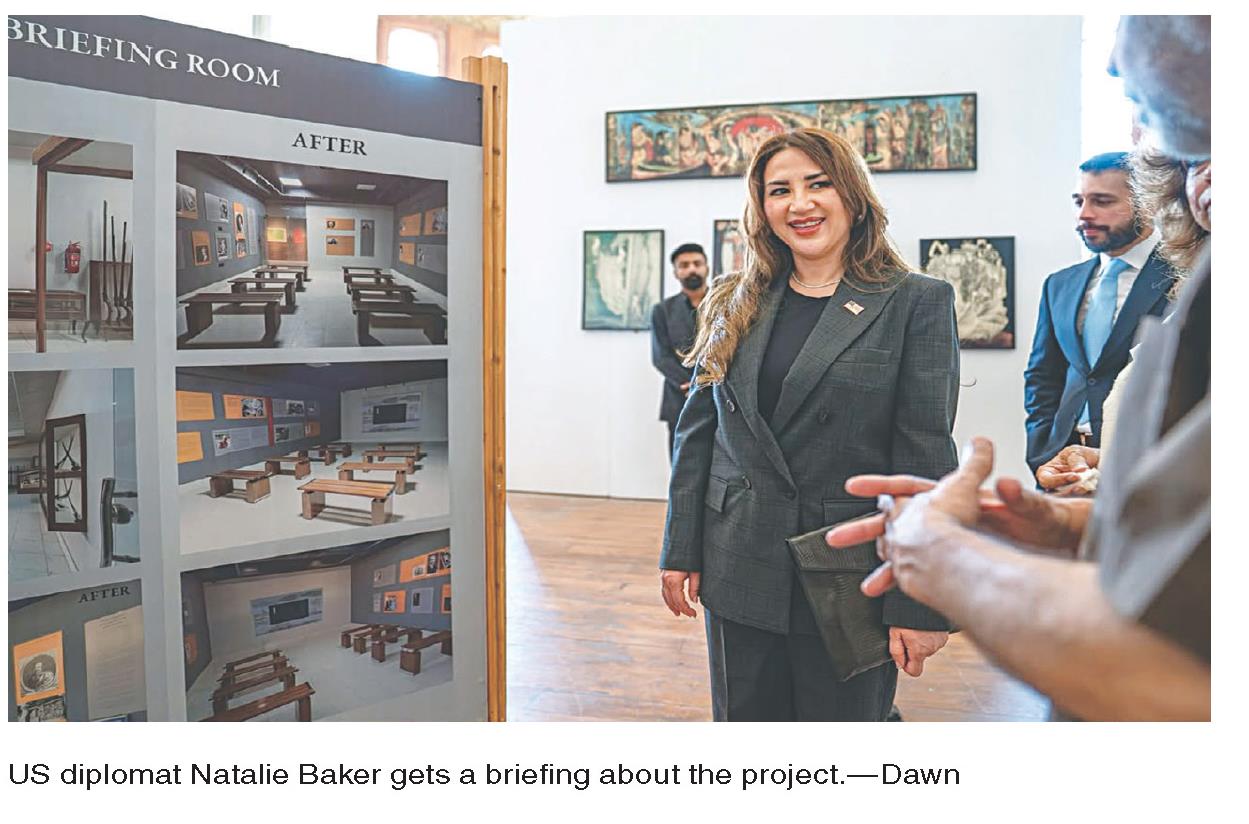
KARACHI: The completion ceremony of the Mehrgarh Museum of Balochistan, organised by the US Consulate General in Karachi in collaboration with the Sindh Exploration and Adventure Society (SEAS) and the Balochistan Culture Department, was held at the Frere Hall here on Saturday.
Supported by the US Ambassadors Fund for Cultural Preservation (AFCP), the Mehrgarh Museum of Balochistan represents the first-ever AFCP initiative in Balochistan.
Implemented in collaboration with SEAS and the Balochistan Culture Department, the project preserves ancient Neolithic and archaeological artefacts from the historic Mehrgarh civilisation, upgrades museumcuration to internationalstandards, expands community outreach, and trains local heritage professionals to ensure long-term collection care.
Natalie Baker, the chargé d’affaires (CDA) at the US Embassy Islamabad, Balochistan government official Nawabzada Mir Muhammad Zarain Khan Magsi, project leads Dr Asma Ibrahim and Dr Kaleemullah Lashari unveiled a commemorative plaque that will stand at the entrance of the Mehrgarh Museum in Quetta.
Though it is already working and functional, the museum will be officially reopened later this month.
Speaking at the ceremony, the US diplomat Baker highlighted the power of American expertise to deliver tangible, lasting results and foster trust between the peoples of both nations.
‘Today, we are thrilled that, through American excellence in museums and heritage preservation, the Mehrgarh Museum of Balochistan will showcase the 8,000-year-old Mehrgarh civilisation and many others,’ CDA Baker said.’Projects like this one show what American expertise delivers: lasting, tangible results that preserve history, create jobs and strengthen local communities. Together, the United States and Pakistan are making real progress in protecting this remarkable legacy,’ she said.
Speaking on the occasion, Dr Asma Ibrahim, one of the project leads, said the Mehrgarh Museum is not simply a museum of the archaeological site of Mehrgarh. It is a museum of Balochistan, representing the province’s extraordinary archaeological, historicaland culturalheritage.
‘Balochistan possesses an exceptionally rich and diverse cultural history. Its archaeological record takes us from the earliest human settlements and the development of agriculture and crafts to the great civilisations of the Indus region and the subsequent historical periods. Its heritage also reflects centuries ofculturalinteractions,trade,artistic traditions, political developments and the experiences of its people,’ she said.
Talking about SEAS Pakistan and its commitment to cultural preservation, she said that ‘SEAS Pakistan is a heritage organisation committed to archaeological research, exploration, conservation, museum development, documentation and the preservation of cultural heritage. Our work is driven by the understanding that heritage is not simply a legacy of the past; it is an important resource for education, cultural identity and sustainable development.
‘Over the years, SE AS Pakistan has undertaken several significant cultural preservation initiatives in collaboration with national and international partners.
An important part of this journey has been our association with the US Government’s AFCP.
‘Through this partnership, SEAS Pakistan has had the privilege of undertaking heritage preservation projects at three important sites in Karachi: Varun Dev Temple at Manora, the Indus Valley School of Art and Architecture and the historic Frere Hall,’ she pointed out, adding that each of these projects represents a different dimension of Pakistan’s cultural heritage.
‘Together, these projects reflect our commitment to preserving religious, architectural, educational and historical heritage, while making these places more accessible and meaningful for the public. These experiences have strengthened our institutional capacity and given us valuable opportunities to work with international experts, local communities, government departments and heritage professionals.
‘The present project at the Mehrgarh Museum in Quetta is another important milestone in this continuing journey. It extends our work beyond Karachi and Sindh, reinforcing our commitment to the preservation and presentation of the wider cultural heritage of Pakistan, particularly the extraordinary heritage of Balochistan,’ she said.
Sharing a bit about the challenges they faced during the journey, she said that working in Balochistan brought its own challenges, including logistical difficulties, security-related constraints, delays and unexpected circumstances.
‘There were moments when the work demanded considerable patience, determination and problemsolving. However, we remained committed to our objectives, and today we can proudly say that we have brought this project to completion,’ she said.
Dr Ibrahim also stressed that a museum is not successful simply because its galleries look attractive.
‘It becomes successful when people visit it, learn from it, connect with its collections and develop a sense of pride in their heritage. It is particularly encouraging to see students visiting the museum, participating in educational activities and learning about their own history,’ she said.
She added that the ongoing internship and educational sessions conducted by the museum’s teaching staff are encouraging examples of how a museum can become an active centre of learning.
‘I firmly believe that museums are not merely repositories of the past. They are educational institutions, research centres, spaces for dialogue and important instruments for building cultural identity.
‘The Mehrgarh Museum has enormous potential to become a major educational and cultural destination, attracting students, researchers, tourists and visitors from across Pakistan and internationally. This project should therefore be seen not as an endpoint, but as the beginning of a new chapter for the museum,’ she concluded.