
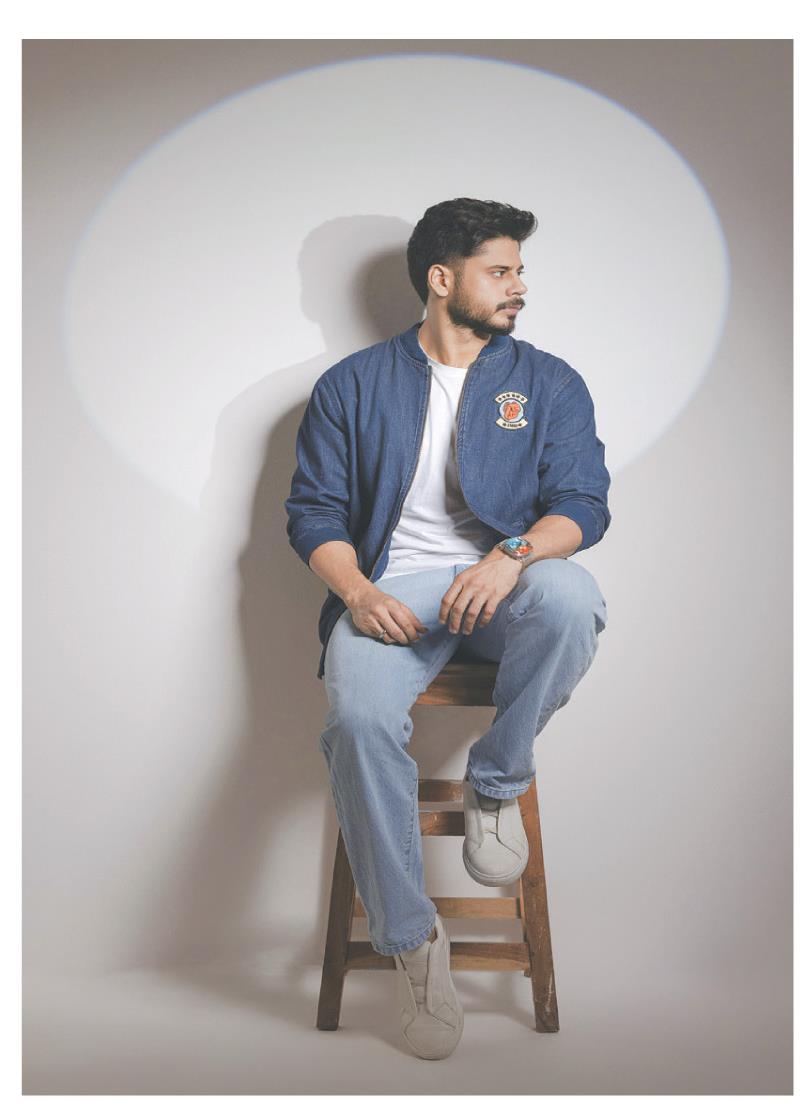
When I meet Haris Waheed at a coffee shop, he is incapacitated by a leg injury, but he still arrives on schedule. No crowd gathers around him, and there is no fuss over the character who had television audiences talking about him disliking him, laughing at him, and yet waiting to see what he would do next.
Haris seems oblivious that this too was a possibility in a public spot. He recently played Shayan in ARY Digital’s Bas Tera Saath Ho (BTSH), a privileged, morally compromised young man who could manipulate people, take extreme measures to avenge an insult, make questionable decisions, and then deflect criticism with a joke or a cheeky remark.
With the drama now concluded, Shayan’s journey offers a chance to reflect on what made him so watchable.
Haris settles into his chair and adjusts himself comfortably before beginning our discussion on the craft behind a role that was ncycr meant to be straightforward.
‘I didn’t want to glamorise him [Shayan],’ he says, making his position clear from the outset. ‘I don’t want to label people as negative and then keep my distance. Whether someone is an antagonist or morally compromised, I like discussing them and understanding their psychology.
For Haris, the challenge wasn’t to make Shayan seem innocent; it was to make him recognisable.’I always try to bring humanity to a character,’ he explains. ‘When someone watches him, I want them to feel that some of these habits might be in them too, or that they might react similarly. We all know people who behave this way. We may even recognise something of ourselves in them.
UNDERSTANDING SHAYAN Shayan’s humour was one of his defining characteristics, but it wasn’t merely a device for entertainment. Haris felt the character needed another dimension, especially given the drama’s often intense central conflicts.
‘When we were shooting, we kept returning to the same points of conflict in the story, says Haris. ‘At one point, I found the character a little boring and, when that happens, I try to make the character more interesting. I thought the drama needed some comic relief, somewhere the audience could take a breath.
However, the humour had to belong to Shayan rather than feel imposed on him.
‘I wasn’t necessarily trying to make him as funny as he became. I found the humour interesting, but at times I wasn’t sure how people would respond.
That uncertainty is part of the work. An actor can make choices but cannot fully predict how viewers will interpret them. Haris’ priority was to make the character believable enough to keep audiences invested in his story.
‘I only thought that if I made him believable, the people watching would connect with him,’ says Haris while adjusting his injured leg. He then takes a sip of his drink. ‘Whether they liked or hated him, they would stay with his journey.
That, to me, is what acting is about.
Shayan’s behaviour also showed some self-awareness. He wasn’t always oblivious to the consequences of his actions, which made his decisions more revealing.
‘He knows when his friends are making a fool out of him, yet he still goes along with it. He deliberately asks his friend to make a deepfake video of Anas and Ansa [Farhan Saeed and Sana Javed], knowing it will embarrass them. But before doing something like that, a person must consider the backlash.
What will people say? What if someone finds out? How will I handle the criticism?’ For Haris, the key distinction was that Shayan could be entertaining without being admirable. Understanding a character is not the same as defending him.
‘There is a fine line,’ Haris elaborates.
‘If you glamorise him, you lose the point.
You may end up creating a strange version of the character, and the story no longer works as intended. We can make a morally compromised person understandable, but we must also remain mindful of the consequences of his actions.
With the drama over, the audience can now see Shayan as a fully developed character rather than simply waiting for his next misstep. The question is no longer just when his downfall will come, but why viewers remained interested in a man whose family and friends had so many reasons to dislike him.
In the end, he wasn’t even part of the happy ending in the Mursaleen household,and nothing could be a more litting end for a character like him.
TABREZ WAS A DIFFERENT STORY This isn’t the first time Haris Waheed has played a morally grey character. In Jaan-iJahan (2023), he played Hamza Ali Abbasi’s stepbrother, Tabrez, who does everything imaginable wrong and hopes to get away with it, all with his mother’s blessing.
Haris believes comparing Shayan and Tabrez is inevitable. Both men inhabit morally grey territory, but the actor views them as products of very different circumstances.
‘I defined them differently from the beginning,’ he says. ‘Shayan belonged to a younger age group, was pampered, and his parents supported his endeavours. Tabrez, on the other hand, was ignored by his father, had his own issues, and his mother had been planting ideas in his mind since childhood.
Those differences shaped how the characters related to the world around them. Tabrez’s resentment had a history, whereas Shayan’s behaviour stemmed from a very different upbringing.
The contrast matters because Haris does not treat morally grey roles as interchangeable opportunities to play a villain. The character’s background, emotional responses, and self-understanding must inform the performance.
‘I keep going back to the director to discuss the character,’ he tells me. ‘If he is doing something on the surface, I want to understand what is happening inside him. How would he react internally? What would make him act that way? I try to dig into the character’s childhood because so much of a person’s behaviour begins there.
Haris believes this work is especially important when the writing does not explain every detail.
‘In our stories, a character’s justification isn’t always fully developed. Not everything is written in that much detail.
Silence isn’t always explored, and smaller details are sometimes left out. An actor has to work through those details to build an understanding of the character.
THE QASIM ALI MUREED CONNECTION One name that immediately comes to Haris’ mind when he thinks of two of his ‘best worst characters’, he says, is director Qasim Ali Mureed, who gave him the chance to portray both Shayan and Tabrez. The actor appreciates being trusted with roles that go beyond a conventional hero-versus-villain dynamic.
‘I had worked with Qasim before, and that character was even more vicious,’ he says. ‘I really enjoyed playing him because he created the space for that performance.
He understands the psychology of negative characters and likes discussing what drives them to behave as they do.
Haris considers that interest valuable.
Instead of treating an antagonist as a collection of bad actions, a director can encourage an actor to explore the motivations behind them.
‘Usually, people want to keep their distance from negativity. They label someone negative and leave it at that. But if you look at the psychology, you can find something interesting.
‘That understanding helps an actor, because the character’s energy comes from within. You don’t have to force it.
The collaboration also allows a character to develop during production, says Haris. He seems to be really invested in fleshing out his characters. But where does such a thinking approach to acting originate from? FROM NAPA TO TELEVISION Haris’ approach to acting was shaped by training and experience long before Shayan appeared on television. He recalls being asked a peculiar question early in his career that shaped his future as an actor.
‘Since I was interested in acting, I was referred to a TV director for a small role,’ he recalls. ‘However, when he asked me, ‘Do you want to become famous, or do you want to be an actor’? I chose the latter. He then suggested I meet [theatre actor] Saleem Mairaj, which is how I found Napa [National Academy of Performing Artsj and auditioned.
Having been accepted at Napa, Haris’ subsequent training helped him view acting as a craft rather than a route to visibility. He also recalls learning from experienced performers, including the late Napa founder Zia Mohyeddin.
‘I have been doing this work for years,’ says Haris. ‘I spent time in theatre and learned from people such as Zia Mohyeddin. That experience gives you confidence.
I don’t look at a senior actor now and think I can’t stand beside them. I know I have worked on my craft.
He also casually mentions spending time with Bollywood star Naseeruddin Shah, who brought his Motley Theatre to Pakistan in 20l3, during Haris’ early days. He adds that the experience had a lasting impact on his journey as an actor.
THE SUPPORTING ACTOR’S ADVANTAGE Over the past three years, Haris’ career has spanned projects such as Jaan-i-Jahan, Contractors (2024), Pamaal (2025) and Bas Tera Saath Ho. All of the roles were what would be termed supporting roles in common parlance, not the lead role. I wonder if taking on a lead role is his ultimate aim. But Haris tells me he doesn’t consider lead status the only measure of a worthwhile role.
‘I never set out to fit into a particular box,’ he responds with earnestness. ‘I didn’t decide I would do only a certain kind of work. I went toward the material that interested me, especially when it challenged me. I wanted to hear people say I had done good work, and I felt the best way to get there was to keep practising the craft.
That attitude also explains his willingness to take on antagonistic roles. He isn’t trying to build a career on negativity; he is seeking roles that let him explore something new.
‘If I realise I am repeating myself, I cannot keep doing the same thing,’ he adds. ‘I want to work on different material. It is not about whether the character is good or bad. It is about whether there is something about him I can explore.
For Haris, even a character with less screen time can be rewarding if the writing and performance offer sufficient depth. The goal is not simply to be seen more often but to leave an impression.
Social media has changed the relationship between actors and viewers. Praise and criticism can arrive immediately, sometimes from people who have followed an actor’s work for years, and sometimes from anonymous accounts. Has this changed how he views his output? Haris tries to distinguish criticism of a performance from a personal attack, he says.
‘When someone understands your body of work and talks about the work itself, you can recognise that there may be something worth considering. You can see that the person has a point-of-view, and is discussing your work.
But, obviously, not every comment warrants equal attention.
‘If somebody says something that has no basis, it is just a personal opinion. You can leave it alone. You don’t have to take every comment personally.
He has also watched audiences respond to Shayan with a mix of fascination and dislike. For an actor, that response is helpful when it shows the performance has connected, even if the character isn’t universally loved.
BEYOND THE SCREEN Away from work, Haris enjoys trekking and spending time exploring nature. The contrast with the entertainment industry is part of the appeal, he admits: the outdoors offers a break from constant visibility and the expectations that come with it.
‘I love going into a forest,’ he shares. ‘I have been trekking before, and what surprises you is the variety of things you discover. You read about certain places in geography books, but when you experience them yourself, they become something completely different.He is also drawn to the physical challenge and to the distance it creates from everyday life.
‘When you go trekking, you are away from the world you normally inhabit. You walk, deal with the weather, and figure things out. It gives you a different perspective. You are not thinking about the industry or what people are saying about you.
Age has also changed the way he thinks about health. What once seemed easy to take for granted has become an important part of how he wants to live.
‘When you are younger, you don’t think about your health the same way,’ says Haris. ‘You assume you are fine. As you grow older, you realise just how important it is to be healthy, and to have a healthy environment around you.
The 32-year-old has also become more mindful of the need to examine his thoughts and emotions before acting on them.
‘It is important to address the thoughts and feelings that come into your mind before you give them words or act on them,’ says Haris. ‘Just addressing them can make a big difference. When I started paying attention to my health, I realised what a huge difference it made in my life.
For an actor, he says, life itself becomes part of learning about people. Happiness, disappointment, relationships and change all contribute to that understanding.
Haris remains guarded about his personal life, preferring to focus on what experience teaches rather than recounting private matters for public consumption. That same thoughtfulness shapes his admiration for actors such as Saba Qamar, Naumaan Ejaz, and Faisal Rehman, whose work he respects for its craftsmanship and commitment.
WHAT COMES NEXT? So where does Haris go from here? He says he wants to explore direction, production and theatre alongside acting on screen. He doesn’t seem eager to map out every step of his future in an ever-evolving industry.
‘I am open to opportunities,’ he says candidly.
‘You can’t plan everything in advance. You have to keep working, keep learning, and see what comes your way. If something interesting comes along, I want to be ready.
That openness matches the career he has built so far: one shaped by training, curiosity and a willingness to take on characters who don’t offer easy answers.
He also credits hard work and determination for his career success.
Two of Haris’ dramas, Bano on Geo Entertainment and Lagan Lagi on ARY Digital, are currently airing, and he hopes the audience will love his characters (Shehryar in Bano and Daniyal in Lagan Lagi) as much as they loved Shayan. He believes taking on different roles lets him showcase his acting prowess, which is why he chose these two dramas.
With Bas Tera Saath Ho now behind him, Shayan joins Tabrez as another character through whom Haris explores the contradictions of human behaviour. He does not need the audience to approve of these men.
He simply wants them to understand these men enough to keep watching.
The writer is a broadcast journalist who writes on sports, film, television and popular culture.
X: @omair78