
In British-Pakistani writer, director, producer Seemab Gul’s Ghost School, the world of interior Sindh becomes a quiet question mark, and a screaming statement especially when it comes to young girls’ education and healthcare.
The problems are everywhere yet nowhere in the rural, sand-encrusted fishing village where Rabia (Nazualiya Arsalan) lives. The surroundings stir quite a lot of questions in the mind of the 10-yearold contemplative girl whose school closed down without notice. Rumours of djinn taking over people and institutions spread with nonchalant normalcy, as if it’s an everyday occurrence. Nobody notices the apparentness of it all.
Oddly, Gul chooses to keep the various characters and family members nameless, addressed by Rabia only by their adopted professions or by their relationship to her.
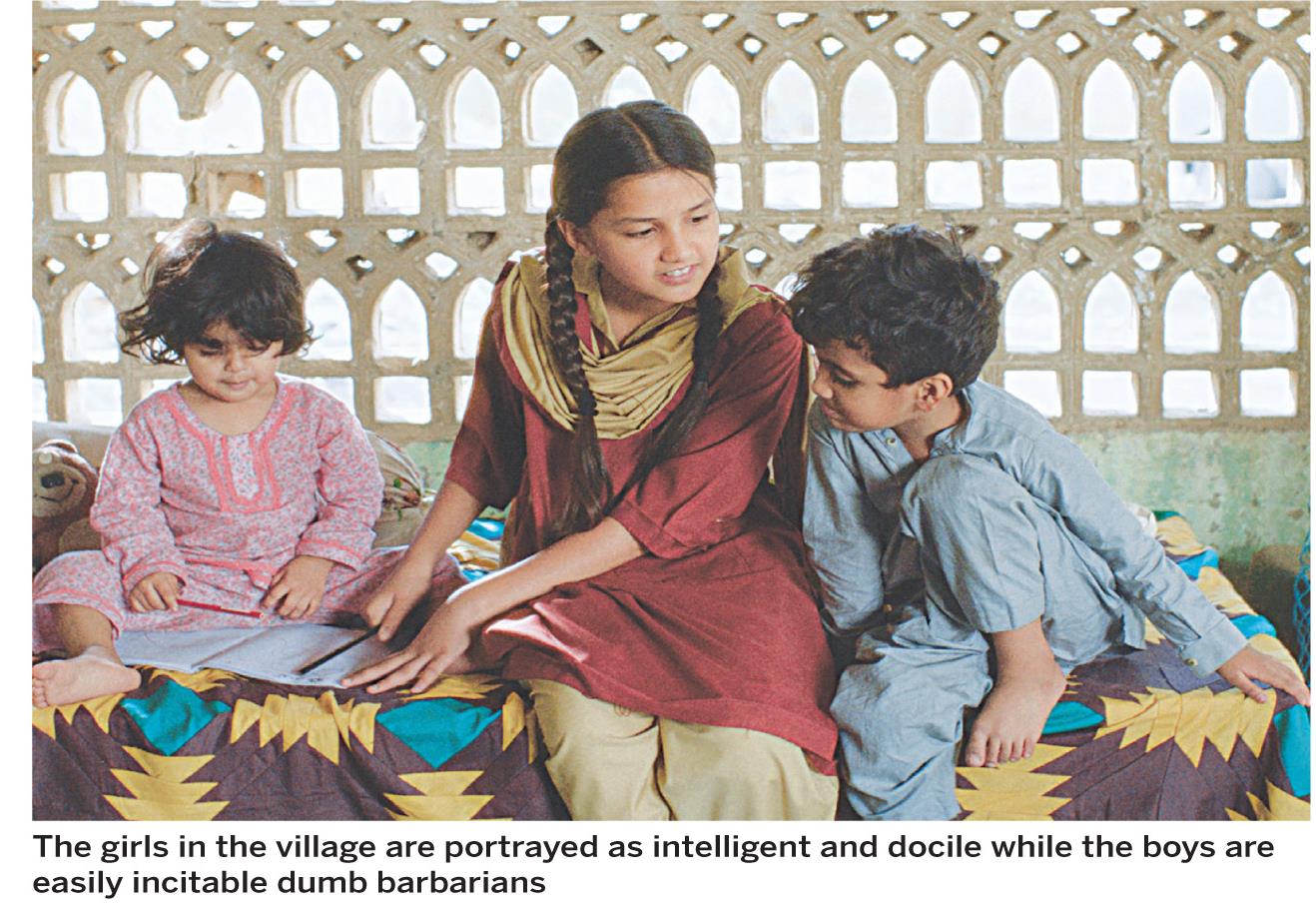
The girls in her village are intelligent and docile, and the boys are easily incitable dumb barbarians (one was expecting this).
The school teacher (Muhammad Zamaan) is nowhere to be found. When she tracks him down, the teacher and his wife are all but ready to leave for the city as small-town politics have become too much for the couple.
The school principal (Adnan Shah Tipu) whom she also eventually tracks down lives at the other end of the spectrum.
He believes education to be a privilege for the rich. For him, Rabia, the daughter of a fisherman and a housemaid (played by Samina Seher), shouldn’t worry about learning. After all, he says, what would landlords do if all fishermen and farmers educated themselves and left for a better life? Rabia leaves the principal’s house, sees an old well and screams like an adult who has had enough not a child who wants to hear her echo. It’s a strange disconnect, but the realisation for the viewer is far from alarming. Rabia, for the most part, is an angry representation of the outside world, silently scowling at the injustices of politicians, bureaucrats and officers alike.
So,for most of Ghost School,Rabia walks, and walks, and walks, and walks (yes, there is a lot of walking), seeking answers that are everywhere for the audience to sec. She notices half-completed buildings abandoned along the way a hospital, a college, a school left incomplete because state funds were looted. Schools that get state funding but hire no teachers are deemed ‘Ghost Schools’ by institutions of developed countries, as Rabia, and the audience, are told.
She meets a vegetable vendor (Kehan Naqvi) who is happy to have left school when he reached the Efth standard, and a blind old man (Tutu Baba) sitting in the shade, who goes gung-ho against politicians. At his barbershop, her uncle (Taha Khan), a sensible, educated young man, tells her not to prod and to return home with the local longa driver (Vajdaan Shah) and his white steed Burraq. Rabia, instead, pays him to drop her at the district commissioner’s office.
At one point, Gul makes an appearance as the girl’s saviour. She gives Rabia a ride home in her car and offers her an education in Karachi. In exchange, the little girl has to take care of her house chores.
Everyone Rabia encounters speaks perfect Urdu, using words that spring right out of classic literature from my grand-dad’s youth; not one of them has a hint of Sindhi in their dialects. Every actor ‘acts’ as if they aren’t yet attuned to the subtleties of film acting, and deliver stilted dialogues with the aghastness of a first world resident. The entire exercise makes Ghost School a very long, very tiring, decidedly vocal, one-dimensional message board, littered with sticky notes about how old-fangled and suffocating Pakistan really is.
For good measure, the film is shot with the arty and serious 3:2 squarish aspect ratio by Afghan-German cinematographer Zamarin Wahdat, accentuating the boxed in lives these characters live.
Now don’tgetme wrong, I am all for stories that have pluck, purpose and message, with the guts to stand against institutions, with due reason. The filmmaker took the Sindh censor board to court and won and one can see why they had issues with the film.
Notwithstanding the gutsiness, I am also a supporter of subtlety, impartiality, panache and pacing, especially when it comes to spinning narratives (panache and pacing are important on the technical front to keep the film engaging).
Here, the message lingers inclegantly, full of one-sided hubris, as if no other interpretation or viewpoint exists in this world. That conviction is wrapped around a brick that’s flung directly at the audience.
And it smarts.
The last two films that hurled a brick like this were The Window by Kanza Zia and Ammar Lasani, and years ago, Iram Parveen Bilal’s Josh: Against the Grain.
Both films found international applause at film festivals, but little audience in Pakistan. However, Parveen Bilal’s film had better dialogue delivery and less stilted performances.
In Gul’s film, despite the trained, theatrical performances of her cast who often act on cue the real gem is Nazualiya Arsalan. The little girl is a find whose naturalness somewhat eases the insistent nature of Ghost School.
Gul’s film carries an idea worth exploring that, according to the Asian Human Rights Commission, the country has 30,000 ghost schools that deprive 22.4 million students of education. However, her script needs to go back to the drawing board, irrespective of international partnerships or grants.
Released by Cinelava, Ghost School is rated ‘U’ (Universal) and features mild scenes of arson. The film is co-produced by Red Balloon Film (Germany) and backed by grants from MOIN Film Fund Hamburg SchleswigHolstein and the Red Sea Fund.
The writer is Icon’s primary film reviewer