
For the generation that I belong to, watching matches that gave you near-confirmed heart attacks was the norm.
Whether it was the Chennai Test of 1999 against India, the Multan Test of 2003 against Bangladesh, the inaugural T20 World Cup final against India, or Saeed Ajmal’s brutal bashing at the hands of Australia’s Mike Hussey three years later, we grew up watching cricket at the edge of our seats. Victory was never guaranteed until the final ball, and sometimes defeat had to stare us in the face before glory could be claimed.
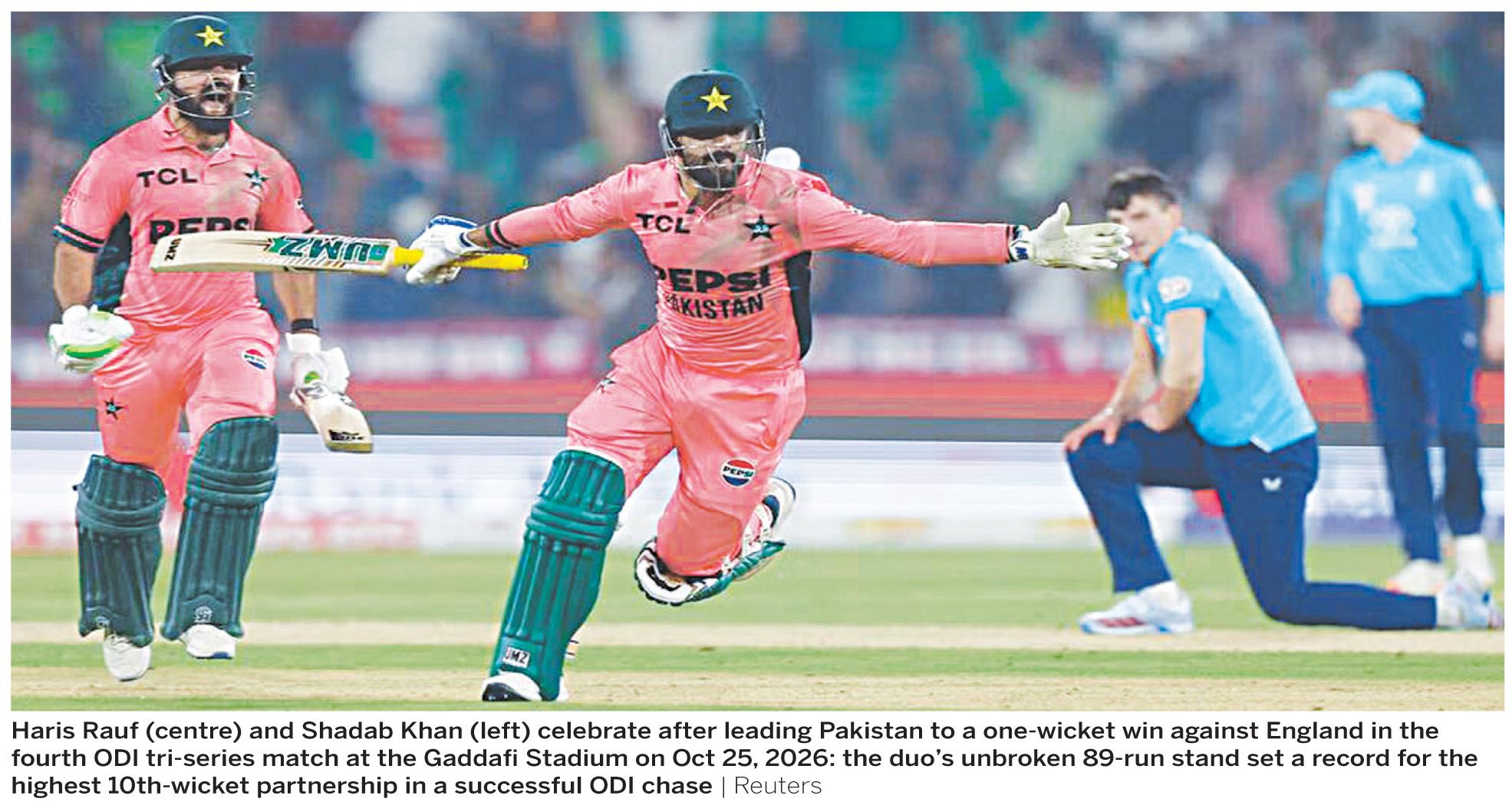
After two recent nail-biting encounters in the recently concluded tri-nation series, I was surprised to see my 11-yearold jumping out of his seat at Sri Lankan Janith Liyanage’s penultimate-ball six that culminated the second highest successful ODI chase in history and, in England’s next match, Shadab Khan’s match-turning innings his maiden ODI century and the highest 10th wicket partnership in the history of ODIs. For my son, these were revelations.
When I confronted him, I heard what every father in his forties must eventually endure: ‘What do you know about close matches’? Have you ever even seen one?’ For someone who grew up on an ODI diet, has witnessed Pakistan collapse for 87 while chasing 125, endured the heartbreak of the 1987 World Cup semi-final in Lahore, and seen the World Champions crumble for 43, this was too much to take. I did what any aggrieved father would do.
I took him back to 1986, to a time when there was no internet, coloured kits were still an exception rather than the norm, and cricket was played as much for pride as for victory.
It was Pakistan’s first match with India after the famous Javed Miandad last ball six final in Sharjah. The rivalry was finely poised as, out of the 17 encounters, India had won eight, while one had been abandoned following the assassination of Prime Minister Indira Gandhi.
In December 1986, Sharjah was hosting a four-nation tournament that also featured the West Indies and Sri Lanka. The WestIndies swept all three matches to win the title, leaving the India-Pakistan encounter a dead rubber in the standings, but a battle of nerves on the field.
Imran Khan exploited the conditions to bowl India out for 144 in the 44th over of a scheduled 45. Mohammad Azharuddin top scored with 49, while Imran claimed three wickets. In reply, Pakistan’s batters did what today’s team has become all too familiar with. After a promising 50-run opening stand, Ramiz Raja and Shoaib Mohammad fell. Asif Mujtaba, playing only his third ODI, managed 11. Then came disaster: Miandad was dismissed for a golden duck, Imran for a two-ball duck and Mudassar Nazar for just one run.
From 50 without loss, Pakistan slumped to 53 for four and then 65 for six.
Manzoor Elahi, often regarded as Pakistan’s answer to Ian Botham, was left to fight alone. He had already made an impression on his ODI debut against India two years earlier, scoring a valuable 36 and bowling out Kapil Dev and Mohinder Amarnath. Here, he produced the innings of his life, scoring a maiden ODI fifty, while dispatching Kapil Dev and Ravi Shastri for boundaries. His 54-ball stay, featuring three fours and two sixes, carried Pakistan to a memorable victory and, since then, India’s win ratio against Pakistan in ODIs never went up.
Twenty-eight days later, Asif Mujtaba found himself in Perth, playing in the America Cup, with Pakistan chasing 274 against Australia. Once again, the situation was desperate.
Opener Qasim Umar, playing in his last tournament before being banned, launched a remarkable counterattack, reaching his fifty with Pakistan’s score at 68. He eventually fell for 67, with Pakistan reeling at 96 for five. Manzoor Elahi and Imran Khan tried to rebuild, but Imran’s dismissal at 129 left Pakistan needing around 150 runs, with more than 21 overs remaining.
Asif arrived and took charge, adding 52 with Manzoor, 43 with Saleem Yusuf and another 43 with Wasim Akram, who contributed just five runs. When last man Saleem Jaffar joined him, Pakistan needed seven runs from the final over.
Asif’s mistimed shot for a four was stopped at the boundary, leaving Jaffar to face Steve Waugh. Eleven months later, Waugh would torment Jaffar in the 1987 World Cup semi-final, helping Australia post a formidable total and ending Pakistan’s hopes of reaching the Anal. But here, in front of 17,000 spectators at the WACA Ground and millions of radio listeners in Karachi, Jaffar struck Waugh for a double off the penultimate ball, winning the match.
Asif was unbeaten on 59. Nearly six years later, he would produce another memorable rescue act in Hobart. He would smash his only six of the innings on the last ball, to tie the score. Guess who was bowling then.Then, who can forget Salim Malik’s whirlwind innings in Kolkata, when Pakistan needed 79 runs in nine overs? Just 47 days after the victory against Australia, Pakistan were again in trouble. Chasing 239 to win in 40 overs, Pakistan were 160 for live when Manzoor Elahi was dismissed.
With his place in the side at stake, the 23-year-old Malik responded with an unbeaten 72 off just 36 balls, taking on Kapil Dev and Mahinder Singh to pull off a remarkable chase. Pakistan won the match by two wickets with three deliveries left, taking their tally of wins against India to double figures.
From the late 1980s onwards, Pakistan’s improbable victories increasingly came to be associated with their bowlers Wasim Akram, Waqar Younis and, later, Shoaib Akhtar. Whether it was Shahid Afridi blasting a hundred at breathtaking speed or Saeed Anwar smashing hundreds at will, solo batting heroics were reduced. At the end of Shoaib Akhtar’s career, however, came a match where Abdul Razzaq reminded everyone that this tradition was far from dead.
Playing South Africa in Abu Dhabi in October 2010, Razzaq produced an innings for the ages. Many, myself included, had switched off the television and gone to bed when he walked out to bat. Pakistan were 136 for five, needing another 153 runs in a little over 20 overs. Razzaq added 81 with Fawad Alam before putting on an unbeaten 42-run partnership with Shoaib Akhtar.
His own contribution was an astonishing 109 not out off just 72 balls, featuring 10 sixes and seven fours. Shielding the tail from a South African attack featuring the Morkel brothers, Charl Langeveldt and Lonwabo Tsotsobe, he guided Pakistan to a one-wicket victory with one ball to spare.
For my son, these were extraordinary moments. For me, they were reminders of a cricketing heritage stretching back decades: of unlikely heroes, collapsing batting orders and victories snatched from the jaws of defeat.
The writer writes on old films, cricket and music and loves reading books. X: @suhaybalavi