
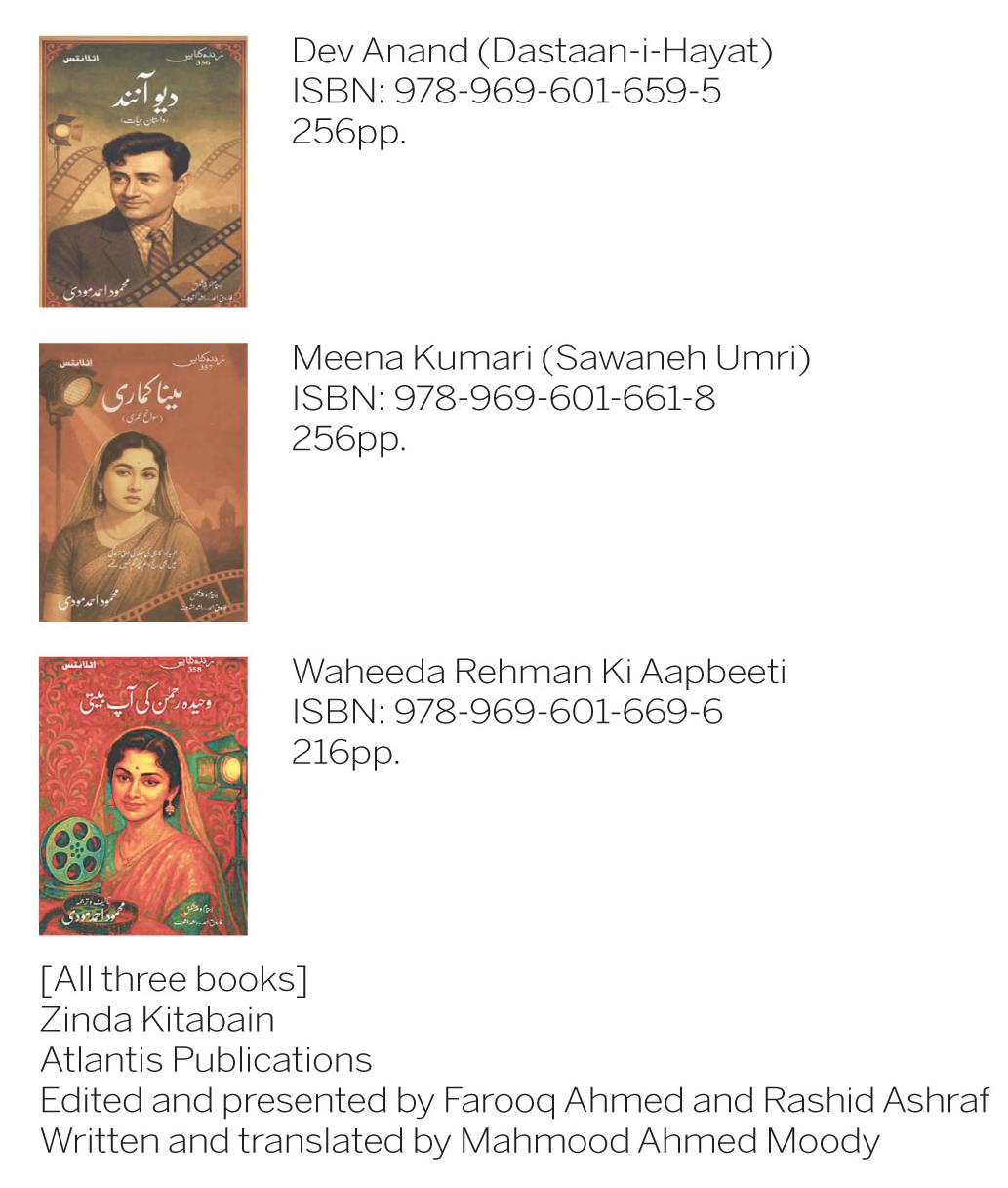
Indian cinema of the 1950s, 1960s and 1970s cannot be discussed without mentioning the three stalwarts Dev Anand, Meena Kumari and Waheeda Rehman. Bollywood produced stars whose lives became almost as fascinating as the films in which they appeared.
Anand, Kumari and Rehman represent three distinct dimensions of this cinematic history. Actor and producer Dev Anand embodies the charismatic, optimistic and constantly reinventing hero; actress Meena Kumari has come to symbolise tragedy; while actress Waheeda Rehman represents grace, discipline and artistic intelligence.
The Urdu translations of three books on Dev Anand, Meena Kumari and Waheeda Rehman one an autobiography, another a biography and the third a series of conversations bring into focus three of the most enduring figures of Indian cinema. Originally written in English by their respective authors and subsequently translated into Urdu, these works offer Urdu readers an opportunity to encounter not only the stars but also the individuals behind their screen images.
What makes these translations particularly interesting is not simply the stories they tell, but the challenge of preserving the historical atmosphere, the cultural references, the personalities and the narrative voices of the original works. In translating these books, veteran journalist and writer Mahmood Ahmed Moody has remained mindful of the era in which these stars lived, attempting to preserve its authenticity and cultural nuances.
DEV ANAND Dev Anand’s Romancing with Lifé was published in 2007, four years before his death. The autobiography traces his journey from his early life in Lahore and his arrival in Bombay to his emergence as a star. Among its fascinating details are his wartime experiences with the British Army during the Second World War, the hardships of his early struggling days, when he shared a room with four others, and his vivid recollections of his 1998 visit to Lahore.
The book does justice to his anecdotes about films, friendships, romances, professional struggles and the changing landscape of the Hindi film industry. He recalls important figures, such as actor and director Guru Dutt, actress and singer Suraiya, Waheeda Rehman and actress Zeenat Aman, as well as his equally talented siblings. The way he narrates his early years of struggle is much like the opening minutes of one of his films full of movement, character and promise.
The autobiography rarely settles for the ordinary, something true of Anand’s movies. I am still perplexed as to which of the 35 chapters is more fascinating they cover how he found his way to acting, what conviction compelled him to become a producer, and how that journey ultimately led him behind the camera.
Anand never seemed overly concerned with the box-office report; he followed his heart instead. As a Pakistani reader, one can sense his affection for the Lahore he once knew and experienced. A nd for those unfamiliar with his cinema, the book may well create an irresistible curiosity to discover the films behind the memories.
MEENA KUMARI Unlike the book on Dev Anand, Meena Kumari’s life is rendered as it truly was an epitome of tragedy. Meena, who started out as Baby Meena (real name Mahjabeen Bano), died at the young age of 38, too early to write an autobiography, so much of the information about her was gathered from books and accounts published after her death.
Moody’s translation of various sources gives the biography an almost investigative quality. It begins with Meena Kumari’s death and then traces her life back to its beginnings. Knowing her fate from the outset lends the account a haunting inevitability. Her death easts a long shadow over everything that precedes it, colouring our understanding of her childhood, family, career, marriage and relationships.
These chapters are woven through her connections with the people who shaped her life and work actor Dharmendra, lyricist and director Gulzar, Guru Dutt and, of course, her husband, screenwriter and director Kamal Amrohi. According to the author, actress Madhubala wanted Kamal Amrohi for herself, when he was in love with Meena Kumari, though the provenance of this claim is not clear.
The book attempts to distinguish Meena Kumari the person from Meena Kumari the myth. She had already become identified with the image of Hindi cinema’s great tragedienne. Her films, poetry, personal relationships and premature death combined to create a powerful public mythology.
WAHEEDA REHMAN The Urdu edition brings selected material from Nasreen Munni Kabir’s Conversations with Waheeda Rehman to a wider readership, while keeping Waheeda Rehman’s own voice at the heart of the narrative.
Although Kabir’s original book is structured as a series of conversations, the Urdu edition moves beyond a straightforward conversational format. Its material is reshaped into a more fluid, story like narrative, giving the book an intimate, natural, and refreshingly restrained tone. Spanning nearly 30 chapters, the book is divided almost equally between Waheeda Rehman’s life and career and the story of her relationship with Guru Dutt.
It covers her early life, entry into films, association with the legendary Guru Dutt, her personal life, and collaborations with major directors and actors. Particularly valuable are her observations about filmmaking itself, as she emerges as someone who is more than just an actor.
Her discussions of her directors and co-stars offer insights into the working methods and creative personalities of different generations of Indian cinema. Waheeda comes across as independent, humorous, observant and professionally serious. Her willingness to make decisions on her own terms is an important part of her story.
The book is further enriched by nine chapters drawn from excerpts of Ismat Chughtai’s celebrated novel Ajeeb Aadmi, which brings the narrative to a compelling conclusion. Chughtai and her husband, Shahid Latif, were closely associated with the Bombay film world of the 1940s and ‘50s, and the novel captures the atmosphere, personalities and milieu of that era with remarkable intimacy. The central characters are widely understood to be inspired by Guru Dutt, Waheeda Rehman and Guru Dutt’s wife, actor and singer Geeta Dutt.
With an Urdu edition on the legendary actress Sophia Loren already published, and similar volumes on legendary figures such as Amitabh Bachchan and Rishi Kapoor in the works, this growing collection has the potential to become an important cultural bridge connecting the golden age of Indian cinema with a new generation of Urdu readers, while preserving the voices, stories and personalities that defined an era.
The reviewer writes on old films and music and loves reading books. X: @suhaybalavi