
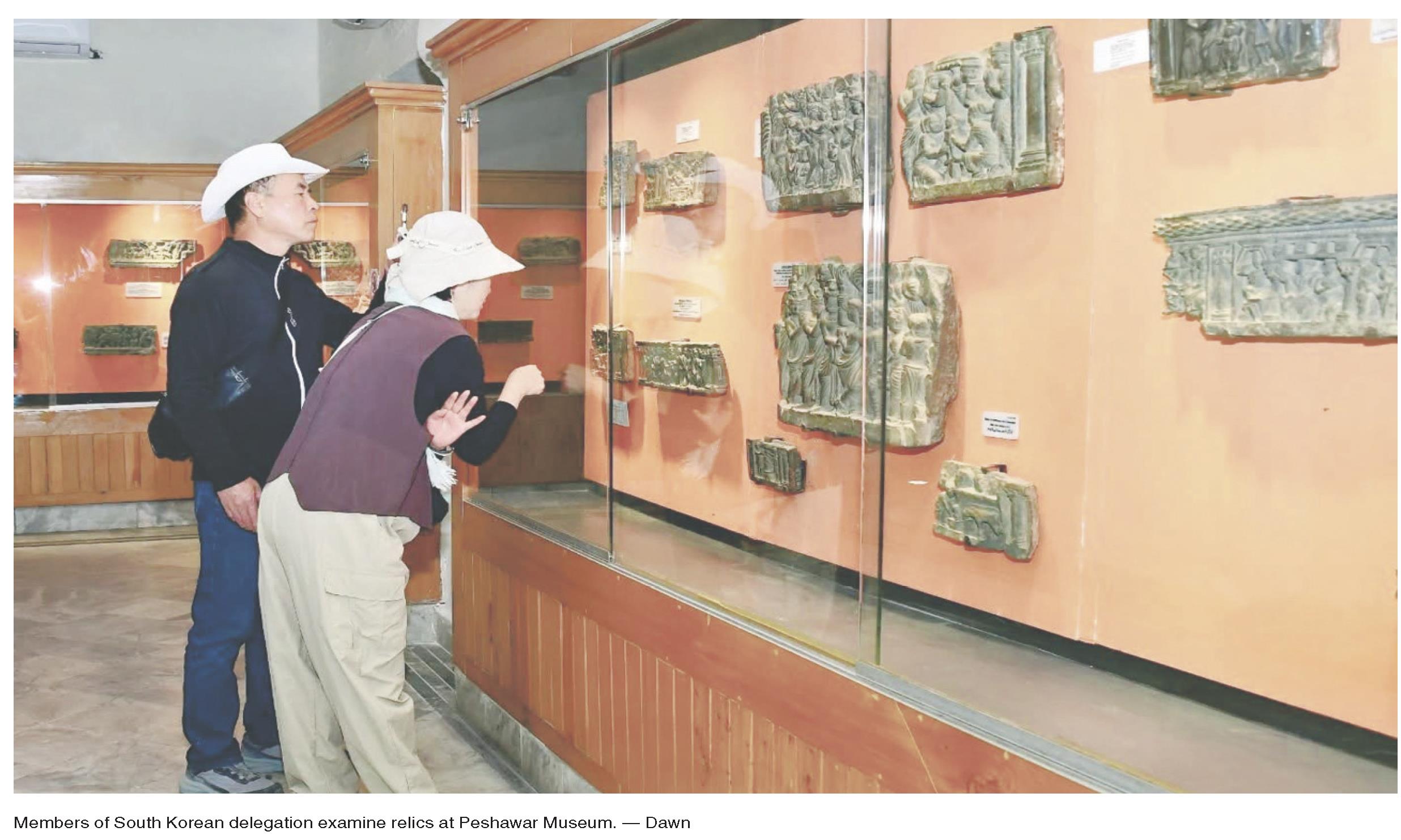
PESHAWAR: A delegation of tourists, historians and cultural enthusiasts from South Korea visited the historic Peshawar Museum the other day, immersing themselves in its world-renowned collection of ancient Gandhara art and tracing the region’s profound, deep-rooted Buddhist roots.
The visitors spent hours navigating the museum’s majestic main hall originally constructed in 1907 as Victoria Hall during the British colonial era examining rare schist stone sculptures, sacred Buddha relics, ancient coins, terracotta figurines, and intricate panels depicting the life, birth, and spiritual journey of Prince Siddhartha.
Mesmerised by the historical craftsmanship and the meticulous display of antiquities unearthed from key archaeological sites like Takht-i-Bahi, Sahri Bahlol, and Jamal Garhi, members of the South Korean delegation expressed deep reverence for the sacred artefacts preserved within the facility.
‘Standing among these ancient masterpieces feels like walking directly through the very origins of Mahayana Buddhism,’ a visiting guest told Dawn, reflecting on the emotional impact of the tour.
‘The shared spiritual history carved into these stones connects Northeast Asia with ancient Gandhara in ways that remain deeply moving. It is an unforgettable privilege to witness how carefully Pakistan has guarded these sacred relics for global pilgrims and history lovers alike,’ he said.
During their comprehensive walkthrough, the delegation members also commended the provincial government for maintaining the iconic redbrick architecture and protecting the diverse non-Islamic her-itage scattered across Khyber Pakhtunkhwa. They particularly praised the Directorate General of Archaeology and Museums for maintaining high standards of curation and conservation.
Briefing the foreign delegates, the Director General of Archaeology and Museums, Dr Abdul Samad, underscored the provincial government’s broader commitment to historical preservation, international cultural outreach, and the promotion of global heritage tourism.
‘Pakistan is a proud and diverse custodian of multicultural heritage, and every stone in Gandhara tells an extraordinary story of human civilisation,’ Dr Samad informed the visitors.
‘Our top priority remains the scientific preservation of these historical sites alongside actively promoting religious tourism. By opening our doors to international delegations and scholars, we are successfully showing the world Pakistan’s true, peaceful identity as a welcoming hub of shared history,’ he said.
Senior museum curators and officials also informed the South Korean guests that ongoing systematic documentation, digital archiving projects, and advanced structural restoration works are currently underway.
These initiatives are specifically designed to facilitate international researchers, historians, and Buddhist pilgrims who frequent the province.
At the conclusion of their guided tour, the South Korean group expressed optimism that enhanced cultural exchanges, heritage partnerships, and targeted religious tourism initiatives would continue to deepen bilateral relations and foster mutualunderstandingbetween the two nations in the coming years.