
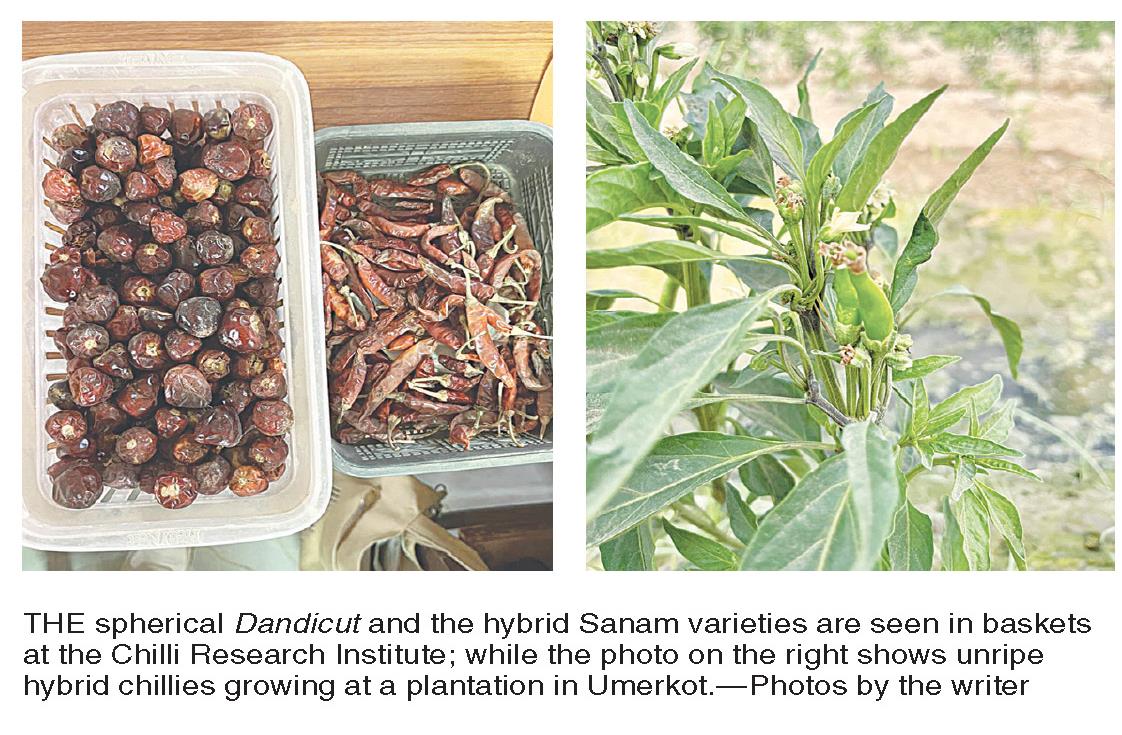
THE story goes that in the 1960s, a handful of chilli seeds travelled south from Radha Ram in Punjab to Kunri in Sindh. Harvest after harvest proved so successful that, within two decades, the town shot to fame as the red chilli capital of Asia.
The farmers put their fortune down to divine largesse but the scientific explanation is far more mundane: Kunri simply had the exactly the right climate for a brief window of time partially humid and partially dry for its soils to produce one variety of chili that cannot be grown anywhere else in the world.
That chilli is Dundicut or Longi, which when plucked comes off without the stem, hence the name. Thislittle fighter registers between 30,000 and 35,000 Scoville heat units which measure the concentration of natural capsaicin. Its aroma is so distinctive that it can be identified from afar by the breath-stopping kick it delivers to the top of the nose.
But it has more bark than bite.
Abbas Datwesh, a grower, picks a button-shaped one, pops it into his mouth and chews it as proof. ‘See, he says, ‘it’s the flavour not too spicy, not at all bitter.
‘This is what the world wants, says grower and exporter Hamayoon Sattar.
Kunri’s Mirch Mandi wholesale market trades over 100,000 tonnes of chillies every year.
Here, bag after bag of dried chillies are stacked against the walls of the godowns.One of the sacks is ripped so a handful of dried chillies can be coaxed out. They are a mature red, but covered in blisters that look like cigarette burns. It is Sanam, the hybrid variety.
The sacks of Longi mirch, on the other hand, are locked away inside the godowns, like treasure, for the few who know its value.
But sales of the original are collapsing. Its harvests have more than halved for two reasons: it doesn’t make enough money and hybrid seeds do. Dundicut/Longi earns Rs100,000 in profit per acre, but the hybrid Sanam seed rakes in eight times that.
Nostalgic farmers keep growing Dundicut for their own kitchen, but are finding it harder to justify the losses. As grower Abdul Jabbar puts it, ‘We haven’t abandoned our indigenous variety, our identity, Kunri’s identity. We are still very much waging this war with all the know-how and resources that we have.
But the real crisis is that the nation’s favourite chilli, which once made Pakistan the world’s fifth largest exporter, contains a major carcinogen.
Aflatoxin B1 is a naturally occurring compound produced by the mold Aspergillus flavus, which d evelops in decaying vegetation and soil.
It is classified as a Group 1 carcinogen, the highest category of confirmed cancer-causing agents, by the International Agency for Research on Cancer. Long-term exposure to it is associated with hepatocellular carcinoma and liver cancer.
Aflatoxin B1 is one of the most potent naturally occurring poisons known to science, and it is present in theredchillipowdersoldinPakistan.
The European Union’s legal maximum limit for aflatoxin B1 in driedchillies is five micrograms per kilogram and 10 µg/kg for total aflatoxins. However, Pakistani ground and crushed chilli products routinely show concentrations exceeding 80-90µg/kg eight to nine times the EU’s total aflatoxin limit.
The consequences of this contamination are well-documented, says Dr Mohammed Siddiqui of the Pakistan Agriculture Research Council (PARC). Pakistani shipments have been returned; and buyers in regulated markets such as Europe and parts of the Gulf just look elsewhere for supplies.
There is a detail in local packaging for certain branded chilli powder products that once you know, you cannot unsee. Their labels say: intended only for consumption within Pakistan. They can’t be sold abroad because they fail internationalsafety standards.
Contamination Contamination begins in the field. After the harvest, the chillies spend days drying on the bare ground or soil. The air is rarely clean because a fine haze of sand rides in on the wind from Thar tosettle on everything in sight.
During the day, the chillies absorb dust and heat. At night, they absorb humidity. If they are packed in plastic bags to be transported to the vegetable market, fungus develops when the moisture mixes with the carbon dioxide that is released by a freshly picked chilli. According to PARC’s Dr Siddiqui, their quality starts deteriorating from thereon.
Farmers sometimes cause more damage when they stand on top of the chillies as they transport them to market in carts.
An effort has been made to reduce contamination by ending open-ground drying. One experiment was with a solar tunnel dryer made of steel rods, sheets, a solar plate, battery, exhaust fan, and 100 drying trays.
Traditional drying takes up to two weeks but the solar tunnel does it in five days, in controlled conditions. Aflatoxin levels fall, quality rises and the prices improve.
Hybrid seeds In the Longi fields, farmers practice what international donoragencies would normally celebrate as an environmentally sustainable practice.
When one particular plant shows extraordinary strength by standing taller than the rest, fruiting fuller, developing a deep vermillion red, the farmer will tie a strip of white cloth around its stem so it stands out in a sea of green. At harvest time, this plant’s seeds are separated from the rest, dried, and stored for next season when they go back in the ground.
‘You watch the plant,’ Jabbar says. ‘You know which one will give you something good.’ Over generations, this technique has produced varieties finely tuned to their environment, soil, rainfall and tem-perature.
Hybrid seeds make this impossible, because you have to keep buying new ones each season as they are cruelly engineered to produce inconsistent, lower-yielding offspring.
Despite this, the more profitable Sanam crops persist as far as the eye can see in Kunri. Unlike the fat Dundicuts, these are long-fingered ruby pods that droop from short but upright stems.
These hybrid seeds come from Thailand, Malaysia, Indonesia, China, South Korea, and India (via Dubai) and farmers tend to prefer these varieties.
‘Their focus is on yield. Not on taste, not on aroma, but yield,’ saysDr Shahan Aziz, a food scientist at the University of Karachi.
The flavour profile the capsaicin, the aroma compounds, the particular heat that made the Dundicut famous is not part of the breeding brief. The resulting generation, called F1, carries the dominant characteristics ofbothparents such as higher yield, more uniform fruiting and greater disease resistance, but doesn’t taste the same.
This article is a condensed version of an investigative report by Dawn’steam. A detailed version can be accessed on Dawn.com