
ISLAMABAD: A group show at Gallery6 brings together a diverse group of contemporary practitioners, each exploring the human figure in their own way.
Some obscure it, others distort it, and a few push it to the edge of abstraction.Throughthisrange ofapproaches, the participating artists of ‘Figure, Form and Field’, examine how the body continues to hold meaning in modern art, standing at the crossroads of tradition and experimentation.
Curator Sadia Gul articulates this premise succinctly: ‘A figure is never just a body. It is a record of what shaped it, what it carries, and what it chooses to conceal.’ The most compelling works, particularly Behzad Ahmed Warsi’s hybrid animal portraits and Hassan Rana’s intricate dioramas, achieve a rare balance of conceptual depth and emotional power. Warsi uses animal and human figures to explore identity, occupation, vulnerability, and defiance with subtlety. In his ‘Veil of Resilience’ series, he reflects on the fragility of life through human and animal forms, colour, and shadow.
‘The Face of Oppression’ shows a r e d c1a d,standout faceless image behind a tiger shrouded by a dark keffiyeh. The composition is an evocation of endurance under siege that feels both timeless and urgently tied to the current crisis in Gaza. Warsi’s apprenticeship under Shahid Rassam grounds his work in genuine depth. As he states: ‘I am drawn to the courage that existsbeneath stillness: the instinct to endure, to remain, and to rise.’ Hassan Rana removes the human figure altogether.
His dioramas of weathered architecturalsurfacescreate spaces thatinvite contemplation without narrative resolution. In his recent works such as ‘Drift’, ‘Suspended’, and ‘Intuition’, heconstructs miniature envir onments of f r a g m e n t e d archite cture that b e e o m e thresholds into limi-nalpsychologicalspace.
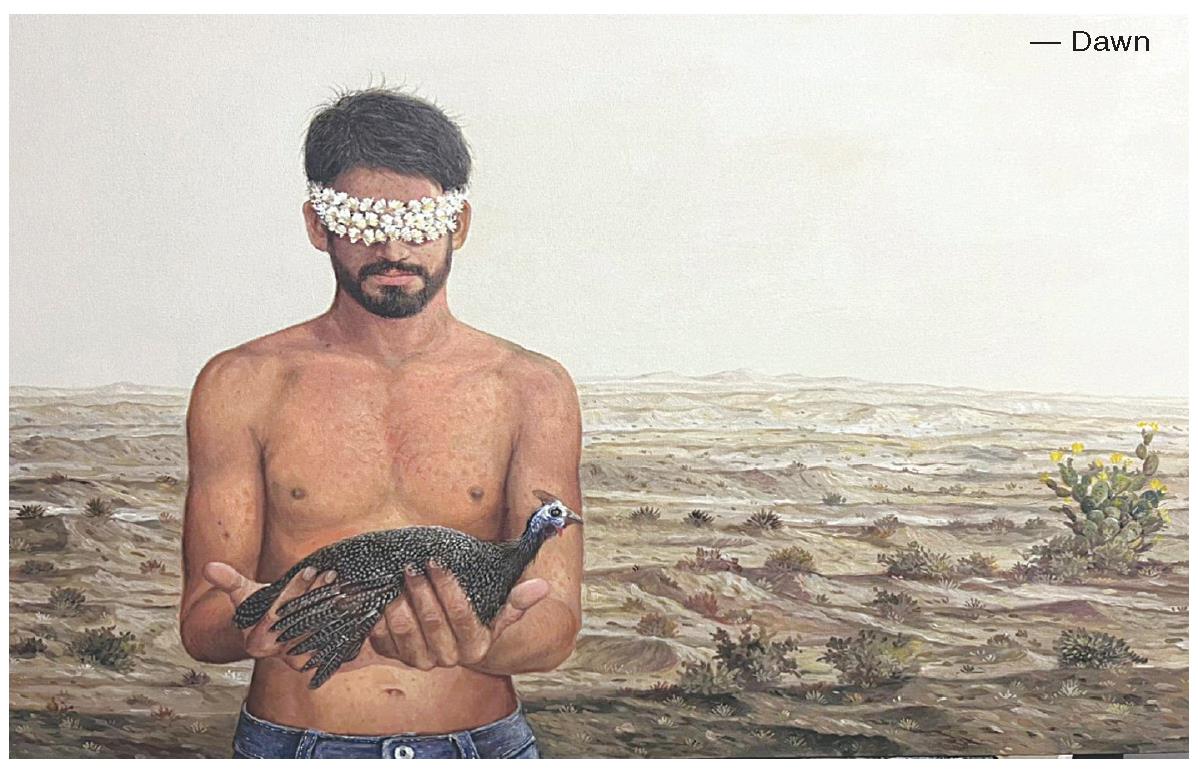
Asif Hussain’s work inhabits the fragile space of unfulfilled longing, weaving quiet symbolism from Punjabi folklore.
His recurring motifs-the guinea fowl and the spectral groom-are set against barren landscapes that evoke separation. His strongest pieces trust the bird’s contemplative stillness, allowing its gaze at an unreachable moon to carry the weight of love and loss.
Asrar Faroogi transforms urban cityscapes into emotional impressions, bringing an Impressionist sensibility to scenes like balloon sellers and bazaars. Jawad Ahmed Jan’s large, pale canvases featuring a recurring green netting pattern are outstanding fortheir conceptualboldness.
Nimra Ansar Khatana explores cultural memory by integrating Phulkari embroidery passed down through the women in her family onto birds and animals.
In her crow paintings, delicate white motifs graft onto black-and-grey plumage.
Through ‘Hero No. 1’, she deploys irony to interrogate authority, with the work sitting at the meeting point of ‘serenity and melancholy’.
In ‘The Weight of Uncertainty’, a reclining woman surrounded by goldfish presents serenity punctuated by melancholy, though the composition occasionally becomes overly static.
Samiya Mahir Sheikh uses canvas as a site of introspection and rebellion, blending satire and symbolism.
In works like ‘Mirror, Mirror Who Made Me’, she assembles identity as ‘a mirror in motion,’ where animals, music, and satire collide.