
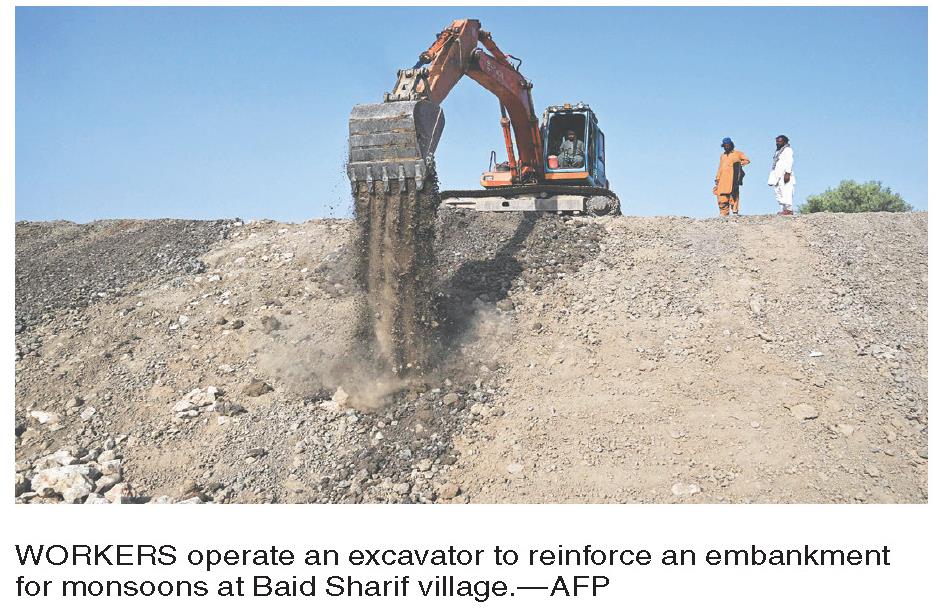
JACOBABAD: In a Pakistani village nestled in rice fields, Abdul Hafeez Khoso remembers the vast industrial zones he saw in Germany when he visited to file a pioneering climate legal case.
‘They’re spreading pollution: up in the sky there are no borders, it can affect anywhere,’ the 43-year-old said, describing areas far larger than his village of 800 people.
‘This is a problem for the whole world that is why it should be resolved at the global level.’ Mr Khoso and 38 other farmers from Pakistan’s southern Sindh province who were devastated by ‘apocalyptic’ flooding in 2022 are suing German energy firm RWE and cement maker HeidelbergMaterials in a rare bid to make big polluters pay damages for climate impacts.
The lawsuit argues that the companies’ emissions contributed to climate change and intensified rain that wiped out their crops, livestock and homes.
They are being targeted over their climate-warming emissions, rather than specific operations in Pakistan. They are headquartered in Germany, where a recent legal case opened the door to such suits.
‘The year 2022 was an apocalyptic scene; not even our elders had ever witnessed such weather,’ Mr Khoso, who lives in Jacobabad district with his wife and toddler, told AFP. ‘We had noth-ingleft,’ he added.
Backed by Pakistani and European organisations, the case seeks compensation andbuilds on international efforts to extract climate damages from corporations.
Climate litigation haslargely targeted governments.
Lawyers say a ruling requiring a company to pay compensation proportionate to its greenhouse gas emissions would mark a major breakthrough.
Germany’s judiciary moved toward that principle in a case brought by a Peruvian farmer against RWE. His compensation claim was rejected, but the courts left the door open to holding emitters liable.
Roda Verheyen, a German lawyer involved in both cases, said the Pakistani farmers’ lawsuit builds on that ruling and accuses companies of ‘wrongful behaviour’.
‘Large companies knew about the general impacts of climate change since the 1960s,’ she said.The lawsuit also draws on research documenting farmers’ losses in floods that hit a third of Pakistan, killed 1,700 people and affected 30 million.
In Dadu district, plaintiff Abdul Khalique Laghari, 55, estimates he lost $14,000 in assets, including his house, 40 acres of crops and livestock.
‘To this day, we are unable to repay our debt,’ he said, pointing to crumbling walls and remnants of flood-damaged houses.
‘This has caused us serious mentalharm.
However, RWE and Heidelberg Materials call the claims ‘unfounded’.
Heidelberg Materials said its operations complied with German laws and firms could not be expected to retroac-tively face different standards, while RWE called the lawsuit ‘yet another attempt to shift climate policy demands to German courtrooms’. It said allowing emissions while permitting retroactive civil liability would be contradictory.
The civil case is likely to take years. But for the litigants, the attempt is worth it.
Munawar Khatoon said the floods wiped out her family’s main source of income. ‘We worry about how the next generation will manage to live if this continues,’ said the 43-year-old landowner in her village, Usman Samtio.
‘This case is for justice, she added. ‘We hold these companies responsible for our destruction’-AFP