
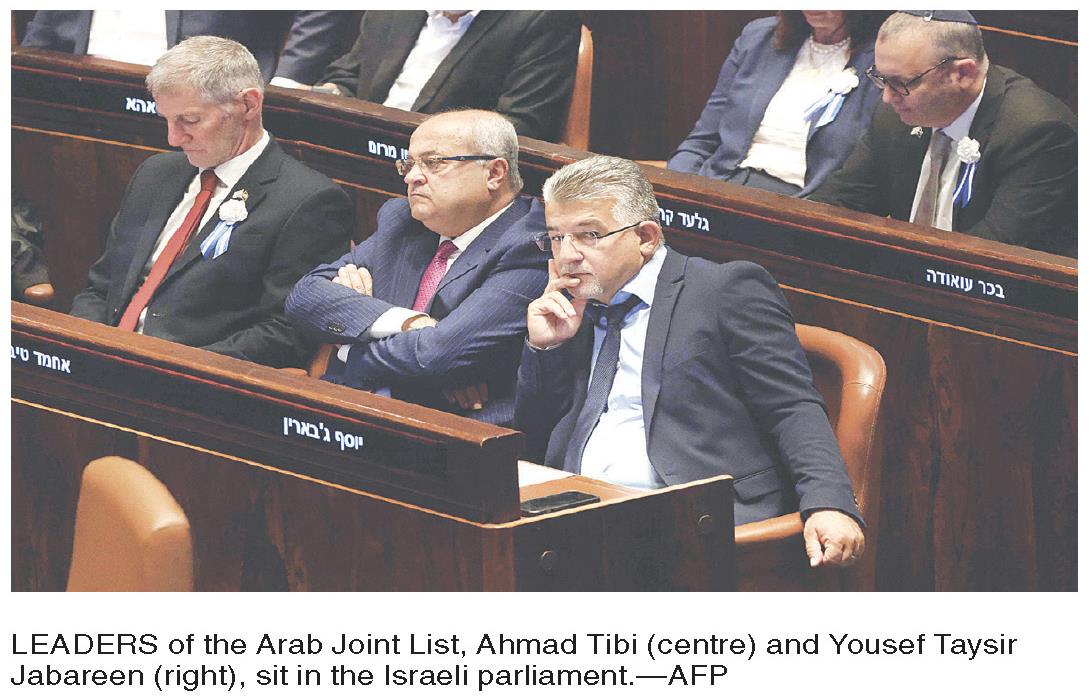
JERUSALEM: Tensions ran high at the first session of Israel’s parliament on Tuesday as old and new party leaders traded barbs over the possibility of forming a government with the support of Arab lists.
Two Arab parties, the Joint List and Raam, won an unprecedented 19 seats out of the parliament’s 120 in the Oct 27 election, putting them in a position of kingmakers. But in both camps, some view a government that relies on their support with deep suspicion.
During the swearing-in of the new parliament on Tuesday, farright Israeli leader Itamar Ben Gvir heckled a prominent leader of the Arab-Israeli community.
‘Who is he pledging allegiance to, Hamas?’ Ben Gvir shouted at Yousef Jabareen, leader of the largest Arab-majority Joint List.
‘Anyone who is not loyal shall not be in the Israeli Knesset!’ (parliament) he wrote on X shortly after.A number of lawmakers from the Joint List left the hall during the Israeli anthem, apparently to avoidstanding up for it. The act of protest caused a stir in the chamber.
Netanyahu himself, in a speechduring the ceremony, lamented that the two main Arab parties refuse to recognise Israel as a Jewish state even though Raam leader Mansour Abbas has done so in the past and claimed they sought to establish an ‘Islamic state’ or a ‘nationalist Palestinian state... on the ruins of the Jewish state’.
The inauguration comes at a time of political uncertainty, with neither of the two main blocs having secured a majority. President Isaac Herzog tasked ex-army chief Gadi Eisenkot with forming a new government on Sunday, following consultations with party leaders last week during which a majority recommended him.
Legislative onslaught On Tuesday, Eisenkot and his allies launched a legislative onslaught against caretaker Prime Minister Netanyahu’s legacy.
Though questions still linger as towho can form a government, Eisenkot’s broad left-to-right bloc wasted no time in setting the agenda of the new Knesset with a green light from Israeli-Arab lawmakers, whose role has stirred up heated opposition from Netanyahu’s base and even right-wing supporters of Eisenkot.
Eisenkot’s Yashar party said it submitted a slew of proposals before the new parliament, including establishing an independent commission to investigate security failures that allowed the Hamas attack on Oct 7, 2023, the deadliest day in Israel’s history.
Netanyahu has long opposed such a probe, denying any wrongdoing and calling instead for a politically appointed commission.
Eisenkot’s party also moved for a sweeping repeal of a judicial overhaul implemented by Netanyahu’s government, which had triggered some of Israel’s largest-ever protestsbefore being overshadowed by three years of war.
Setting the stage for legislative action, Eisenkot’s bloc announced it had secured the votes to install a new parliament speaker, Matan Kahana, also a former senior military figure.
But neither Eisenkot nor Netanyahu has the 61 votes needed to form a government.
‘I am committed in this complex situation to form a national-emergency government as quickly as possible,’ Eisenkot, a low-key 66-yearold who only recently entered politics, said before his swearing-in.
Netanyahu, speaking after the inaugural session, made a new push for a national-unity government, saying Israel needed to confront a threat from Iran’s clerical government, which has survived two major Israeli bombing campaigns the premier ordered with support from US President Donald Trump.-AFP