
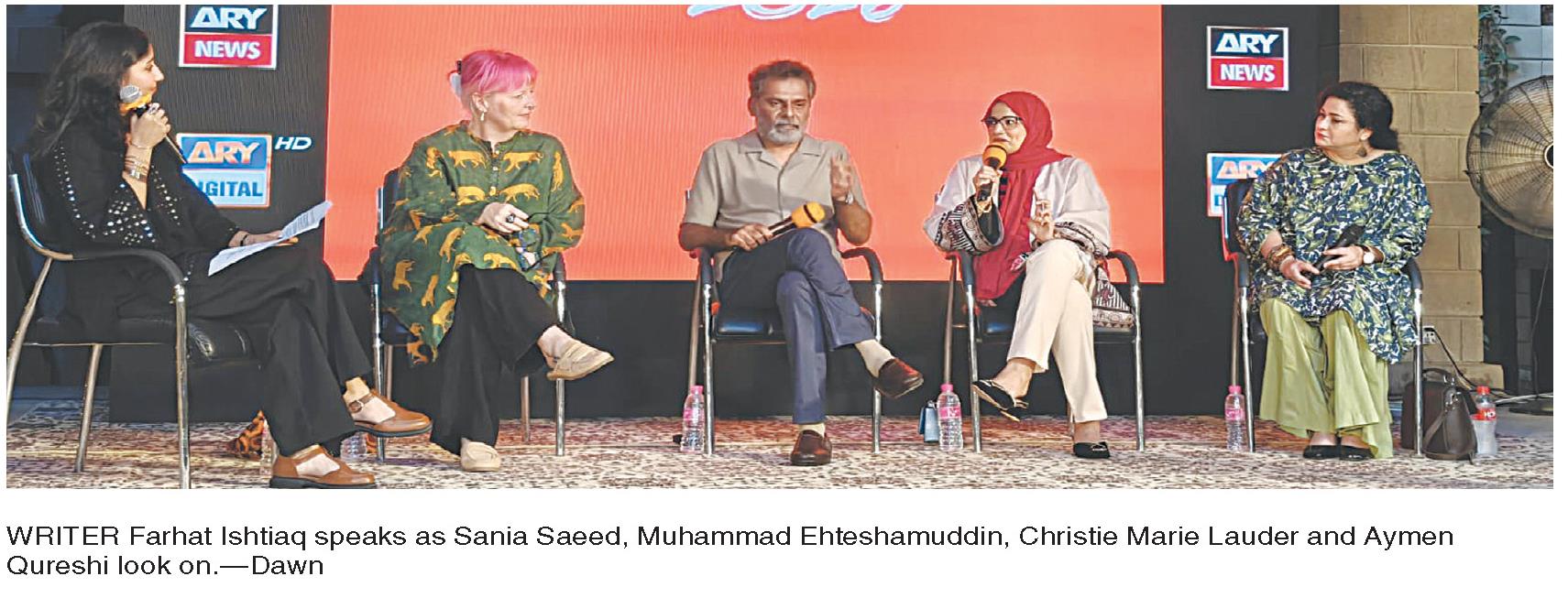
KARACHI: The fourth edition of the IVS Film Festival (IVSFF2026) opened on Friday at the Indus Valley School of Art and Architecture (IVS) with a compelling panel discussion exploring the journey of stories from the written page to the screen.
Titled ‘How Stories Travel: From Literature to Film,’ the panel featured acclaimed actor Sania Saeed, writer Farhat Ishtiaq, director and actor Muhammad Ehteshamuddin and academic and journalist Christie Marie Lauder, with the conversation moderated by Aymen Qureshi.
The panel examined the creative, cultural and practical challenges of adapting literature for film and television, as well as the restrictions and possibilities that influence storytelling in Pakistan.
Reflecting on what literature has meant to her as an actor, Sania Saeed spoke about how the books she encountered early in life, many of them translated works dealing withwar, childhood and human struggle, influenced her approach to her craft and her understanding of people.
Speaking about her role as Safia in Manto, she recalled being deeply conscious of the responsibility of portraying a real woman whose daughters were still alive. She said that she ultimately found Safia in the ‘hidden women’ she had encountered throughout her life.
She noted that literature allowsaudiences to engage with a world through their own imagination, while screen narratives place greater emphasis on the characters and their performance.
For Farhat Ishtiaq, adapting literature for television involves difficult choices.
She noted that while novelists can engage readers through their words and world-building, television places the characters at the centre of thenarrative. ‘Adaptation therefore requires writers to make compromises and respond to the sentiments and expectations of their audiences.
The conversation alsoturnedtothe question of creative freedom and censorship in Pakistan.
Ehteshamuddin spoke candidly about the restrictions filmmakers face when attempting to tell stories that engage with sensitive subjects.
He argued that filmmakers often findthemselves confined to stories of the home and family because subjects such as religion and politics can be difficult to address openly. He also stressed the importance of fighting for the stories filmmakers believe need to be told.
Ms Lauder approached censorship from an academic perspective, reflecting on how restrictions on what can be discussed in educational spaces can affect students and their understanding of the world. She emphasised the need for greater breadth of representation and exposure, particularly for young people developing their own creative and critical perspectives.
The panel concluded with a call to the next generation of Pakistani storytellers to explore the country’s realities and tell authentic local stories.
The opening discussion set the tone for a festival centred on learning, experimentation and the future of Pakistani storytelling. Over the next two days, IVSFF2026 will screen 33 short films by emerging filmmakers from across Pakistan, alongside workshops and conversations with leading voices from the country’s film and media industries, said a press release issued here on Friday.