
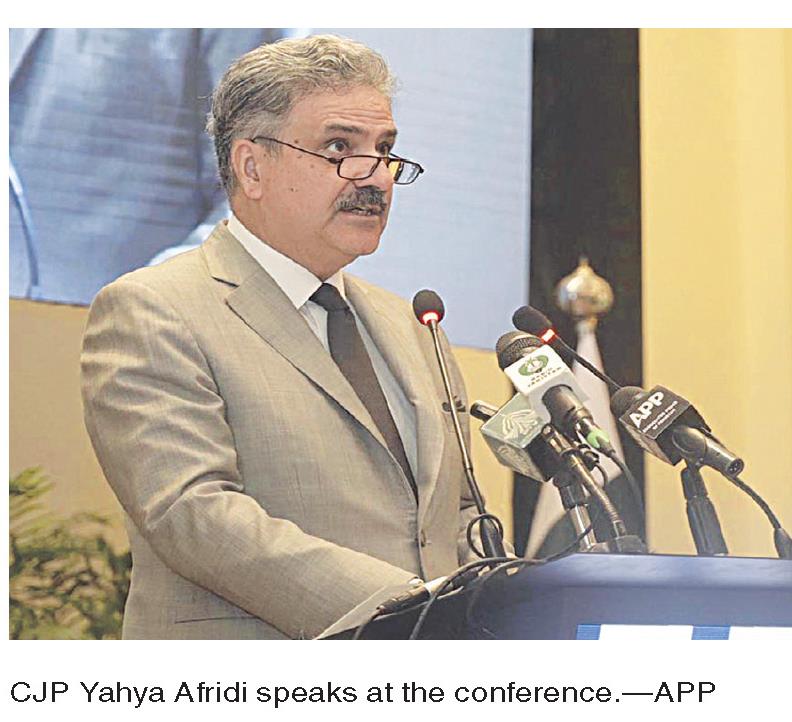
ISLAMABAD: Chief Justice of Pakistan (CJP) Yahya Afridi, speaking at a conference on Saturday, emphasised that public confidence in the judiciary was neither inherited nor proclaimed, but earned through integrity, competence, fairness, compassion and, above all, institutions that empowered judges to perform their duties independently and with excellence.
‘Judges are called upon every day to decide matters relating to the life, liberty and rights of citizens, often under immense pressure,’ the CJP said, adding that judicial well-being was therefore not a personal comfort but an institutional responsibility essential to judicial independence and the effective administration of justice.
The CJP was speaking at the National Judicial Wellbeing Conference: From Reform to Recognition, organised to commemorate the International Day for Judicial Wellbeing, a day also acknowledged by the United Nations General Assembly.
The CJP appreciated the young and brave judges of the district judiciary, saying they possessed admirable virtues. Their conviction and dedication to service at the remotestjudicial outposts, often under dire conditions, deserved acknowledgement and appreciation,he said.
The CJP recalled changes made to the Code of Conduct for judges to ensure a set procedurefor dealing with extraneous influence on judicial officers. The process entailed supervision not only by the high courts but also by the CJP himself.
‘This means that if there is even the slightest bit of influence upon a judicial officer, the CJP himself will be standing with them,’ he said.
Institutional support The CJP announced that all tehsil courts in Punjab, Sindh, Khyber Pakhtunkhwa and Islamabad had been solarised, while the 18 districts of Balochistan would soon be provided with the equipment, as assured by the chief justice ofthe Balochistan High Court, within the next 30 days.
He recalled that during visits to remote areas of the country soon after assuming office, he had realised there was a disconnect between the district judiciary and the National Judicial PolicyMaking Committee (NJPMC), the apex policymaking body.
Previously, projects proposed by the district judiciary took three to four months for approval.
By the time approval was granted, costs had usually escalated, meaning the projects were often never completed.
Consequently, the NJPMC decided to appoint additional secretaries for each province from the district judiciary to serve as a link between district courts, the respective high courts and the NJPMC.It also decided that projects submitted by a district judge should be approved and their funds disbursed within 21 days.
The NJPMC asked the district judiciary to submit a wish list, which identified four essential requirements: uninterrupted electricity, internet connectivity, facilities for women visiting district courts and clean drinking water.
The CJP stressed that he was referring to the remotest areas of the country, rather than metropolitan cities, where women sometimes lacked even basic facilities.
Consequently, the NJPMC allocated funds this year for the four essential requirements.
The CJP noted that during the 20 years since the establishment of the Access to Justice Funds (AJF), a total of Rs900 million had been disbursed. In contrast, Rs3.4 billion had been allocated in one year for the four projects, including e-libraries, internet connectivity, water and women facilitation centres.
The CJP reiterated that the district judiciary would remain a central priority of the judicial reform agenda, with continued focus on judicial well-being, professional support, time-bound adjudication, improved infrastructure, technologyenabled services, institutional accountability and citizen-centric public facilitation.