
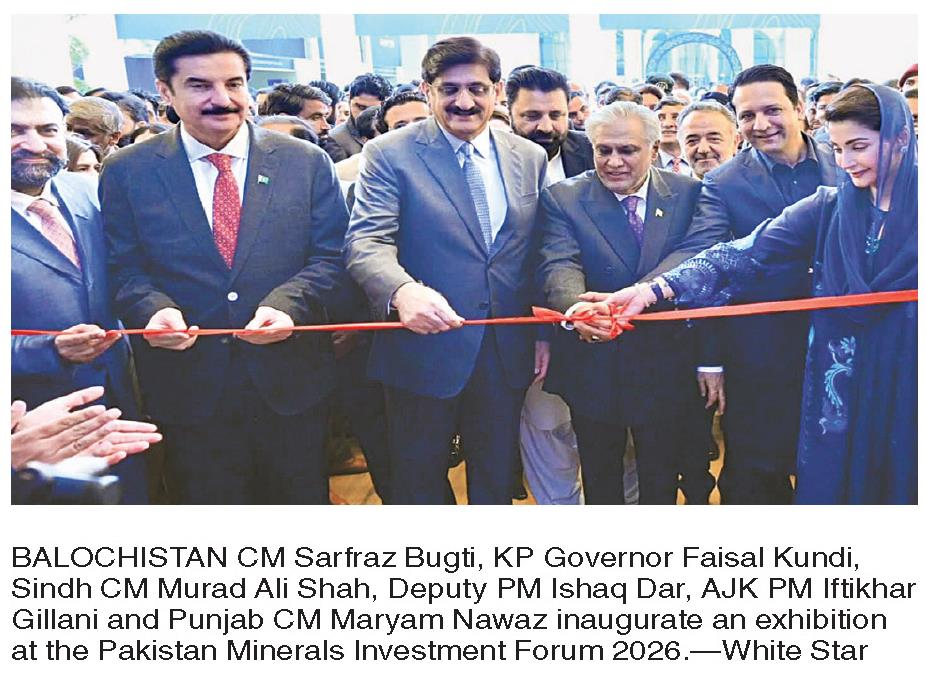
ISLAMABAD: Pakistan on Thursday showcased its vast mineral resources, ranging from coal and salt to gold and critical minerals, to attract international investment, promising predictable, investor-friendly policies, institutional support and security.
The investment pitch was made on the opening day of thetwo-dayPakistanMinerals Investment Forum 2026 (PMIF26) by Deputy Prime Minister and Foreign Minister Ishaq Dar and Finance Minister Muhammad Aurangzeb, while leaders from all four provinces, Azad Jammu and Kashmir (AJK) and Gilgit-Baltistan highlighted their respective min-eral resources and investment opportunities.
‘The forum broughttogether delegations from 60 countries, 122 exhibitors and over 5,000 attendees on thefirst day,’ including diplomats and representatives of international financial institutions and the global mining industry, said the state-run Oil and Gas Development Company Limited (OGDCL), the event’s organiser.
Inaugurating the forum and its international exhibition, Mr Dar reaffirmed Pakistan’s commitment to creating a predictable, investor-friendly environment for the mining sector through institutional facilitation and policy reforms.
He said the government had made mineral development a strategicnationaleconomicpriority, as the sector was essential to diversifying exports, strengthening the industrial base and mobilising domestic and foreign investment.’Our ambition is clear: to develop Pakistan’s mineral resources responsibly, strengthen our industrial base, diversify our exports, empower our provinces and communities and establish Pakistan as a competitive and trusted partner in the global minerals economy,’ Mr Dar said.He highlighted Pakistan’s copper and gold potential along the Tethyan Metallogenic Belt, as well as deposits of iron ore, chromite, lead, zinc, coal, rock salt, marble, gypsum and gemstones.
He cited the Reko Dig copper-gold projeet in Balochist anas an example of collaboration involving international expertise, national participation and provincial ownership.
Mr Dar said growing global demand for minerals used in clean energy, electric vehicles, battery storage and advanced technologies had created new opportunities for Pakistan.
He said provincial governments would play a greater role in ensuring that mineral development generated local employment, skills, infrastructure and wider economic benefits while maintaining environmental standards.
Petroleum Secretary Hamed Yaqoob Sheikh said the launch of the National Mineral Data Centre, GSP Geoportal and Agreement Exchange at the forum would strengthen institutional capacity, improve access to geological information and facilitate cooperation in the mining sector.
In his keynote address, Finance Minister Muhammad Aurangzeb highlighted progress in restoring macroeconomic stability, citing a fiscal deficit at a 22-year low, three consecutive years of primary surpluses and foreign exchange reserves of $21.5 billion, equivalent to more than three months of import cover.
He said improved fiscal and external buffers had helped the country withstand economic challenges, while recent credit rating upgrades and access to international capital markets reflected growing investor confidence.
However, he stressed that sustaining these gains would depend on structural reforms and a shift towards export-led growth rather than consumption-driven expansion. Mr Aurangzeb said mining could become a major driver of sustainable growth, exports and investment. He highlighted the availability of profit and dividend repatriation facilities for investors and stressed the importance of strengthening domestic investment to attract foreign capital. He also reaffirmed the government’s commitment to maintaining reform momentum and creating conditions for long-term investment.
Provinces showcase mineral potential During a session titled ‘Provincial Prospectivity to Prosperity’, provincial leaders presented their mineral resources and investment plans. Punjab CM Maryam Nawaz invited investors to explore the province’s mineral wealth, announcing financial incentives, interestfree loans and one-window facilities to encourage investment and value addition.
She said revenue from Punjab’s Mines and Minerals Department had increased from Rs10bn to Rs40bn in just over two years. Highlighting resources including emeralds, marble, granite, gold, gemstones, copper, pink salt and iron ore, she outlined measures such as concessional land leases, financing of up to Rs5bn with the provincial government bearing the interest cost, and incentives for eligible investors in designated industrial estates.
CM Maryam said placer gold deposits had been identified in Punjab’s rivers and surveys were underway to determine their quantity. She added that Chiniot had an estimated 261.5 million tonnes of iron ore, which could be processed into steel through domestic facilities.
Sindh Chief Minister Murad Ali Shah invited domestic and international investors to explore the province’s mineral wealth, saying Sindh had identified 27 minerals and was promoting scientific exploration, responsible mining andvalue addition.
He described Thar coal as the province’s major mineral asset and highlighted public-private partnerships and Chinese cooperation in developing the resource. He also highlighted Sindh’s regulatory framework, open auction process for mineral concessions and the Sindh Business One Stop Shop portal for investor facilitation.
Balochistan Chief Minister Sarfraz Bugti assured investors of a secure environment and invited them to partner with the provincial government in developing its mineral and energy resources.
KP Governor Faisal Karim Kundi also invited domestic and international companies to invest in the province’s mineral sector, promising security and one-window facilitation.
AJK Prime Minister Iftikhar Ali Gillani said the region had significant untapped mineral potential, including ruby, tourmaline, topaz, granite, coal and bauxite. He invited companies specialising in high-altitude mining to explore investment opportunities and said the government was aligning it s mining legislation with the regulatory framework being developed across the country.
Gilgit-Baltistan Chief Minister Amjad Hussain also invited international investors to explore the region’s largely untapped mineral resources, including precious minerals, metals, dimension stones and placer gold. He said the region had introduced an online portal for mining licences, but acknowledged that poor connectivity and energy shortages remained major obstacles to investment.
Exploration financing The forum’s business sessions focused on financing early-stage mineral exploration, developing new mining projects and strengthening geological survey cooperation. A session on exploration financing brought together representatives of the Asian Development Bank, International Resources Holding, Globacore Minerals and M. Klein and Company.
Another session examined emerging mining projects and the requirements for bringing discoveries into commercial production. A separate discussion involving the Geological Survey of Pakistan and geological institutions from Germany, Turkiye and China explored data sharing, technical cooperation and ways to reduce exploration risks.
Alongside the conference, PMIF26 featured an international exhibition with 122 exhibitors showcasing mining equipment, technologies and services.
Major exhibitors included Barrick Mining Corporation, National Resources Limited, Globacore Minerals, China Molybdenum/MCE, Komatsu, Allied CAT, Mari Energies, Pakistan Petroleum Limited, Pakistan Mineral Development Corporation, Metso, Siemens, ABB, Weir, Xinhai, Orica/Biafo Industries and Wah Nobel Group.