
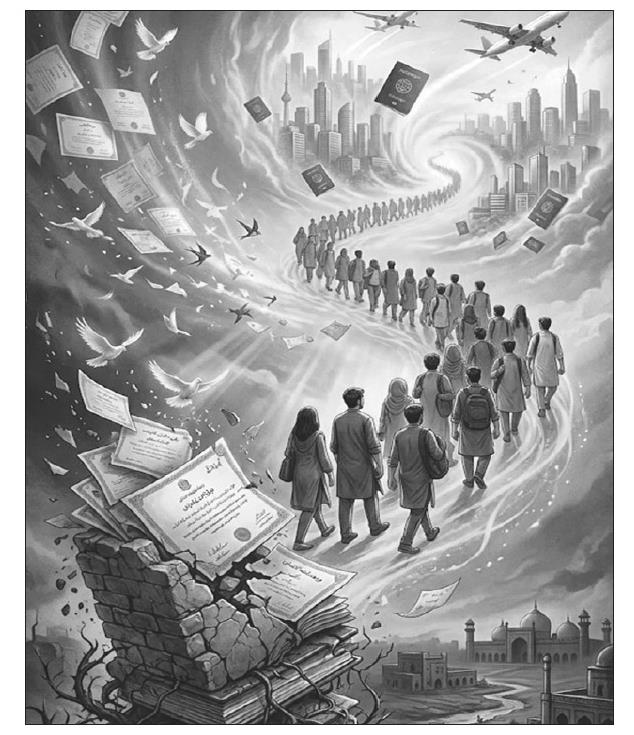
YOUNG, educated men and women leave Pakistan every day because the country has failed to carve out a space for them to breathe, work and grow. This is a tragedy unfolding quietly. As a daughter of Balochistan, I witness this daily. I see our young men standing in endless immigration lines, and our brilliant young women sitting at home, watching their hard-earned degrees gather dust. The trajectory of a student in Balochistan is painful.
Students dedicate 16 years of their lives to education, fuelled by the promise that hard work paves the way for a secure future.
They graduate, but struggle to step into a career. What follows is a soul-crushing reality: highly qualified graduates continue to perform menial chores at home, while aging fathers continue to bend their backs to keep the kitchen running.
This tragedy is compounded by a deeply broken system. In Balochistan, employment is rarely the reward for talent and grit; instead, lucrative opportunities are gatekept by the powerful, while the poor but brilliant students are pushed to the sidelines.
Even on the rare occasion that a graduate does secure a job, the starting salary hovers around a meagre Rs36,000. In an era of hyper-inflation, surviving on this amount is not a livelihood; it is a slow, agonising economic strangulation.
When a young person looks abroad, they see an escape from this undignified struggle. Overseas, their labour translates into stable currency, a liveable wage, a secure future, and a peaceful environment for their children. Fleeing the country is not a luxury; it is a desperate act of survival, a harsh compulsion.
Yet, this mass exodus leaves behind a bleeding homeland. If our doctors, teachers, engineers, and thinkers all board flights out of the country, who will heal our sick, educate our children, and nurture the soilof Balochistan? If the state wishes to stop this catastrophic brain drain, it must move past empty rhetoric and take immediate, structural action. The government is directly responsible for the economic safety of its educated populace. To anchor the youth to their homeland, a decisive blueprint must be implemented.
First, every university graduate must be funnelled into a structured internship, placement programme, or entry-level job immediately upon graduation to eliminate the agonising waiting period. Second, the state must actively stimulate local economies by funding small businesses, offering accessible micro-loans, and establishing tangible industries, tech parks and vocational skill centres in regions like Turbat, Gwadar and Panjgur.
Additionally, if the local market cannot provide physical jobs, the state must build the infrastructure for digital ones.
Providing high-speed internet and robust freelancing incubators would allow Baloch youth to earn foreign remittance.
Above all, favouritism and nepotism must be treated as serious crimes. When positions are filled based on competence rather than connections, the youth would thrive and bring honour and stability to the entire nation. The equation is simple: if you eliminate systemic unemployment, you eliminate the need to flee. No one wants to leave the embrace of their mother, the comfort of their native tongue, and the warmth of their home just to survive.
Haleema Abdul Rauf Turbat