
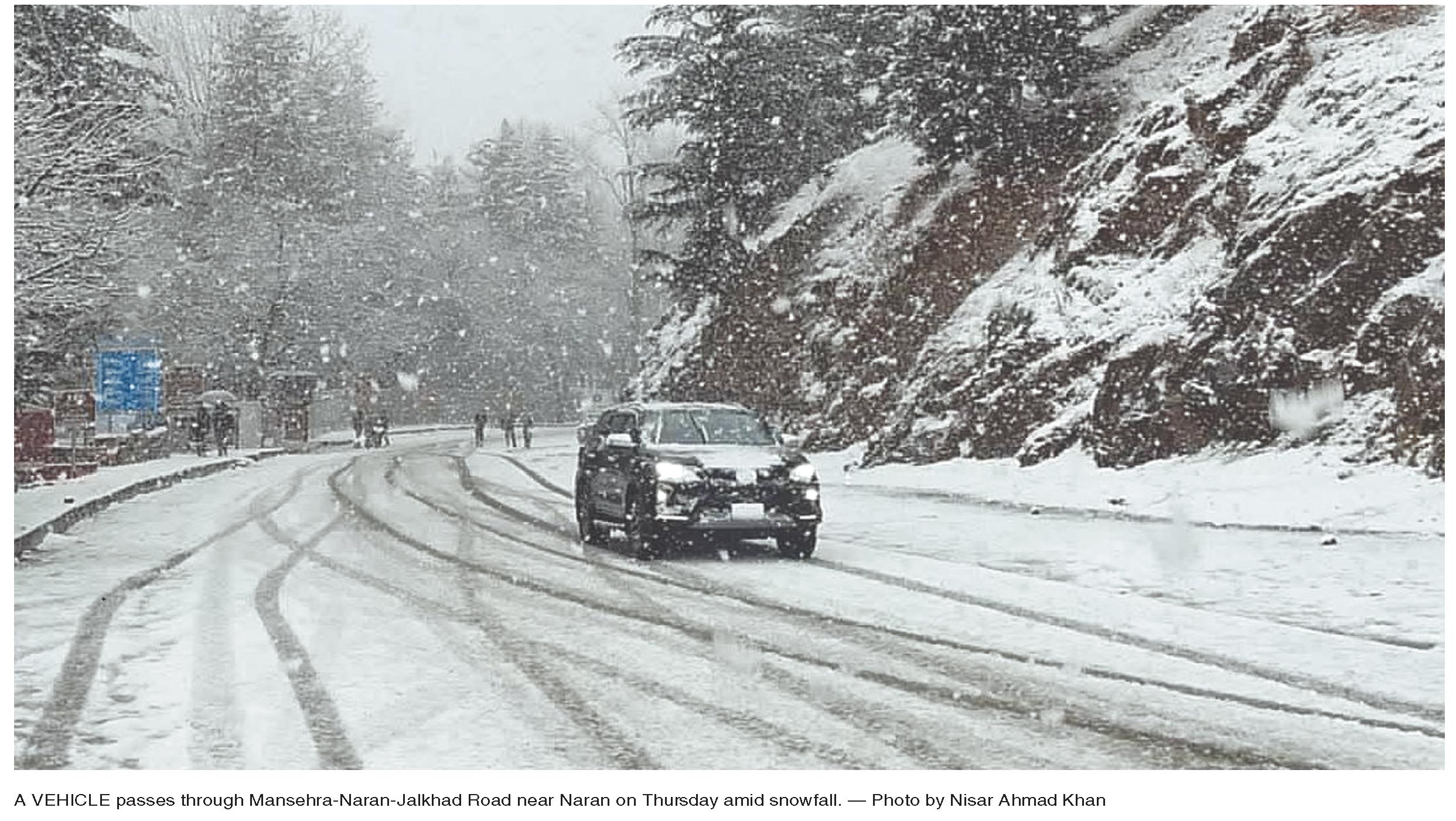
MANSEHR A: Mountainous parts of Hazara division received heavy snowfall for the second consecutive day on Thursday, while rain lashed low-lying areas, bringing the mercury further down.
‘We have permanently closed our two checkposts established in the Gattidas and Bassal areas of Upper Kaghan valley for the safety of tourists and others travelling between Khyber Pakhtunkhwa and GilgitBaltistan after heavy snowfall,’ DPO Mohammad Waqas Khan told reporters.
The snowfall, which began in the early hours of Wednesday, continued intermittently in the mountainous upper parts of Hazara division, including Kaghan, Siren and Konsh valleys in Mansehra district and Kandia and Spat valleys in Kohistan region.
The first heavy rainfall of the winter season, which began in the early hours, continued intermittently in Mansehra, Torghar, Upper and Lower Kohistan and Kolai-Palas districts, compelling people to pull out their warm clothes, coats and sweaters.
Link roads connecting dozens of villages with the main arteries, including the Mansehra-Naran-Jalkhad Road and Karakoram Highway, were also blocked by heavy landslides, causing difficulties for local communities, especially those living in highaltitude areas.
The Mansehra-Naran-Jalkhad Road, which was blocked to all types of traffic beyond Batakundi in Kaghan valley, remained closed for the second consecutive day.
According to reports, five oil tankers taking gasoline from Rawalpindi to Gilgit-Baltistan remained stranded near Babusar Top amid heavy snowfall for the last two days.
Police said the tankers were not on the KP side of the border and might have been stranded on the Gilgit-Baltistan side near Babusar Top.
Hussain Deen, chairman of the Kaghan Valley Hoteliers Association, said hotels and eateries would continue to welcome tourists amid the snowfall until the valley was completely closed for the winter season and reopened next summer.
‘Though tourists rushed to Naran and its adjoining areas to enjoy the snowfall, the Mansehra-Naran-Jalkhad Road beyond Soach remains completely closed because of adverse weather conditions,’ said tourist Agib Arshad.
He said he had travelled to Naran with friends to enjoy the snowfall, but the weather had turned severely cold.
In Swabi district, severe hailstorms damaged standing crops and vegetables in parts of Chota Lahor and Tordher areas, farmers said.
Potato, sugarcane, bean crops and vegetables were badly hit by hailstones.
The farmers said that the potato crop was in a very critical stage and similarly beans were near to harvesting but the hailstones damaged them, causing financial losses to the growers.
Tariq Khan, a farmer of Tordher, blamed the hailstorm on climate change and said he and other local growers didn’t know how to tackle the issue. Khalid Khan, district president of Kisan Board, complained that whenever the farmers faced financial losses or were hit by climate change, the government didn’t come forward to help them. ‘It is responsibility of government to play its due role,’ he said.
Also, the Bajaur tribal district received moderate rain, which ended the prolonged dry spell.
Residents said the rain started in the early hours and continued afterward.
They also said snow fell on some high mountains, including the famous Kohi Moor mountain, turning the weather colder.
Farmers welcomed the rainfall saying it will boost their newly raised wheat crops.
Also, suspension of electricity was reported in most parts of the region.