
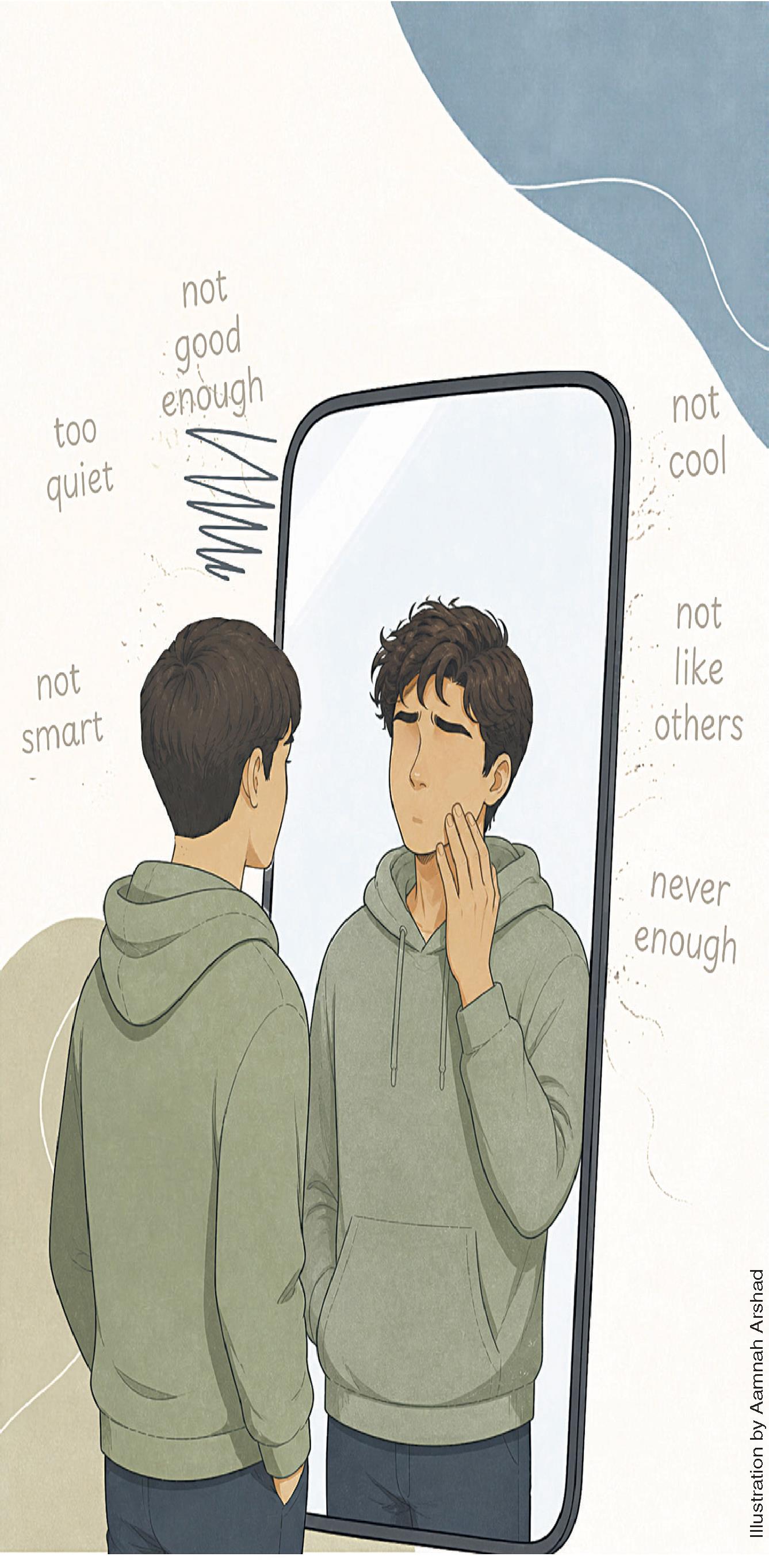
Ahmad had never thought much about his nose until his aunt mentioned it. That evening, he stood in front of the mirror, analysing his face.
He turned slightly to one side, then the other, trying to understand what she had noticed about him that he had somehow failed to notice for years. His cheeks had always been chubby. His nose had never been perfectly straight. So what had changed? Nothing about his face had actually changed. Only the way he looked at it had changed.
Am I really unattractive? The thought disturbed him. But how had he reached that point in the first place? Had he simply been sitting one afternoon, staring at himself and suddenly decided that his face was too dark, too chubby or that his nose was too bumpy? Absolutely not! It had not been an accidental realisation. Someone had planted the thought in his mind. It had started with his aunt.
One evening, when Ahmad returned home from college, he found his aunt sitting on the sofa. During their conversation, she casually commented that Ahmad did not groom himself well. She spoke as though she were merely stating an obvious fact, unaware of how deeply her words could cut.
His aunt eventually returned to her own home, but her words stayed behind. They lodged themselves in Ahmad’s mind like a splinter he could not remove.
It was not that Ahmad had always been obsessed with his appearance.
He had heard unpleasant comments about his looks and physique before.
For the most part, he had learnt to ignore them.
But this time was different. These words had come from someone he loved.
This was the same aunt with whom he had spent his childhood, the same person who had played with him when he was young and watched him grow up. Her opinion carried a weight that the words of strangers never could.And so Ahmad began to look at himself through her eyes.
Every time he stood before a mirror, he noticed the things she had pointed out. His cheeks seemed larger. His nose seemed worse. His complexion suddenly appeared dull. Features he had never thought much about before became defects in his mind.
The more he thought about them, the more convincing they became.
Soon, his appearance was no longer merely something he saw in the mirror. It became something he carried in his thoughts throughout the day.
The consequences were immediate. Ahmad had a quiz the following morning,but he could barely concentrate on his studies. He opened his book, read the same paragraph several times and absorbed nothing. His mind kept returning to the same question: What if she was right? The next day, he performed terribly in the quiz.
His poor performance was unusual. Ahmad had once been one of the brightest students in the class.
He was capable, hardworking and usually attentive during lectures.
But recently, he become distant.
He rarely participated, seemed distracted and spent most of his time lost in thought.
Professor Rehman noticed these changes. So, after class one day, he asked Ahmad to come to his office.
‘What’s happening to you?’ he asked. ‘You are capable of much more than this. Why have you stopped paying attention? Is something disturbing you?’ At first, Ahmad hesitated. He felt embarrassed explaining that a few words about his appearance had affected him so deeply.
Eventually, however, he told him everything. Professor Rehman listened patiently.
Then he leaned back in his chair and said, ‘Ahmad, people will always have opinions. Some will praise you. Some will criticise you.
Some will admire you, while others will find faults in you. That is simply human nature.
Ahmad remained silent.
‘But you have to understand that if you allow every opinion to determine how you see yourself, you will spend your entire life trying to become the person everyone else wants you to be.
Those words made Ahmad look up.
‘Becoming a people-pleaser will not bring you peace,’ Professor Rehman said. ‘It will only leave you exhausted, resentful and constantly dependent on someone else’s approval. Today, it may be your appearance. Tomorrow, it may be your grades, your career, your personality or your choices. If you keep living according to other people’s judgements, when will you ever have the opportunity to become yourself?’ Ahmad had no answer.’People are entitled to their opinions,’ the professor continued. ‘But you are not obligated to make those opinions your reality.
For the first time in days, Ahmad felt something loosen inside him.
Professor Rehman smiled.
‘You cannot control what people say about you. You cannot force everyone to like you, respect you, admire you or even understand you. But you can decide how much power their words have over you.
He paused before adding, ‘Your life is far too valuable to be reduced to somebody else’s passing judgement.
Ahmad thought about his aunt’s words. Perhaps she had simply expressed an opinion. Perhaps the real damage had come from the importance he had given it. He had allowed one person’s judgement to become the lens through which he viewed himself. He had allowed a sentence spoken in passing to steal his concentration, his confidence and even his academic performance.
He suddenly understood that the mirror had never been his enemy.
It was the voice in his head that had changed.
That evening, Ahmad stood before the mirror again. His face was still round. His cheeks were still chubby. His nose had not magically changed. But today, he felt different. He looked at his reflection for a long moment and smiled.
He did not need to convince himself that he was the most handsome person in the world. He did not need compliments. He simply needed to accept that this was him. And that was enough.
Dear kids, remember that no one is obliged to love or admire you. Not everyone will understand you, appreciate you or speak kindly about you. You are your own person, perhaps imperfect, but still learning and growing. And there is freedom in realising that.
After all, you are the only version of yourself that exists.