
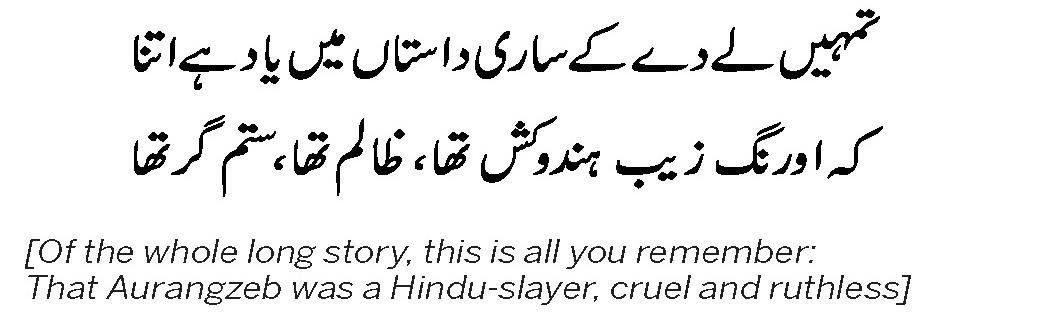
In recent years, we have seen a number of scholarly as well as lightweight correctives to repair the malignment that has been inflicted upon the sixth Mughal emperor, Aurangzeb Alamgir. Indeed, this intriguing figure has provided much inflammable fuel for the propaganda mill of the likes of Hindutva.
Among these corrective writings are important studies by Munis Faruqi and Audrey Truschke. In her analytically rigorous account, for example, Truschke showed us that, even though the emperor did carry out acts that appear to us today as not only invidiously discriminatory but also unspeakably cruel, he was a complex figure driven essentially as was the wont of the Mughals by the exigencies of the Timurid state.
When viewed in his own fuller historical context then, Aurangzeb cannot be described exhaustively as that paradigm Mughal bigot we generally see portrayed by Hindu nationalists and constructed by naïve journalists.
How very interesting: many generations before our Rutgers professor, the well-known 19th-20th century South Asian scholar Allama Shibli Numani had already stated, with the classical wit of a master, what happens to be the very essence of Truschke’s discourse -As a matter of fact, Shibli has a definite priority in this matter, even though it is somewhat disappointing that he doesn’t figure at all in Truschke’s study.
Around 1911, he wrote what was called a ‘refutation’ of the charges against Aurangzeb a crowded chargesheet hung around the neck of the emperor by ‘biased historians.’ In our modern postcolonial times, we have seen feverish charges of retrogressive attitudes and policies hurled at Aurangzeb charges that upon closer examination almost always turn out to have been conceived in isolation from the emperor’s administrative and cultural ecology, bereft of their context, or embodying but a truncated story.
Did this sixth Mughal ruler outlaw music as we have sometimes heard? Indeed, he may have personally considered music a digressive indulgence. But when we juxtapose his private attitude with the historic fact that the royal Mughal band [Naubat] never ceased to function during his rule, then we are faced with a highly complex situation and must address its nuances. What is more, here we have an eminent fact to ponder on, namely that more Indo-Persian treatises on music were written during Aurangzeb’s time than let’s carve this in our cultural consciousness the preceding five hundred years of India’s past.
A similar charge concerning poetry is to be found on the condemning list that Aurangzeb rejected poetry and poets did not receive his patronage. Again, this seems like an individual personal choice, not the policy of the Mughal state. Here let’s note this: the greatest Persian poet of Indo-Muslim culture, Ghalib’s mentor Mirza Bedil, was offered Aurangzeb’s patronage, which the proud poet declined. And yet, Bedil did flourish in Aurangzeb’s princely court, being patronised by none other than the emperor’s son, Prince Azam Shah, whom too the poet abandoned out of his own free will.
But in this regard the most efficacious antidote to the chronic contra-Aurangzeb fever is the case of princess Zebunnisa, the eldest daughter of the emperor. Zebunnisa was a superb poet and a scholar of philosophy, astronomy and theology. Aurangzeb loved her dearly; thus, when she completed her memorisation of the Holy Quran, he declared a three-day grand state celebration in the entire empire.
The case of Zebunnisa must give us a pause, for both in her poetry and personality she appears to be if I may be allowed anachronistic vocabulary here liberal, progressive, and even ‘secular’. Listen to this: ‘No Muslim I, But an idolater, I bow before the image of my Love, And worship her: No Brahman I, My sacred thread, I cast away, For round my neck I wear Her plaited hair instead.’ And more daringly, ‘In the mosque I seek my idol-shrine.
Note that all of this is happening, so to speak, right under the nose of Aurangzeb. And, indeed, all of this goes against the very grain of bigotry.
So this is the milieu of Aurangzeb’s royal household.
Small wonder, then, that Zebunnisa was a highly strongwilled and independent-minded princess. She never married and insisted that she meet all men who sought her hand in marriage or to whom she is betrothed. Yes, she rejected all of them.
A complicating and meaningful historical fact is that she observed veiling, finding no contradiction between her brave independent-mindedness and her strict veiling.
We recall that she adopted ‘makhfi’ [hidden] as her pen name (takhallus) but this did not hide her personality nor her open public presence. And more, she was taught by a woman, Miyabai.
Let her speak for herself ‘I am the daughter of a king, but I have taken the path of renunciation, and this is my glory, as my name is Zebunnisa... I am the glory of womankind.
The columnist is a historian and teaches at the Institute of Business Administration (IBA) Karachi. All translations of Zebunnisa are by Magan Lal and Jessie Westbrook