
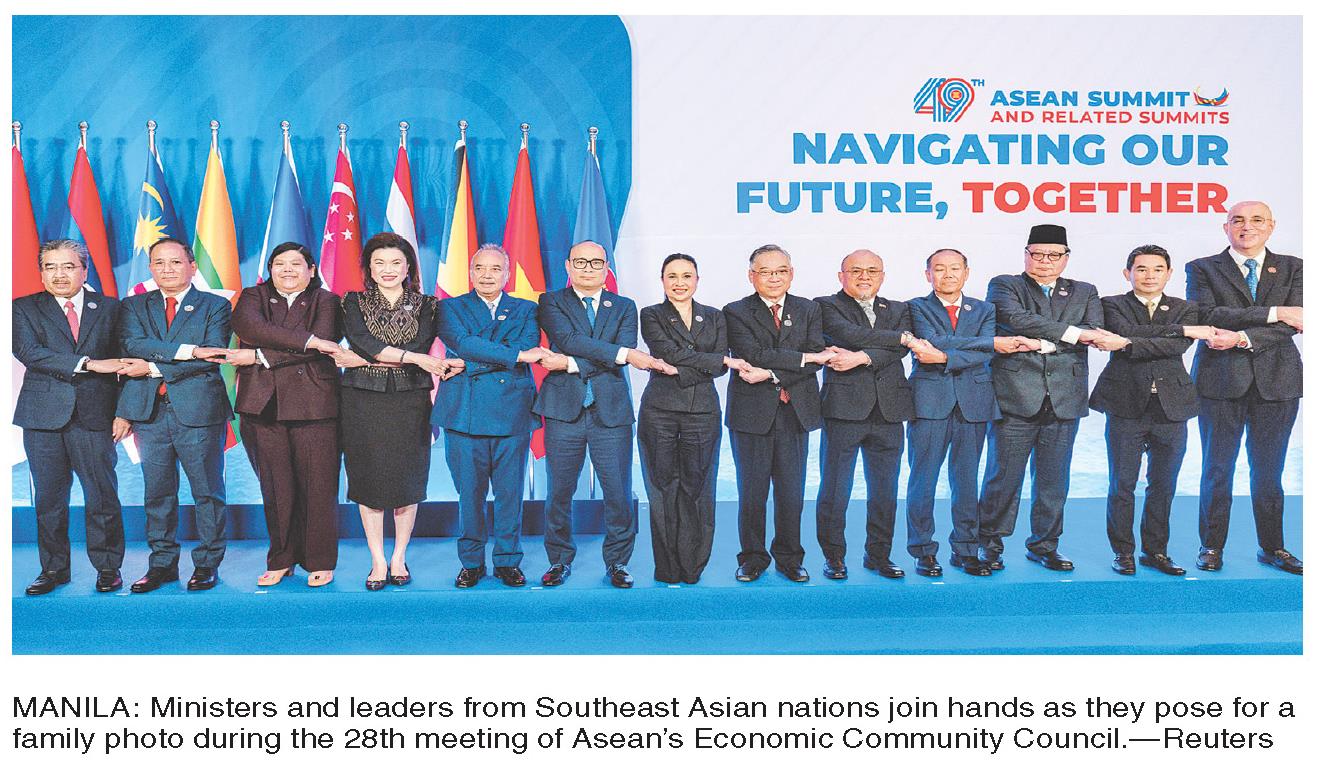
MANILA: A key regional summit opened in Manila over the weekend, with Southeast Asian heads of state facing questions on trade, security and an ongoing energy crisis while playing host to a who’s who of global leaders.
US President Donald Trump is scheduled to arrive on Tuesday near the summit’s conclusion, a visit expected to include a sideline meeting with fellow Quad countries India, Japan and Australia the first of his second term.
The meeting of the Quad a grouping broadly aimed at counterbalancing China’s regional influence would come days before a historic sit-down with Chinese leader Xi Jinping and Russia’s Vladimir Putin in Shenzhen.
Australian Prime Minister Anthony Albanese will sign a new defence pact with host country the Philippines.
Nearly 20,000 police officers have been deployed around Metro Manila for the summit, with progressive groups predicting a turnout of thousands on Tuesday for an antiTrump march on the summit site.
Much of the uproar targets the US PaxSilica programme a supply-chain initiative designed to counter China’s dominancein semiconductors and rare earths whose flagship Philippine project, a 1,620-hectareAI manufacturing hub north of Manila, threatens to displace Indigenous families.
A day of early meetings kicked off on Saturday with Canadian Prime Minister Mark Carney announcing a Philippine trade deal.
But two issues that have vexed Asean leaders for years a languishing South China Sea ‘Code of Conduct’ and their relationship with war-torn Myanmar look to be Singapore’s problem when the bloc’s rotating chair passes to the city-state in 2027.
Asean and China were unable to conclude negotiations on a long-delayed South China Sea code of conduct under the Philippines’ chairmanship, despite reaching provisional agreement on about 80pc of the draft, Manila’s foreign minister said on Sunday.
Negotiations on an Asean-China Code of Conduct in the South China Sea have dragged on for over two decades, but the Philippines, as current chair, had committed to speed up those talks and conclude the code this year.
‘There is no conclusion yet,’ Philippineforeign minister Ma. Theresa Lazaro told a press conferenceat a summit of the 11-member Association of Southeast Asian Nations in Manila, adding that several key issues remain unresolved, including questions over whether the code would be legally binding.
‘The Asean countries plus China have also different views on how things are,’ she added.
China’s Southeast Asian neighbours want the code to be grounded in international law, which they have repeatedly accused Beijing of disregarding as it asserts its sovereignty over nearly all of the South China Sea.
Beijing maintains that its actions in the South China Sea have been lawful and professional.
Hopes of achieving a so-called Code of Conduct in the disputed South China Sea between Asean states and China during Manila’s year in the chair, meanwhile, have flagged.
A Southeast Asian diplomat involved in summit preparations said he did not expect a code to be signed at the summit.-AFP