
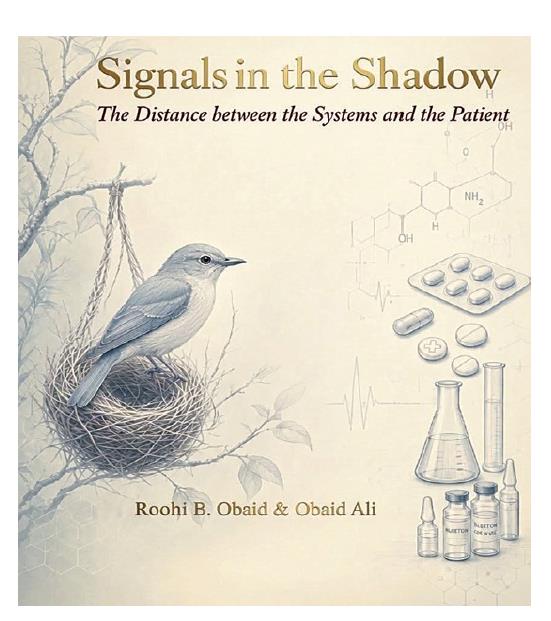
KARACHI: A new book titled Signals in the Shadow The Distance Between the System and the Patient was launched here at a local hotel on Sunday.
Co-authored by known pharmacists Roohi Bano Obaid and Dr Obaid Ali, the book examined the limitations of conventional pharmaceutical quality systems and the importance of scientific judgement in safeguarding public health.
The gap between formal pharmaceutical regulatory compliance and the actual protection of patients also came under discussion at the event, which brought together key stakeholders and experts from different disciplines.
Federal Education Minister Khalid Maqbool Siddiqui was the chief guest. Former senior United States Food and Drug Administration (FDA) official Dr Ajaz S. Hussain and former chief executive officer of the Drug Regulatory Authority of Pakistan (Drap) Asim Rauf were among the main speakers.
They offered perspectives shapedby their respective experience in international regulatory science and pharmaceutical governance.
The authors also elaborated on the book’s central message, drawing attention to the distance that can emerge between what pharmaceutical quality systems document and what patients ultimately experience.
Roohi Bano Obaid said that compliance documents and laboratory reports were essential components of quality assurance, but could notbe regarded as the complete representation of a medicine’s quality.
‘Our responsibility is not only to meet the standard on paper but also to remain alert to what the system may still be missing. Sometimes the earliest warnings are found in signals thatroutine processes overlook or fail to connect unusual patient complaints, subtle changes in a product’s appearance or small deviations in manufacturing processes, she said.
Dr Obaid Ali emphasised that the ultimate measure of a pharmaceutical quality system was the confidence patients could reasonably placeinthemedicinestheyreceived.
‘The completeness of records alone cannot establish the reliability of a medicine. Scientific evidence, regulatory judgement and institutional accountability must remain connected. Findings assessed in isolation, without sufficient context, can create a false sense of security. Genuine patient protection requires competent institutions, reliable evidence, professional independence and the willingness to investigate what does not fit established expectations,’ he said.