
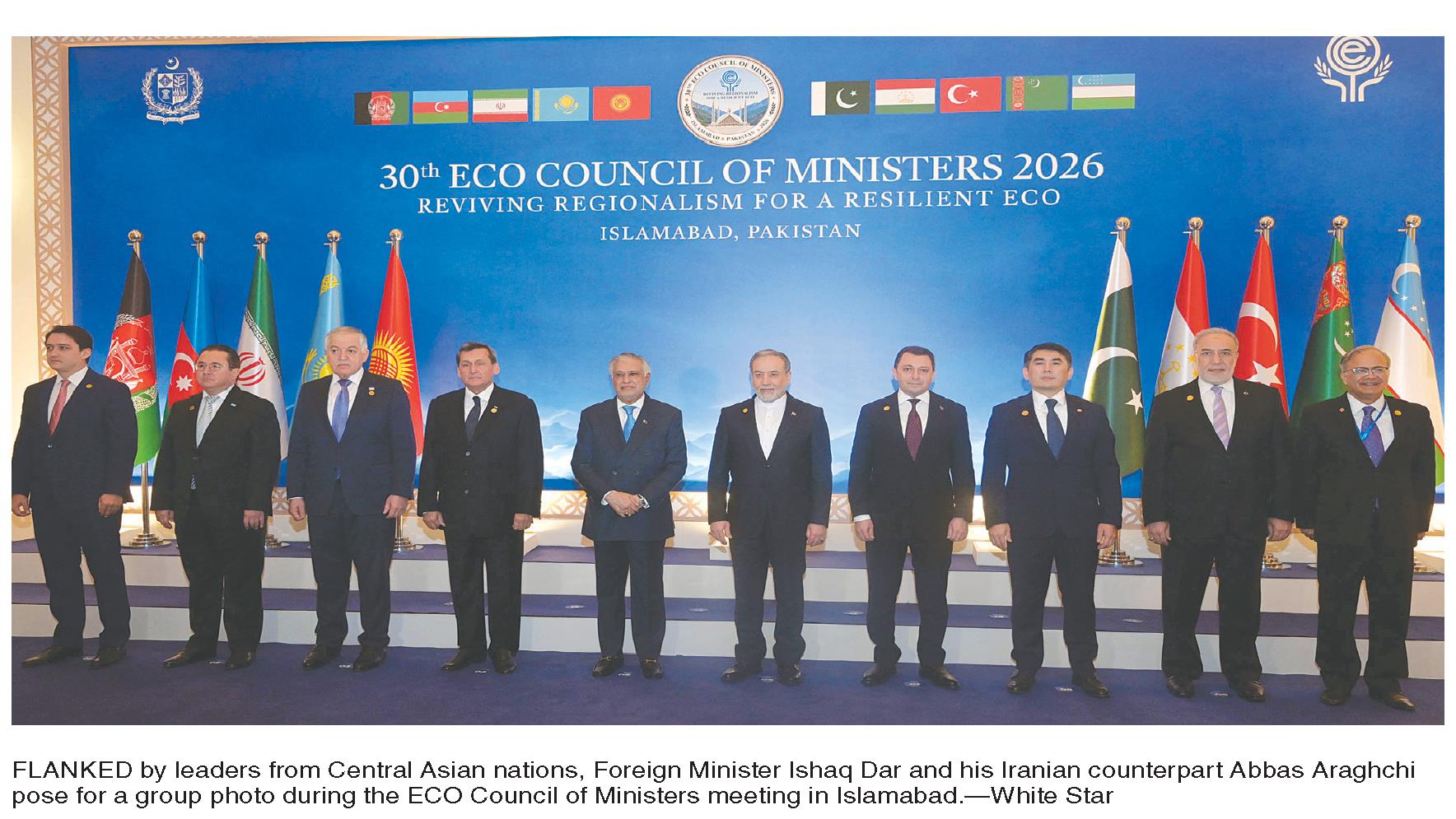
ISLAMABAD: As members of the Economic Cooperation Organisation (ECO) gathered in Islamabad for the 30th meeting of the Council of Foreign Ministers, Pakistan reaffirmed its commitment to finding a peaceful resolution to the US-Iran conflict through diplomacy.
Addressing a media briefing after the meeting on Monday, Deputy Prime Minister and Foreign Minister Ishaq Dar shared details of his discussions with Iranian Foreign Minister Abbas Araghchi.
Mr Dar said he had discussed the regional situation with his counterpart, adding that Iran had ‘fast-tracked’ its seven-day proposal to reopen the Strait of Hormuz into a two-day plan.
‘So, the response from the United States is pending. We have not given up hope or efforts,’ he said.
He expressed hope that Washington would respond to the proposal ‘very soon’, now that the US midterm elections were over.
Mr Dar also hoped that the Islamabad Memorandum of Understanding signed between Iran and the US on June 18 would be implemented. He said the seven-day and two-day proposalson the Strait of Hormuz had been ‘extracted’ from the MoU.
In a statement, the Foreign Office said Mr Dar and Mr Araghchi had reviewed bilateral relations and exchanged views on regional and international developments of mutual interest.
Strategic goals The ECO foreign ministers adopted the Strategic Goals of Economic Cooperation 2026-2035, also called ‘ECO Vision 2035’, a roadmap for the bloc’s next decade focused on regional trade, investment and connectivity.The adoption of the framework at the Islamabad meeting also marked the start of Pakistan’s 2026-27 chairmanship of the organisation.
Mr Dar said the vision provided strategic direction for the organisation and a basis for translating commitments into practical outcomes.
The roadmap seeks greater economic integration among the 10 member states through wider market access, stronger regional value chains, multimodal transport corridors linking Central and South Asia with Arabian Sea ports, and cooperation in energy, digital technology and climate resilience.
Addressing the inaugural session, Mr Dar outlined five priorities for Pakistan’s chairmanship: expanding trade and investment, improving regional connectivity, modernising the ECO Trade Agreement (ECOTA), strengthening regional resilience and investing in human development.
The meeting was attended by foreign ministers from Pakistan, Iran, Tajikistan and Turkmenistan, among others, while several member states were represented by deputy ministers.
Afghanistan was absent because its membership of the ECO remains suspended. Mr Dar said Pakistan and other member states had not recognised the interim Afghan government, explaining why Kabul was not invited.
Afghanistan’s pre-2021 flag was displayed alongside those of other member countries.
The trade agenda also featured ECOTA, with Mr Araghchi welcoming the formation of a technical negotiating committee to reform the agreement. He said a modernised and more inclusive pact could expand regional trade and strengthen economic resilience.
However, sanctions on Iran remain an obstacle to its implementation. Asked how Tehran could participate while restrictions remained in place, Mr Dar said Iran could fully participate once sanctions were lifted, while other members could continue the process in the meantime.
‘Sanctions are not going to remain in place forever. Once they are lifted, the whole world will rush there. I can guarantee you that. I have seen this happen in Libya. The moment sanctions were lifted, the first person to land in Tripoli was the British prime minister,’ he said.
Mr Dar said Pakistan would continue to observe the international sanctions regime approved by the UN Security Council, but stressed the need to keep Iran engaged.
‘So, while sanctions remain in place, we have to stay engaged,’ he said.
He also linked regional economic cooperation to the security situation in Afghanistan, saying Pakistan remained willing to pursue trade, transit and connectivity projects with its western neighbour, provided the Taliban authorities addressed the threat of terrorism.
Mr Araghchi called for economic cooperation to be accompanied by dialogue on regional security. He said the region neededan inclusive framework based on non-aggression and assurances that no country’s territory or facilities would be used to attack another.
Makkah alliance summit Speaking at the post-summit briefing, Mr Dar said Pakistan would host the next meeting of the apex committee of the Makkah Defence Alliance, comprising Pakistan, Saudi Arabia and Turkiye, later this month in Islamabad.
The Strategic Political and Defence Committee (SPDC) comprises the foreign and defence ministers and top military officials of the three countries.
‘We offered in our inaugural meeting that our next formal meeting will be held in Islamabad and everybody accepted,’ he said, adding that an emergency SPDC meeting had been held in Riyadh last month following Houthi attacks on Saudi Arabia.
Asked about the possibility of a new regional security architecture, Mr Dar said the region needed its own security arrangements.
He said global security institutions had not been established overnight, adding that the Makkah pact was meant for self-defence and did not violate Article 51 of the United Nations Charter, which provides for individual and collective self-defence.
‘It is not restricted that these three countries will have a monopoly and will not entertain any other membership,’ he said.
Mr Dar said the alliance was in a transition phase as its institutional framework was being established. Decisions had been taken regarding the secretary general’s office and the permanent secretariat in Riyadh. A working committee comprising representatives from the foreign, defence and military offices of the three countries had also been formed.
Meetings with PM, CDF The visiting foreign ministers and heads of delegations also called on Prime Minister Shehbaz Sharif, who urged ECO members to deepen cooperation in trade and investment, transport and transit connectivity, energy, information technology and sustainable development.
Mr Araghchi also met Chief of Defence Forces and Chief of the Army Staff Field Marshal Asim Munir to discuss regional peace and security challenges, according to a post on the Iranian foreign minister’s Telegram account, Reuters reported. However, the military’s media wing did not issue an official readout on the meeting.
With input from Agencies and Monitoring Desk