
ISLAMABAD: Amid silence from the government side, industrial consumers on Tuesday protested against an additional quarterly tariff burden of Rs24 billion sought by power distribution companies (Discos) on account of higher capacity charges, variable operation and maintenance (O&M) costs and the impact of system losses, resulting in an estimated tariff increase of Rs1.30 per unit for three months.
The only brief intervention from the power division, represented by Power Planning and Monitoring Company (PPMC) Chief Financial Officer Naveed Qaisser, was a request that the additional quarterly tariff adjustment (Q TA) be applied to billing from Dec 1, 2026, until February 2027.
The public hearing was presided over by National Electric Power Regulatory Authority (Nepra) members Amina Ahmed, Maqsood Anwar Khan and Ghulamullah Shaikh on the request of 11 distribution companies seeking approval for additional QTA for the July-September 2026 period.
Once approved, the adjustment would also apply to K-Electric consumers under a government policy in place since 2023.
Two industrial representatives, Amir Shaikh and Rehan Javed, expressed serious concern over Rs39bn in additional capacity payment claims for the quarter against the reference amounts already built into the base tariff, besides Rs5.6bn in variable O&M costs and Rs7.8bn relating to the impact of system losses on monthly fuel charges.
Mr Shaikh, from Lahore, said QTAs normally remained negative when fuel cost adjustments (FCAs) were higher than the charges passed on to consumers during the respective months.
However, this time the industry faced a double shock positive FCAs throughout the quarter followed by a positive QTA even though industrial production decisions had been made on the assumption of a lower adjustment.
He argued that a major reason appeared to be electricity sold to selected consumers under the incremental consumption package (ICP) at a rate Rs10 per unit lower than the normal tariff.
This had translated into a higher QTA for all consumers despite the government’s assurance that the impact of the ICP would not be passed on to consumers other than its beneficiaries, he said. ‘This is like rubbing salt to our wounds.
This is shocking that QTA has gone up,’ he added.
Mr Javed, from Karachi, said the Discos had claimed a Rs29.25bn negative adjustment relating to the ICP, which he contended represented an additional burden on consumers generally.
Several questions he raised about the data submitted by the Discos remained unanswered, while Nepra did not press for responses.
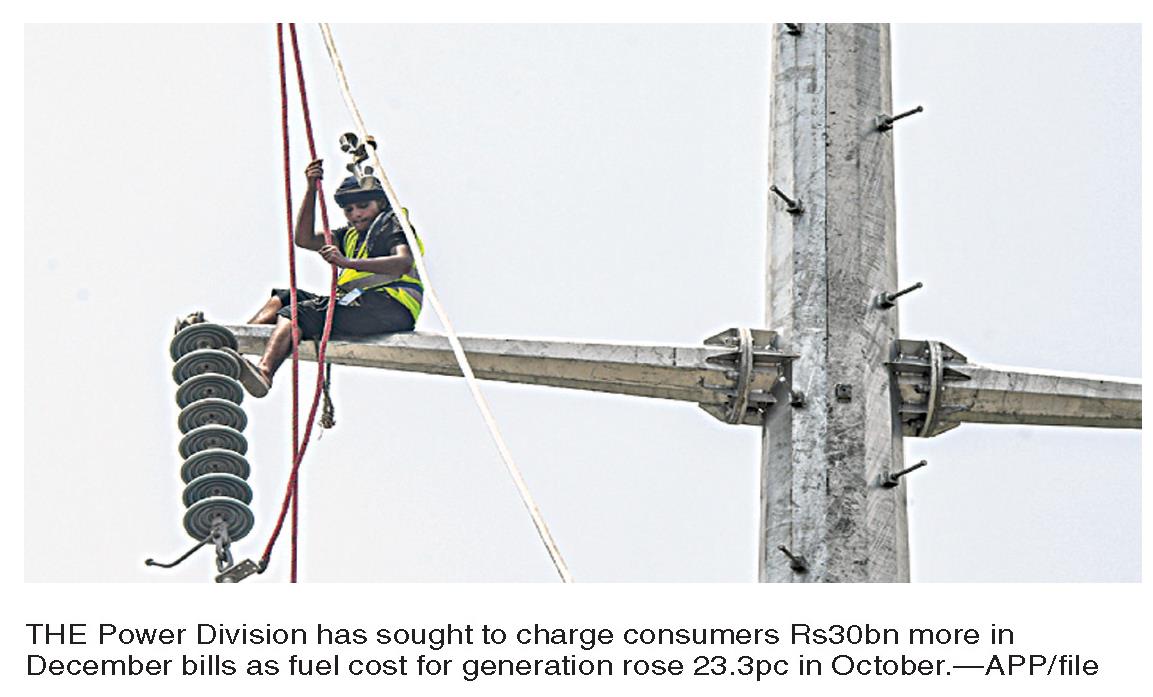
Consumers face Rs2.9 per unit extra charge Compounded by a record Rs70 per unit generation cost on diesel, the overall fuel cost of electricity surged by almost one-fourth in October despite 76 per cent production from local and cheaper fuels and the Power Division sought to add about Rs2.9 per unit charge to consumers in December’s bill to mop up around Rs30 billion.
The National Electric Power Regulatory Authority (Nepra) has called a public hearing on Nov 26 on the request of the Central Power Purchasing Agency (CPPA) of the Power Division to pass on the additional fiscal impact to consumers.