
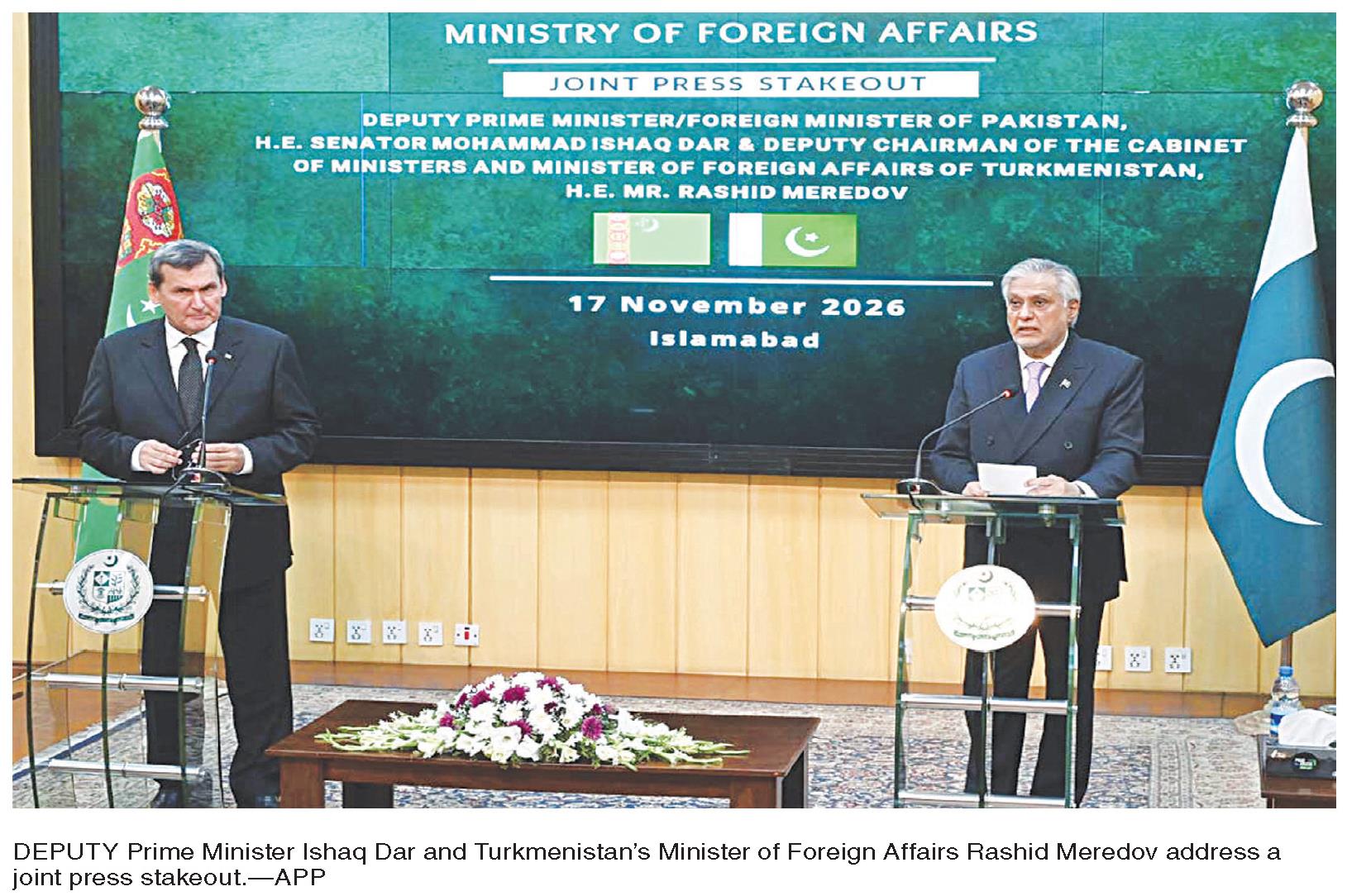
ISLAMABAD: Deputy Prime Minister (DPM) and Foreign Minister Ishaq Dar on Tuesday discussed the Turkmenistan-Afghanistan-Pakistan-India (TAPI) gas pipeline with a delegation led by Turkmenistan’sForeignMinisterRashidMeredov.
The discussion took place at the sixth session of the Pakistan-Turkmenistan Joint Intergovernmental Commission (JIC), which was held in Islamabad.
Mr Meredov, who had arrived in Pakistan ahead of the 30th meeting of the Economic Cooperation Organisation (ECO) Council of Ministers, said the two sides also agreed to convene a meeting of the steering committee for the project.
The two sides recognised ‘the importance of political engagement among the participating countries on the technical and commercial aspects of the project’, Mr Dar said in remarks during a joint pressstakeoutafterthe talks.
The 1,800km pipeline is expected to carry 33 billion cubic metres of natural gas every year from Turkmenistan’s Galkynysh the world’s second-largest gas field to the Indian city of Fazilka, while passing through Herat and Kandahar in Afghanistan, and Quetta and Multan in Pakistan.
The project has two phases: a free flow phase with an estimated cost of $5-6bn and installation of compressor stations for at least $1.9bn.
In 2023, Pakistan and Turkmenistan signed a joint implementation plan to execute the TAPI project. Progress on the TAPI pipeline had been repeatedly delayed because of security issues.
Referring to the talks between Pakistan and Turkmenistan on trade, investment and regional connectivity, the DPM said the discussion was held in ‘a very cordial and constructive atmosphere, reflecting the longstanding bonds of friendship, mutual respect and goodwill that characterise PakistanTurkmenistan’s relationship’.’Pakistan respects Turkmenistan’s policy of permanent neutrality and values our constructive cooperation in regional and international forums.
Protocol, MoU inked Mr Dar said that Pakistan and Turkmenistan signed the protocol of the sixth session of the PakistanTurkmenistan JIC and Programme of Cooperation for the two foreign ministries for 2026-30, and a memorandum of understanding on tourism cooperation.
‘These instruments reflect the shared commitment of Pakistan and Turkmenistan to strengthening institutional cooperation, sustaining regular diplomatic engagement and promoting tourism and people-to-people ties,’ the Foreign Office said. ‘Trade, investment and regional conneetivity featured prominently in our discussions,’ Mr Dar said in his remarks, adding that the two sides had discussed ways to ‘advance work on a bilateral transit trade framework and explore commercially viable transport links’.
Power, communications Both foreign ministers also talked about the proposed TurkmenistanAfghanistan-Pakistan electricity transmission project and the associated fibre optic communications link, highlighting the need for further assessment of its technical and commercial viability.
‘Our discussions also covered opportunities to strengthen cooperation in agriculture, industry, tourism, culture, higher education, information technology, health and financial services,’ Mr Dar told the media.
Mr Meredov said the two sides also considered interaction between the seaports of Chabahar and Gwadar as well as prospects for railway connections through Afghanistan. Attention was paid to the rail viability of routes, tariffs and border procedures, he said.
Mr Meredov added that Turkmenistan was planning to arrange a state visit to Islamabad next year.