
THE HAGUE: The United Nations’ highest court ruled on Thursday that thousands of killings and widespread sexual violence by Myanmar’s security forces against the Rohingya Muslim minority in 2017 amounted to state-sponsored genocide.
The landmark decision by the International Court of Justice (ICJ), or World Court, coming seven years after predominantly Muslim Gambia filed the case, marks the first time the court has held a state responsible for genocide.
It is also only the fourth time since the Nazi Holocaust that an international court ruled the legal threshold for genocide was met, following tribunals on Rwanda, Bosnia and Cambodia.
‘The court finds that Myanmar’s security forces killed thousands of Rohingya civilians, perpetrated widespread acts of sexual violence as well as acts of extreme violence against children and attacked fleeing Rohingya,’ presiding Judge Yuji Iwasawa said in reading the ruling.
The panel concluded that Myanmar committed genocide in northern Rakhine state, adopting a UN figure of at least 10,000 deaths during military ‘clearance operations’ that burned hundreds of villages and drove at least 700,000 Rohingya into neighbouring Bangladesh.
‘The only reasonable inference that can explain Myanmar’s actions is an intention to destroy a substantial part of the protected group,’ the 191-page judgement stated.
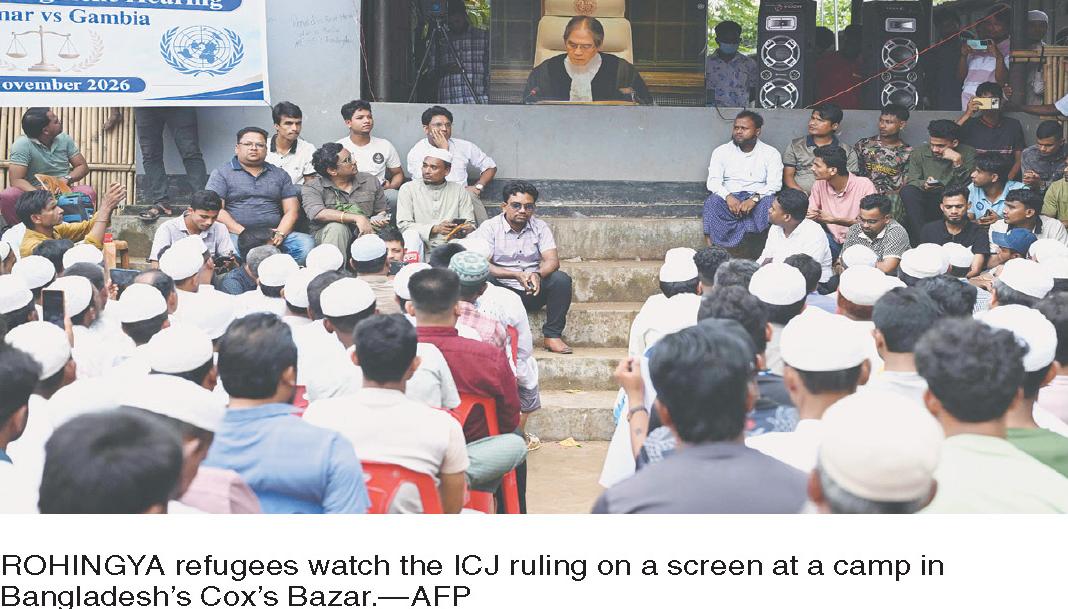
In Bangladesh’s sprawling Cox’s Bazar refugee settlement, where 1.2 million Rohingya now live in exile, more than 1,000 people cheered as the verdict aired on television.
The Gambia, which brought the case with the backing of the Organisation of Islamic Cooperation, called it ‘a historic day for international justice’.
The final, unappealable ruling is expected to influence other cases, including South Africa’s 2023 case accusing Israel of genocide in Gaza. Both Israel and Myanmar say their forces responded legitimately to armed groups.
Judges also found that Myanmar’s military spread anti-Rohingya hate speech on Facebook and referenced a Reuters investigation into the Sept 7, 2017, killing of 10 Rohingya Muslims in Inn Din, after which two reporters were jailed for more than 500 days.
While the court ordered Myanmar to pay compensation and allow the ‘safe and dignified return’ of displaced Rohingya, enforcement options remain limited. Still, community representative Sayed Ullah said from Cox’s Bazar that the decision ‘will strengthen our efforts to return home’.—Reuters