
ISLAMABAD: The United Nations has unveiled an ‘Inter-Agency Winterisation Strategy 2026-27’ for Pakistan, focusing on immediate, life-saving assistance to disaster-affected, displaced and highly vulnerable households during the annual October-March operational window.
The interagency strategy jointly prepared by the UN Office for the Coordination of Humanitarian Affairs (UN-OCHA) and the International Organisation for Migration (IOM), shows only $540,100 available with humanitarian partners and $90,000 in pooled funds, while the total requirement to plug the gap is over $3.54m.
The strategy document also says that if the Sindh case load is withdrawn, since there was no major disaster there this year and provincial disaster authorities have also confirmed that it is more of a contingency for winters, the financial gap for 2026-27 will amount to $1.92m.
The strategy is being coordinated with all relevant UN agencies for their inputs and complementarity.
The primary response comprises winter-appropriate non-food items (NFIs), including blankets, quilts, warm clothing and essential bedding, delivered through in-kind distributions or cash-based assistance where markets are functional and accessible.
Where required, these may be complemented by basic weatherproofing, insulation, emergency shelter improvements and heating solutions.
According to the strategy document, 53 priority districts across six provinces and regions have been identified through consultations with PDMAs, Gilgit-Baltistan Disaster Management Authority, State Disaster Management Authority and sector partners.
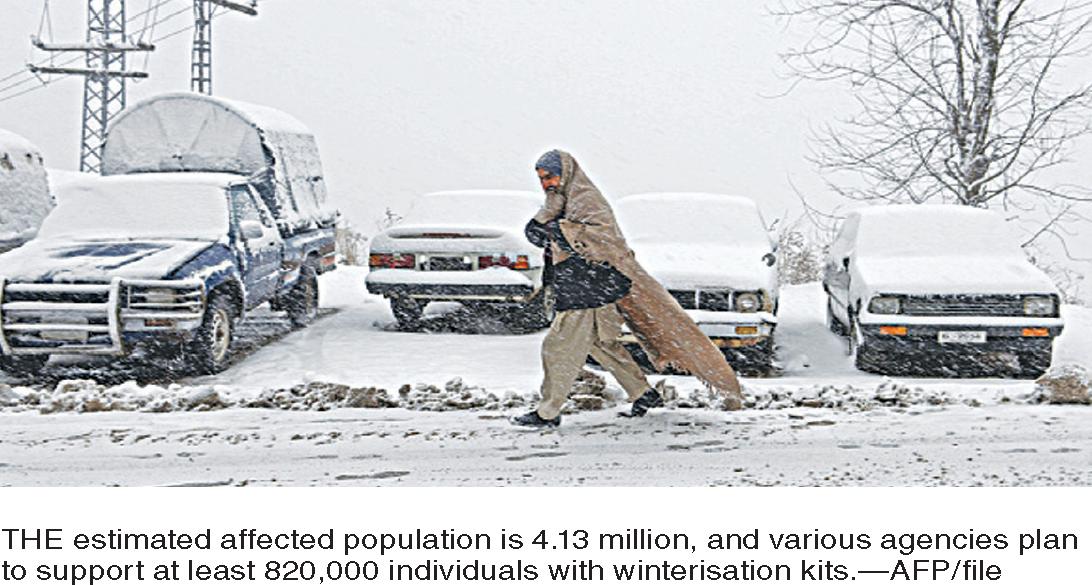
The estimated affected population is 4.13 million people, of whom the Shelter, NFIs and Camp Coordination and Camp Management sector aims to support 826,106 individuals, equivalent to 118,015 families, with one winterisation kit per family.
High-altitude areas face severe winter conditions, including sub-zero temperatures, heavy snowfall, road closures and limited access to adequate shelter and heating.
In lower-altitude and flood-affected districts, particularly in Sindh and Punjab, winter conditions may further exacerbate vulnerabilities among households still living in temporary or inadequate shelters following previous floods.
The strategy is intentionally focused on immediate humanitarian needs rather than longer-term seasonal service delivery. Particular consideration will be given to women-headed households, children, older persons, persons with disabilities and households with specific protection needs.
These characteristics will inform vulnerability assessments alongside shelter conditions, displacement status, differential needs for every segment of the community and household coping capacities.
Geographical prioritisation for winter 2026–27 draws on the NDMA Disaster Early Warning-4 (DEW-4) for October-December 2026.
It also reflects consultations with NDMA and the Provincial Disaster Management Authorities in KP, Sindh, Punjab, and Balochistan, along with the GBDMA and SDMA in Azad Jammu and Kashmir.
These priorities are supported by district-level vulnerability data, recent disaster impacts, and partner assessments.
High winter exposure is expected across Gilgit-Baltistan, mountainous areas of Azad Jammu and Kashmir, northern and high-altitude districts of KP and selected northern and central highland districts of Balochistan.
The estimated winter-exposed population will be distinguished from households requiring humanitarian winterisation assistance.
Unicef is planning winterisation support across six provinces and regions during November-December 2026, comprising 14,000 children’s winter clothing kits, 24,600 blankets and 1,920 quilts. Assistance will be delivered in coordination with provincial authorities and implementing partners, prioritising cold-exposed and vulnerable households, including flood-affected communities.
NDMA’s DEW-4 projects progressively expanding snow cover across the Hindu Kush, Karakoram and western Himalayan ranges during October-December 2026, particularly affecting GB, Upper Chitral, northern KP and mountainous AJK.
The Winterisation Strategy 2026–27 identified nine priority districts/areas in GB: Astore, Diamer, Ghizer, Ghanche, Kharmang, Skardu, Shigar, Nagar and Hunza.
These areas face varying degrees of winter exposure, with high-altitude valleys and remote settlements particularly vulnerable to extreme temperatures, snowfall and disruptions to essential supplies and services.
AJK experiences harsh winter conditions, particularly in its mountainous and high altitude areas, where heavy snowfall, extreme cold, landslides and seasonal road closures can restrict access to remote communities.
In the region, four districts — Muzaffarabad, Neelum, Poonch and Haveli — have been identified as the highest priorities, considering their exposure to severe winter conditions, snowfall-related hazards and accessibility constraints.
For KP, 16 districts have been identified for winterisation planning, with an estimated 1.44 million people expected to require support, according to the updated provincial planning figures.
Seven districts — Swat, Upper Dir, Shangla, Mansehra, Lower Chitral, Upper Chitral and Upper Kohistan— are classified as very high risk, while Battagram and Khyber are classified as medium risk. Four additional districts—Orakzai, North Waziristan, South Waziristan and Kurram — have also been included, recognising significant winter exposure in selected tehsils.
Punjab is classified as a moderate winterisation priority, with risks arising primarily from cold nights, fog, smog and the continued vulnerability of flood-affected households.
In Upper Punjab, particularly the Chenab and Ravi catchments, districts including Mandi Bahauddin, Gujranwala, Gujrat, Hafizabad, Nankana Sahib, Narowal and Sialkot face seasonal cold, fog and air-quality concerns.