
ISLAMABAD: Residents of the twin cities of Rawalpindi and Islamabad and their adjoining areas are set to brace for another possible confrontation between the personnel of the law enforcement agencies and protesters, as the police have already deployed more than 2,000 containers at various locations in the capital and at Attock Bridge, an entry point to the Punjab from Khyber Pakhtunkhwa and northern parts of the country.
The Islamabad police have requested Rs827 million to bear expenses related to the planned protests by the opposition Pakistan Tehreek-i-Insaf (PTI), Jamaat-iIslami (JI) and Kissan Ittehad.
The amount will be spent on container rents, accommodation, food and transportation of police personnel and the purchase of anti-riot equipment, including tear-gas shells and rubber bullets.
Background interviews with some of the police officials revealed that the authorities are expecting between 20,000 and25,000 protesters togatherin Islamabad.
According to them, the PTPs long march is expected to begin from various parts of the country on Sept 27 and may reach the capital within three to four days. They have been directed that all security arrangements should be in place by Sept 26 evening. They further expect that the situation may continue for about a week or so.
They told Dawn that arrangements had been made to ‘intercept’ the protesters outside Islamabad. However, a final decision will be made under the guidance and orders of the government.
Sources said various contractors had committed to providing 1,550 containers, including 350 required to seal the Red Zone. A wall of containers has already been erected around the RedZone, with the police placing containers on roads as well as on greenbelts along its boundary. Out of these containers, around 1,000 will be used to block entry points, major roads and highways and the high security zone, from Margalla Road to Faisal Avenue, Khayaban-iSuhrawardy and Third Avenue, besides the Expressway, Srinagar Highway and other major roads.
The Red Zone has seven designated entry points, including Khayaban-iSuhrawardy, the Old Parade Ground/ Jinnah Avenue, and Aga Khan Road.
Gates at these points will also be closed.
After placing the containers at the entry points and on major roads, they are being welded together and filled with gravel and sand to prevent their removal.
The police have requested 16,000 police personnel and 4,000 anti-riot kits from the Punjab Police and 2,000 officials and 3,000 anti-riot kits from Sindh Police. Besides, three deputy inspectors general of police, seven senior superintendents of police, and 18 superintendents of police have also been called from the Punjab and Sindh.
Besides arranging containers, the contractors have alsobeen asked to arrange 70 coasters, 30 double cabins and buses which will be used to transport the police force.
About 50 portable washrooms and toi-lets were also being arranged for the police near the duty points.
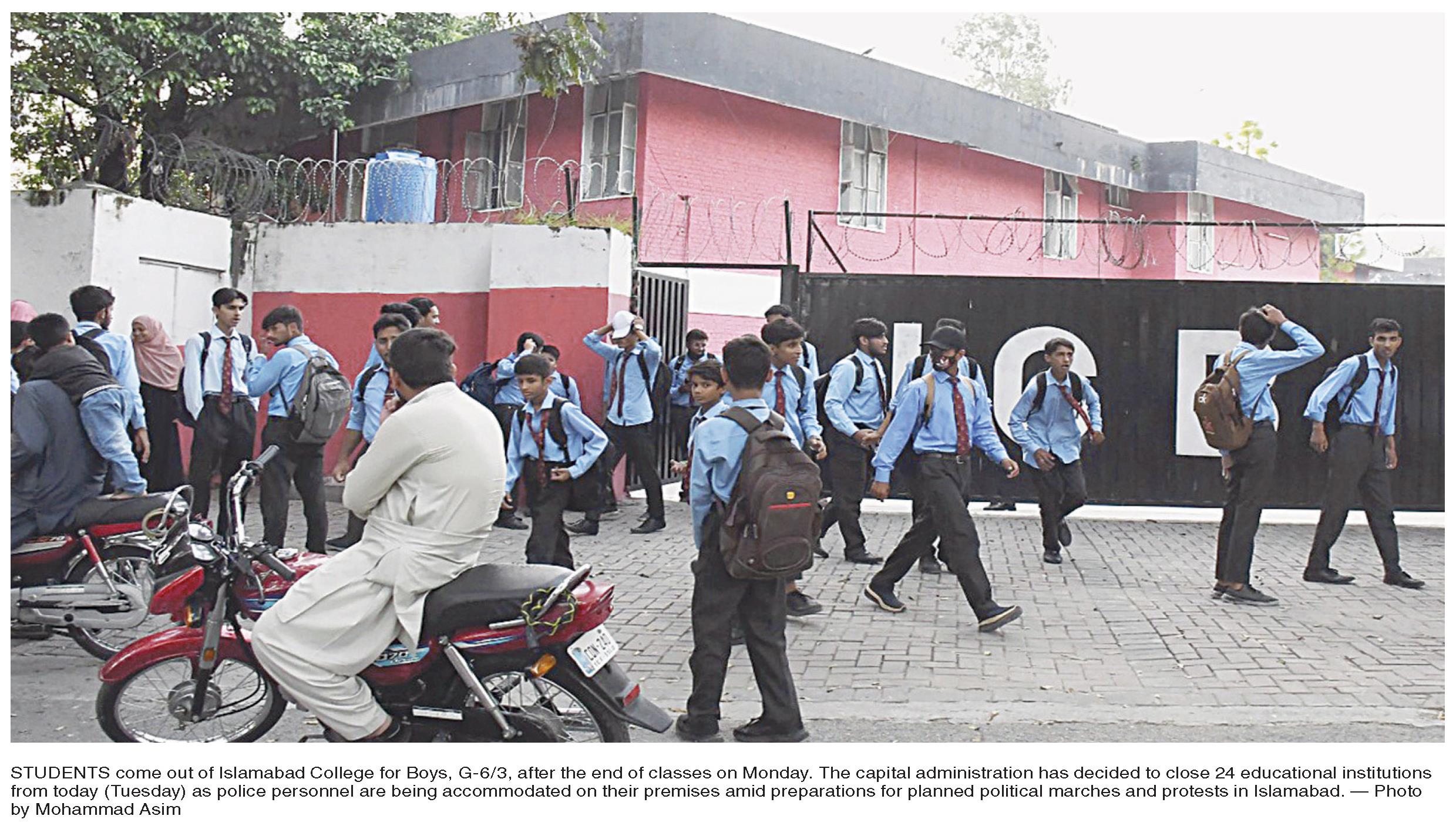
Educational institutions closed Over four dozen buildings have been acquiredforlodgingofthe police personnel. The buildings include government schools, marquees and other government buildings, like Sports Complex and PakChina Friendship Centre. The police personnel from the provinces are likely to start arriving in the capital from today (Tuesday).
Educational institutions where accommodation has been arranged for the visiting police personnel are being closed from today (Tuesday) and the students and their parents have already been informed about the decision.
Islamabad Deputy Commissioner Irfan Nawaz Memon was approached for comment but did not respond.
The extensive deployment of containers and closure of major roads and entry points are likely to cause serious inconvenience to commuters in Islamabad and Rawalpindi.
With key routes such as the Expressway, Srinagar Highway, Margalla Road and roads leading to the Red Zone expected to face restrictions, motorists may have to use alternative routes, leading to prolonged travelling times and traffic congestion.Commenting on the frequent protests in the capital, a diplomat once stated during an informal gathering that ‘Islamabad has five seasons summer, winter, spring, autumn and containers.
Rawalpindi Additional security measures have been introduced in Rawalpindi’s ‘Red Zone’, including the establishment of nine police pickets. A special security plan has been chalked out by the police, under which personnel will be deployed at the pickets round the clock in two 12-hour shifts.
According to sources, foolproof security arrangements have been made to protect important government buildings and installations located in the Red Zone, stretching from The Mall of Rawalpindi to the old airport.
Special police pickets have been established at The Mall, MH Chowk, TM Flashman Chowk, Metro Station Saddar Chowk, T&T Chowk, RA Bazaar Road, Chungi No. 22, Shalimar Chowk and Marka-i-Haq Square.
The Dolphin Force will also patrol designated areas round the clock.
The concerned DSPs and SHOs have been tasked with checking hotels and inns as part of the security arrangements.
Attock Security arrangements have been intensified across Attock district, a key entry point, with containers and sandfilled bags being placed at strategic crossings linking Khyber Pakhtunkhwa with Punjab.
A large number of containers have reportedly been positioned at Attock Bridge and Haroon Bridge, two major crossings connecting KP with Punjab.
The security measures are particularly focused on GT Road and motorway routes near Haroon Bridge, where sandbags have reportedly been placed on both sides of the road.
According to sources, security has also been tightened at other important entry and exit points, including Chach and Ghazi interchanges, while additional police personnel from different districts have been mobilised.
Punjab Police sources said around 30,000 personnel, including senior officers, were being deployed in Attock as part of a wider security plan for the planned protest.
Educational institutions in Hazro city have reportedly been closed temporarily. Some schools have also been earmarked to accommodate police personnel deployed for security duties.
The Attock crossings are considered strategically important because they provide major road links between KP, northern Punjab and the Islamabad-Rawalpindi region, making Hazro and the surrounding bridges a key focal point of preparations for the proposed march.
Mohammad Asghar from Rawalpindi and Amjad Iqbal from Taxila also contributed to the report