
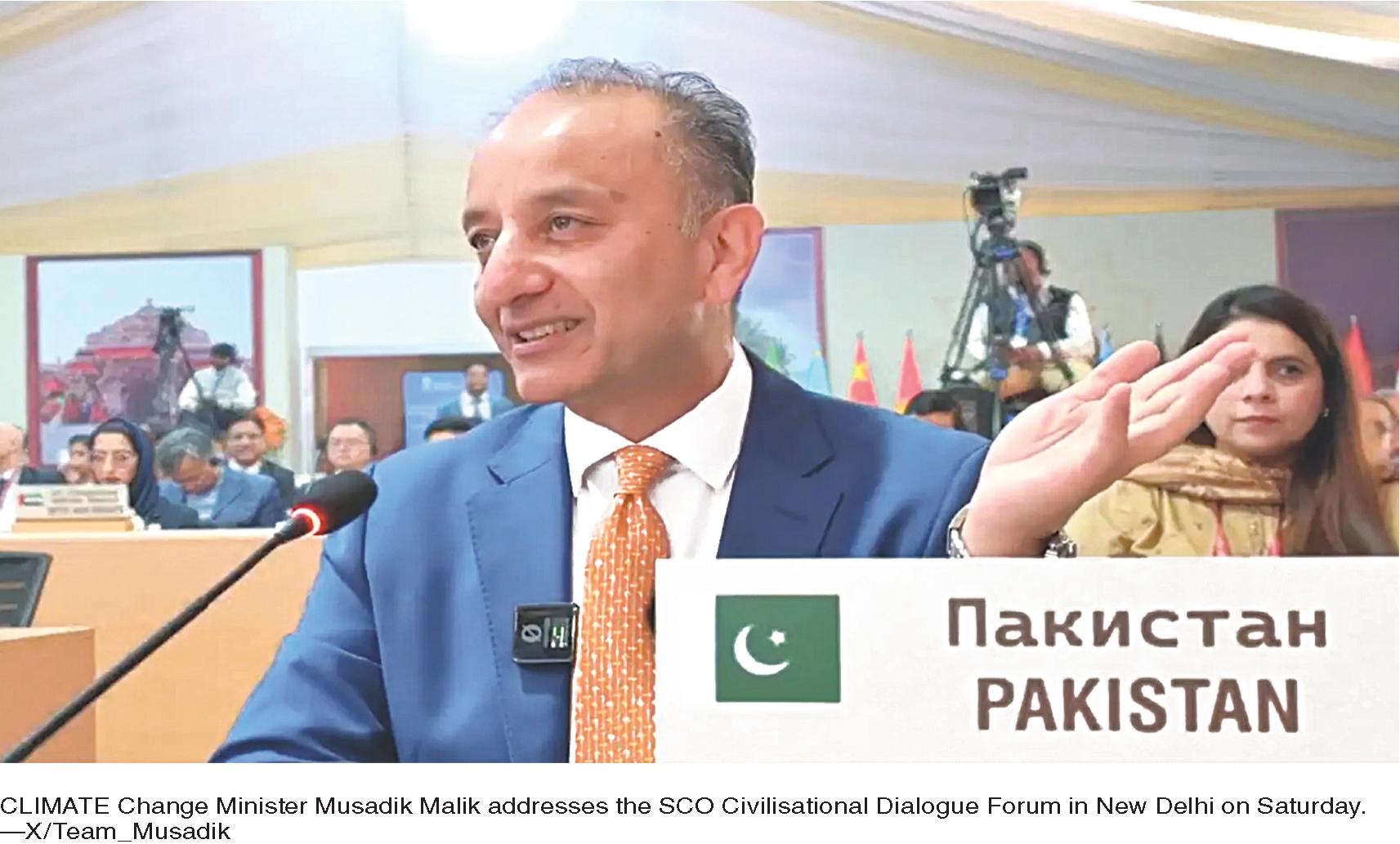
NEW DELHI: Climate Change Minister Musadik Malik on Saturday described climate change as an ‘enemy’ of civilisations, highlighting its devastating impact on South Asian countries at a meeting of the Shanghai Cooperation Organisation (SCO) in India.
Mr Malik is in New Delhi on a three-day visit to attend the SCO Civilisational Dialogue Forum, making him the first Pakistani minister to visit the neighbouring country since former foreign minister Bilawal Bhutto-Zardari attended an SCO meeting in May 2023.
Addressing the forum, the minister said the enemy of civilisation was not another civilisation but climate change, noting that Nepal’s representative had also highlighted the issue.
Mr Malik recalled the Aug 26 floods in Nepal, which claimed more than 1,400 lives and left thousands of others missing, as well as the devastating floods that hit Pakistan in 2022.
He noted that the 2022 monsoon floods claimed 1,700 lives and submerged one-third of the country, including almost the entire province of Sindh.
‘Four days of rain caused Mohenjo Daro’s walls to fall; those walls that no one was able to break for 4,500 years, [climate change] did it,’ he said.
The minister remarked that humans were also an ‘enemy’ because of their contribution to environmental destruction.
‘Do you know what the meaning of Mohenjo Daro is?’ Mr Malik asked. ‘It means mound of the dead.’
He said the ancient site had, in a sense, opened its gates to the living during the 2022 floods, providing refuge to people displaced by the disaster.
He said people had sought shelter wherever they could find it, including parking lots and shopping malls, while mosques, temples, shrines and schools in Balochistan had also opened their doors to flood victims.
‘This is the power of civilisation. This is the power through which nations survive,’ the minister said.
During his speech, Mr Malik presented three proposals for the SCO: the establishment of a network of cultural institutions, a digital repository showcasing the region’s historical and natural heritage, and a climate-resilient heritage framework to address the destruction caused by climate change in the region.
At the beginning of his address, Mr Malik said he had initially intended to deliver his speech in English but felt more inclined to speak in Urdu after considering his proximity to the tombs of Urdu poet Mirza Ghalib and Sufi saint Nizamuddin Auliya.
‘It felt a little strange to speak in English. So, with your permission, I would like to speak in Urdu,’ he said.
The minister pointed out that distinct identities were essential for dialogue, which could only take place between diverse voices.
‘If there is one identity, one voice, then a monologue is needed. There is no need for dialogue,’ he said, comparing it to waking up in the morning, looking in the mirror and speaking only to oneself.
‘There is no beauty in that. Beauty is [in] the vase that has colourful flowers, smell of different kinds. Today, we’re here to celebrate that colourful vase,’ he said.
During his address, Mr Malik highlighted Pakistan’s history and how its civilisation had been shaped by multiple influences, with connections extending across China, Central Asia, Iran and the Middle East.
‘When we look at our roads lead to the north: Bukhara and Samarkand and Central Asia and Afghanistan. The entire history takes us to the north,’ he said. ‘And when we talk about our prayers, our poetry, we are drawn towards the Middle East and Iran or Persia.’
Mr Malik said diversity and the free flow of ideas and identities were things to be embraced. ‘There is wisdom there, in embracing it. We’re here to celebrate these things today.’
Meetings on sidelines
Mr Malik arrived at Purana Qila in New Delhi for the second day of the inaugural SCO Civilisational Dialogue Forum, according to a post shared by his office earlier in the day.
On the sidelines of the forum, Mr Malik held separate bilateral meetings with his counterparts from Tajikistan and Iran, the Pakistan High Commission in India said.
Mr Malik met Tajikistan’s Minister of Culture Sattoriyon Amonzoda and underscored the strong historical and cultural ties between the two countries.
He reaffirmed Pakistan’s resolve to further strengthen these multifaceted ties, particularly through greater people-to-people exchanges.
In a separate meeting with Mohammad Mahdi Imanipour, president of Iran’s Islamic Culture and Relations Organisation, Mr Malik highlighted the deep-rooted historical and cultural bonds between Pakistan and Iran.
He reaffirmed Pakistan’s commitment to further expanding these fraternal ties across all spheres, the high commission said.
A day earlier, after arriving in New Delhi, Mr Malik had described the forum as a ‘tremendous opportunity’ for multilateral dialogue, saying that cultures and civilisations transcended geographical boundaries.
Speaking to Indian news agency ANI, he said the gathering offered an opportunity to discuss shared history, geography, cultures and civilisations.
Mr Malik’s visit to India comes two years after Indian External Affairs Minister Subrahmanyam Jaishankar visited Islamabad for an SCO meeting.
Pakistan currently holds the rotating chairmanship of the SCO Council of Heads of State for the 2026-27 term and is scheduled to host the organisation’s summit in Islamabad in August 2027.