
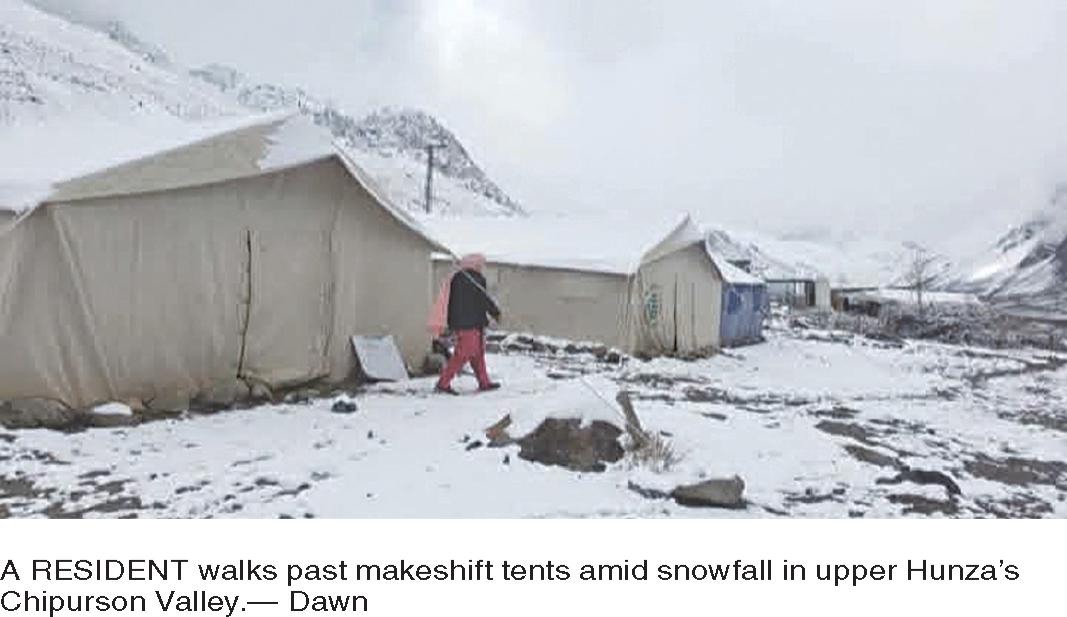
GILGIT: A harsh winter has gripped Gilgit-Baltistan, compounding the hardships of residents as prolonged power outages, road closures and soaring fuel prices bring daily life to a standstill.
Recent snowfall has severed road links to remote districts, leaving routes slippery and hazardous.
Arsalan Ahmed, who lives in Minimarg in Astore district, said villages including Minimarg, Chilum, Kamri, Tatowal, Domal, Rattu and Mirmalik had received up to a foot of snow and would remain cut off for almost six months, with temperatures falling below minus 20°C.
Residents stock up on food and other essentials in advance, but still face shortages of gas, electricity, mobile coverage and medical care.
Heavy snow has also closed Babusar Road, which connects Naran in the Kaghan Valley with Chilas and is normally shut from November to June. The closure forces travellers between Diamer and Mansehra on to a 14-hour journey along the Karakoram Highway, instead of the seven-hour route over Babusar Pass.
Inflation and energy shortages have deepened the strain on households. Mehdi Hussain, a resident of Skardu, said the city endured up to 18 hours of power cuts a day as temperatures dropped below minus 6°C.
An 11.8kg domestic liquefied petroleum gas (LPG) cylinder is priced at Rs3,470 elsewhere in Pakistan, but sells for about Rs7,000 in Gilgit-Baltistan, where firewood, food and public transport are also more expensive.
Those who lost their homes to disasters are suffering most. In the Ghizer villages of Talidas and Rawshan, cloudburst floods last year damaged more than 150 houses and destroyed farmland.
Sahib Jan, a resident, said that although non-governmental organisations had provided some shelters, many families were still living in temporary homes without adequate heating, while frozen pipes had caused water shortages.
Displaced people are also enduring subzero temperatures in tents in the Lous and Parching areas of Astore, in Ghanche and Nagar, and in the Chipurson valley of upper Hunza, where more than 40 families remain homeless after last year’s earthquake.
The power cuts have also disrupted internet access, businesses, online work and education, and winter tourism has collapsed. Ikram Beg, president of the GB Association of Tour Operators, said more than 60pc of residents depended on tourism, yet 90pc of winter activity was suspended for six months because of poor infrastructure.
‘Over 80pc of hotels become dysfunctional, flight operations to Skardu remain limited, flights to Gilgit operate only three days a week and shops remain closed in winter,’ Beg said, adding that inadequate facilities left locals jobless despite the region’s potential for winter sports.
Environmentalists warn that climate change is accelerating glacier melt and flash flooding across a region that is home to about 8,000 glaciers.
The region’s Chief Minister Amjad Hussain Advocate said roughly 1,000 households were affected every year by climate disasters that destroyed homes, roads, powerhouses and schools.
‘Billions of rupees are spent annually on their restoration, placing additional pressure on the region’s limited development resources,’ he said.