
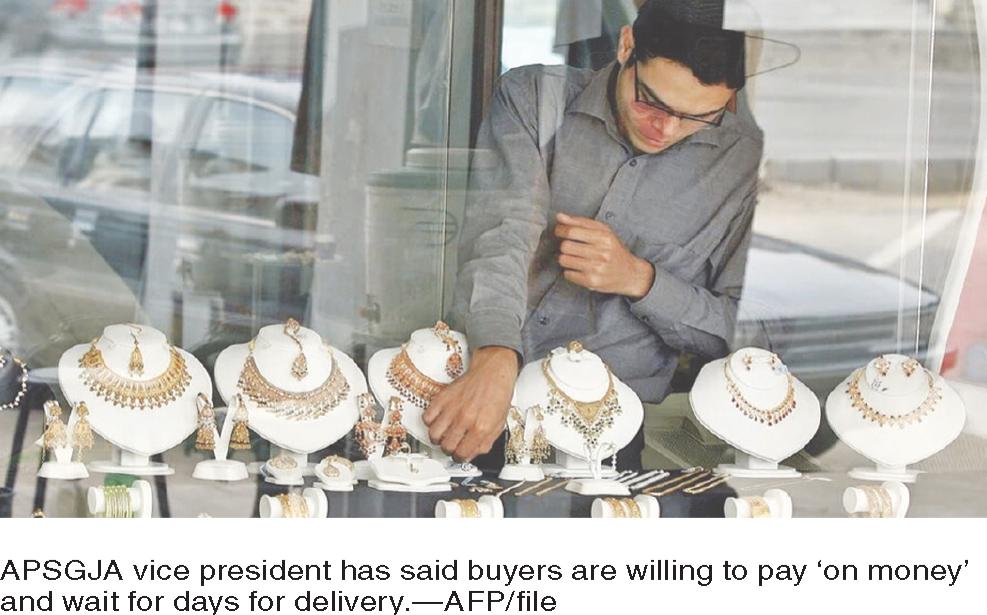
KARACHI: Consumer footfall in Karachi’s gold market has improved following a decline in prices, but jewellers say ‘there are more buyers than sellers right now, in which investors rule the market rather than jewellery buyers’.
However, lower gold prices have also encouraged some genuine buyers to resume purchases after putting them on hold amid a meteoric rise in prices. Many had previously shifted to silver and artificial jewellery.
A random visit to the market suggested that both investors and retail shoppers were visible in gold shops, which had looked deserted when the price of one tola of gold hit Rs585,000 earlier this year.
The sharp increase had driven mainly buyers away from the market, as gold became unaffordable amid high food prices and utility bills.
A salesman at a jewellery shop in Hyderi Market, North Nazimabad, said investors were mainly returning to the market to buy gold in anticipation of further price increases. However, some remained cautious because of uncertainty surrounding the US-Iran-Israel war, although its intensity had eased.
Excessive demand from investors has also led to a shortage of gold bars, prompting dealers to charge premiums of Rs10,000 to Rs30,000 per tola.
‘We don’t have gold bars in our shops. We manage them through our sources,’ the salesman said, adding that bars of almost every weight were in high demand.
Vice President of the All Pakistan Sarafa Gems and Jewellers Association (APSGJA) Hamza Shikarpuri said a premium of Rs10,000 per tola prevailed in the market amid strong investor demand and limited supplies.
‘Investors are happy to pay the ‘on money’ and do not hesitate to wait even one or two days for physical delivery of gold biscuits,’ he added.
According to official rates announced by the association, Pakistan recorded its highest-ever gold prices on Jan 29, 2026, when the price of one tola of 24-karat gold reached Rs572,862 as international prices climbed to $5,505 per ounce.
However, jewellers said the actual record-high price at the time was Rs585,000 per tola, as traders charged premiums amid strong investor demand and a shortage of gold.
When the Middle East war began on Feb 28, 2026, the price of one tola of gold stood at Rs550,000, based on an international rate of $5,278 per ounce.
Currently, gold is priced at Rs376,336 per tola, representing a steep decline of Rs208,664 from the record high of Rs585,000. International gold prices have also fallen by $1,967 per ounce since Jan 29.
While claiming that buyers remained largely uninterested in gold jewellery, Shikarpuri said investors were purchasing even small bars weighing one or two tolas.
Apart from regular investors, some affluent consumers have also been investing in gold while diversifying their holdings across other commodities.
President of the All Karachi Jewellers and Manufacturers Association (AKJMA) Haseen Qureishi acknowledged that investors outnumbered jewellery buyers in the market.
However, he said around 50pc of investors remained hesitant despite the decline in prices, waiting for a further reduction of Rs40,000 to Rs50,000 per tola.
He said the drop in rates had definitely lured genuine gold jewellery buyers to shops, as the marriage season is at its peak this winter and Ramazan begins in early February next year.
Gold prices have experienced unexpected fluctuations amid the Ukraine war, US President Donald Trump’s tariffs on various countries and the ongoing Iran-US-Israel conflict.
However, the rupee-dollar exchange rate has not recorded any significant fluctuations in Pakistan this year, helping avert additional pressure on domestic gold prices.