
SHORTLY after sunrise on Nov 3, the doors of the gurdwara at Aitchison College were thrown open for only the second time since Partition, and the cool morning light crept across its floor. A group of young Sikhs settled in with a harmonium and tabla and began to recite hymns from the Sikh holy scripture.
Inside, Sikhs and Muslim guests – the college’s own prefects among them – sat barefoot and cross-legged on the carpet, heads covered with turbans and scarves.
Many of the visitors from India were in tears. More than 80 years earlier, their fathers and grandfathers had sat on this same floor every morning and evening as schoolboys, to pray.
It was one of the quieter moments of Aitchison College’s 140th anniversary celebrations, held from Nov 2 to 4, and for many of those present it was the one that stayed with them.
Among the guests were around a dozen descendants of Sikh families whose boys had studied at the college, then Punjab Chiefs’ College, from its founding in 1886 until 1947, in some cases across three generations. Their ancestors had left Lahore in 1947 and never returned.
But after the better part of a century, descendants of the Bedi, Bhagowal, Butalia, Chajjalwadi, Isapur, Ladhran, Majithia and Pahuwindia families, the Sodhis of Anandpur, and the families of Sohan Singh and Mohan Singh were able to walk the grounds whose stories they had grown up on.
When the invitation reached Sardar Sukhinder Singh, his first response was that he ‘did not know enough about the college, other than that my father and his brother had studied there.’
The long way round
The visit was more than a year in the making. It grew out of the college’s Archives and Oral History Project, set up to trace the families of pre-Partition students and rebuild their ties with the college, and with the descendants of their ancestors’ classmates on both sides of the border.
Getting to Lahore was not straightforward. Visas came through on the strength of a personal invitation from the principal, Dr SM Turab Hussain. Sarvjit Singh Bedi, grandson of old boys Tikka Jagjit Singh Bedi and Kirti Singh Bedi, admits he had his reservations ‘given the recent history between our countries’, and that several friends told him the time was not right.
‘I went anyway,’ he says. ‘Some opportunities do not come twice.’
At the same tables
The first morning began at the Old Building, recently restored for its 140th year. In the Baradari, beside the marble plaques bearing the names of old boys who served in the two World Wars, Deepinder Kaur Guron wept as her fingertips found the name of her great-grandfather, Sardar Pritam Singh Majithia, the first alumnus to die in the Great War.
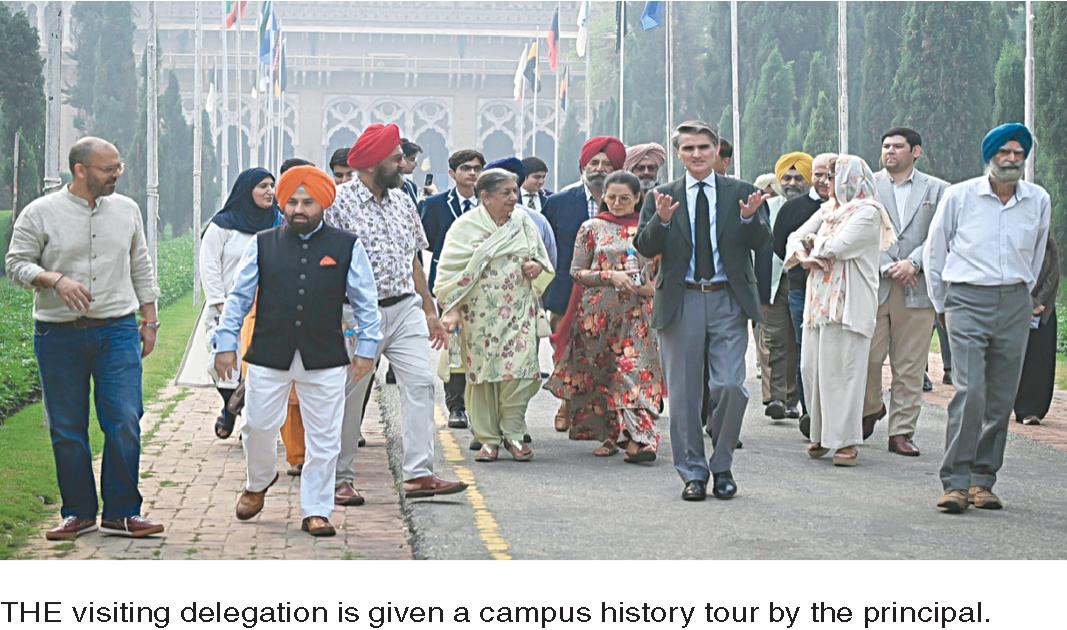
A haze hung over Cypress Avenue as the group set off on a tour of the campus. Lunch was served in the dining hall of Leslie Jones House, where many of the visitors’ ancestors had boarded. Sitting at the same tables where their grandfathers had eaten their daily meals gave many of the guests goosebumps.
Sarvjit Singh Bedi was struck by how much of that past had been kept. ‘Our shared history is still written on its honour boards and walls,’ he says.
A sea of turquoise
After the Keertan on the second morning, the student body gathered for a Special Assembly beside the college’s original foundation stone, laid in 1886 by Sir Charles Umpherston Aitchison, then Lieutenant Governor of Punjab. Among the chiefs present that day was Baba Sir Khem Singh Bedi, one of the most prominent Sikh chiefs of undivided Punjab and a 13th-generation direct descendant of Guru Nanak.
This time, more than 3,000 students stood in uniform and turquoise turbans, their hand-tied turrahs fanned out above them. The turbans ran down Cypress Avenue as far as the eye could see.
From the spot where his great-grandfather had stood 140 years before, retired Brig Amarjeet Singh Bedi rose to speak. He ended, to loud applause, with ‘Aitchison Zindabad’, and wished the college well for the next 1,400 years.
‘A line drawn on a map cannot erase our shared language, culture, history and heritage,’ he says.
In his speech, the principal traced the college’s growth from 12 students in 1886 to more than 3,000 today. ‘Our founders established a college for the aristocracy of their time,’ he said. ‘Today, we aspire to equal opportunity, merit and democratic values.’
Under the lights
That evening, the college and the Aitchison College Old Boys Association hosted a formal dinner at the Old Building, lit up inside and out as if it had been built yesterday. The cake was cut by two of the most senior guests: Malik Muhammad Nawaz Tiwana, the college’s second most senior living alumnus, and Brig Bedi.
Among the distinguished alumni in attendance were former National Assembly speaker Syed Fakhar Imam, noted lawyer Aitzaz Ahsan, former Chief Justice Umar Ata Bandial, ex-diplomat Malik Amjad Ali Noon and senior advocate Ali Sibtain Fazli.
For Fazli, the evenings were a reminder ‘that while history may divide territories, it cannot so easily erase memories, friendships or a sense of belonging.’
On the final evening, a gathering at the Lahore Fort brought the visitors together with old boys. Some of the guests’ elders had been known to Tiwana’s own family, and when he rose to speak, he talked about those ties.
Around the official programme, the visitors found time for the city itself. Sarvjit Singh Bedi visited the old Punjab Assembly building, where his grandfather served from 1937 to 1942. Lahore, to him, ‘was, and still is, the cultural heart of Sanjha Punjab’, the shared Punjab of both sides of the border.
The families did not come empty-handed, and presented the college with three running trophies for its best teachers, one of them the gift of the Patiala royal family, the largest donor when the college was founded in 1886.
Malwinder Singh Guron, whose grandfather studied at the college, hopes the visit is only a beginning. ‘God willing, a time may also come when our children and grandchildren can have a shared experience of growing up together on the campus of Aitchison College,’ he says.
(A detailed version of this article can be accessed on Dawn.com)