
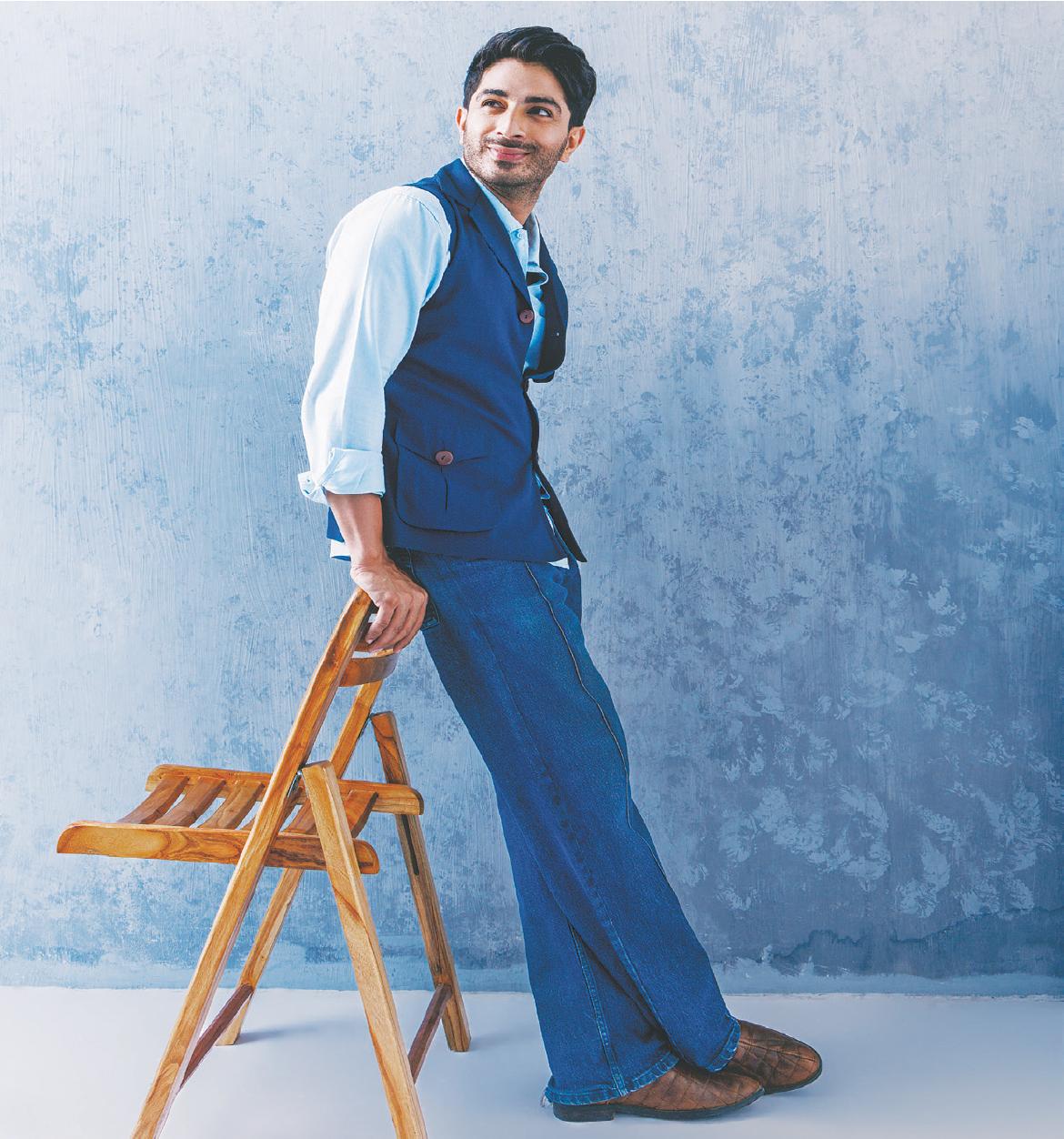
Talha Chahour expounds convincingly about what it takes for an actor to become someone else on screen as our conversation begins. Not in the philosophical sense — although he’s quite capable of going there too — but in the practical sense, of getting into character.
The way a person walks, for instance. Or stands. The way he holds himself when he enters a room. These are small details most viewers probably don’t consciously notice but, for Talha, they’re essential to making a character believable.
‘Getting the walk right is one of the most difficult things in acting,’ he says. ‘Your walk and your body language should look different from character to character.’
He gained eight kilos for his latest role in the drama serial Rutba, grew a moustache that he’s been sporting for a year and spent a lot of time observing how police officers carry themselves. None of it is incidental. ‘My face and my body belong to the character I’m about to portray,’ he says. ‘They’re entrusted to me for that character.’
It’s an intense approach from a 28-year-old actor whose good looks could easily have earned him a place among Pakistani television’s romantic leads. Talha, however, seems more interested in how convincingly he can disappear into a character rather than in how appealing he looks. His years in theatre have a lot to do with that.
‘I don’t work just to look beautiful,’ he says. ‘I work to look real. Truth sells. Beauty alone doesn’t.’
THE INTOXICATION OF POWER
The character currently occupying his attention is assistant superintendent of police (ASP) Hadi in Rutba, written by Umera Ahmed and directed by Haseeb Hasan. The drama is based on a true story, something Talha keenly stresses.
‘What intrigued me the most was that it’s a true story,’ he says. However, the identity of the police officer whose experiences form the basis of Hadi’s story cannot be revealed. Talha was deeply affected by what he read about the real officer’s experiences. ‘I started reading about his life and, at several places, I felt like crying, thinking about everything they had been through,’ he recalls.
Rutba is his second project with Umera Ahmed and Haseeb Hasan, following Jannat Se Aagey, and he was delighted when the producers approached him. The script offered something he hadn’t done for TV before: a character whose principles are tested by the power he acquires.
Hadi comes from a modest, religious household. He’s a hafiz-i-Quran [committed the Quran to memory], the son of an imam [mosque prayer leader] and has worked hard to qualify for the civil service. He enters the police force with ideals that begin to clash with a rotting system.
‘Hadi’s isn’t just the story of an ASP,’ Talha says. ‘It’s a story about the intoxication of power.’
He talks about a young, idealistic officer who wants to dispense justice but finds himself confronting political pressure, money, bribery and moral corruption. The struggle isn’t simply between a good man and a bad system. It’s also about what happens to the man himself.
‘How does the system break him? How does it squeeze him?’ asks Talha. He is insistent that Hadi’s weaknesses must be visible. ‘I didn’t want to give the audience a fairy tale,’ he says. ‘I wanted to give them a real human being who stumbles.’
He emphasises that ‘an official position can be transferred, but your stature is built through your character. What matters is how a person uses the authority entrusted to him. Do you help people? Do you dispense justice?’ And that, Talha believes, is the real test. ‘It [an official position] is a test, not a reward.’
MADEEHA GAUHAR’S PROTÉGÉ
The seriousness with which he approaches Hadi is hardly surprising when one considers where Talha’s journey began.
Born and raised in Rahim Yar Khan, Talha had been involved in debates and school plays since childhood but, while studying at Government College University (GCU), Lahore, acting became something more substantial. He was studying political science after securing admission through the university’s drama quota. He became one of only two students who were selected for the drama quota from approximately 200 applicants.
During his first year at GCU’s Dramatics Club, Madeeha Gauhar, founder of Ajoka Theatre, noticed him. ‘She went to Hassan Amir Shah, the vice-chancellor at the time, and told him, ‘I want this boy,’’ Talha remembers. ‘And then she took me with her. That’s how my journey in professional theatre began.’
Madeeha became his mentor and what he calls his ‘artistic mother.’ Under her guidance, Talha began performing professionally, travelling with Ajoka to India, the United States, Denmark and other places. He estimates that he gave more than 400 theatre performances, taking on a range of characters and plays that few television viewers would associate with him.
There was Banda Singh Bairagi, the Sikh warrior and ascetic. There was Purniya, a historical figure associated with Tipu Sultan’s court, a role for which Talha shaved his head and sported a ponytail. He also played Macbeth and performed in Doctor Faustus.
Theatre, he says, also gave him something that is not easy to describe. He uses the English word ‘subtlety’ to describe what travelling, meeting different people and experiencing different cultures brought into his life. ‘I learnt so much through theatre,’ he says. ‘Travelling and meeting people taught me things that I might otherwise have learnt much later in life.’
What about the transition from theatre to TV?
‘Theatre and television are two completely different mediums,’ he opines. Theatre demands the use of the entire body, while television allows an actor to communicate through the smallest movements, particularly the eyes, he points out. ‘A sensible actor who has done theatre properly and understands the difference between the two mediums has a great advantage, but some people don’t understand that difference. They’re still doing theatre when they’re on television.
‘Unfortunately, theatre here is almost non-existent,’ he continues. ‘There are so many different kinds of theatre around the world. There is musical theatre, street theatre, peace theatre. But how much theatre is actually happening here? Very little. And how many people go to watch it? Very few.’
But Talha’s choice to leave the stage had less to do with the state of theatre than with losing his mentor. When Madeeha died in 2018, he quit theatre. ‘I said goodbye to theatre because all the joy associated with it was connected with her.’
He was in the final year of his degree then. After graduating, he returned to Rahim Yar Khan and became involved in his father’s political activities. Television offers came from Lahore and Karachi, but none convinced him to make the move. ‘I always thought, if I’m going to do something, I’ll do it well. Otherwise, I won’t do it at all.’
He continued auditioning occasionally and, in late 2021, an opportunity finally presented itself. ‘Haissam Hussain was holding auditions for Jo Bichharr Gaye, which became my first television project,’ Talha recalls. ‘He didn’t watch the auditions for a month. When he finally did, I got a call from his associate and they gave me the role of Captain Farrukh.’
The drama introduced him to a much wider audience and marked the beginning of his television career. Mannat Murad, Jannat Se Aagey (2023) and Jama Taqseem and Neeli Kothi (2025) followed. But Talha never forgot what theatre gave him. ‘Theatre has its own intoxication but it has become a medium for a very limited audience. Television is the medium through which you can show your work to the world.’
His preparations for playing ASP Hadi in Rutba have gone beyond simply changing his appearance and body language. He wanted to understand the pressures that officers face and the compromises that can come with their positions. Talha wishes actors were given more time for preparation.
‘You simply don’t have enough time to work on your body language,’ he says. ‘Suppose you’re told you’re going on set next month. What can you possibly do in one month? The script is finalised, and suddenly you’re shooting the following month. So, you end up with the same look.’
However, he praises Haseeb Hasan’s directing style, which has helped him develop the character further. Talha describes the director as someone who spends considerable time working with his actors, sometimes using music to help them enter a scene.
‘He gives you time,’ Talha says. ‘He conducts workshops with music.’ This is something I haven’t heard of before, and he explains that Hasan often has a particular piece of music in mind for a scene. It may play softly while he discusses the character’s emotional state with the actor. ‘It increases the feelings,’ Talha says.
SUCCESS ON HIS OWN TERMS
Despite all this attention to detail, Talha isn’t particularly anxious about the commercial expectations that come with a leading role. He acknowledges that ratings matter, but doesn’t believe they should be the only measure of an actor’s achievement. ‘Of course, TRPs [ratings] make a difference,’ he says. ‘But I don’t look at things as a race.’
For him, satisfaction comes from doing justice to a character. ‘Even if fewer people are watching, if they understand the layers of your character, if an intelligent viewer understands what you’re doing, then that’s an actor’s victory.’
He has a similarly uncomplicated answer when asked whether he feels pressure or not now that he’s in a major drama. ‘I don’t take pressure,’ he says.
His explanation has much to do with faith, a subject he returns to several times during our conversation. Talha believes in working sincerely, putting in the effort and leaving the outcome to Allah.
‘No matter how hard a person works, what God gives is greater than that effort,’ he says. ‘If He wishes, He can make something small appear very big. And if He doesn’t, that’s His will.’ This doesn’t mean Talha has no ambitions. He wants to improve constantly, both professionally and personally. But he doesn’t measure that improvement through fame or his next role.
When I ask what advice he would give aspiring actors, he begins talking about the desire to become a star overnight. Instagram influencers and TikTok personalities enter the conversation, and he makes it clear that he has reservations about the obsession with becoming famous at any cost. So what would he say to them?
‘I’m not going to say anything,’ he replies, laughing. ‘I’m not going to bowl a loose ball.’ He laughs again and offers everyone his good wishes instead.
Talha is more forthcoming about what he wants for himself. He believes that growing older should mean becoming more thoughtful, not simply more successful. ‘Instead of becoming taller, I want to become deeper,’ he says.
‘Something that is only tall can be shaken by the wind. But something deep remains strong even in storms,’ says Talha. ‘I want to improve myself as a person and an artist and move forward.’
THE CONVERSATIONS THAT LINGER
Part of this introspection comes from a personal experience. Talha’s mother died about two years ago, and the loss has changed the way he relates to the world.
Talha is the youngest of his siblings, and he describes his mother as someone the entire family shared their worries and everyday experiences with. ‘My mother was my friend,’ he says. ‘She was the person I shared everything with.’ Whenever something troubled him, he would call her. She had a way of calming him down, of making problems seem less overwhelming.
After her death, something fundamental changed. ‘The chapter of sharing in my life closed,’ he says. ‘Now I share everything with Allah.’ Even with close friends, he finds it difficult to express certain feelings. ‘When I’m performing or working on something, I feel a great sense of peace,’ Talha says. ‘It’s in this work that I find comfort.’
‘Now, whenever I get time off, I run home,’ he says. ‘Even if I get two days, I go. If I don’t get a flight, I’ll take the car and leave.’ He wants to visit his mother’s grave and tell her what’s been happening in his life… the things he would have shared with her in an ordinary conversation.
He doesn’t try to make the experience sound less painful than it is. He talks about turning to God when things become difficult, about crying and finding solace in prayer. The grief remains, even as life and work continue. Perhaps that’s why he has become more conscious of time and the general tendency to spend time worrying about what comes next.
‘We remain caught up in the future and the mistakes of the past, and we ignore the present. Then time passes and we look back and say, ‘I didn’t even enjoy the journey.’ Enjoy what you have,’ he says thoughtfully. ‘Live your life, because zindagi na milegi dobara [you won’t get another life again].’
His acting inspirations include Irrfan Khan, whom he names immediately, and Pakistani legends such as Talat Hussain, Moin Akhtar and Zia Mohyeddin. He speaks of the latter with particular admiration, not only for his craft but for his character and rutba [stature]. The word surfaces again during our conversation: rutba. Not the position a person occupies, but the respect he earns.
As for what’s next, Talha is reading scripts but hasn’t finalised anything. He still has some work remaining for Rutba and would like a little time for himself before taking on another character.
Karachi, meanwhile, is somewhere he comes to work rather than somewhere he seems eager to settle. ‘When I have a project in Karachi, I come, do my work and then run back home,’ he says, laughing. Home remains Rahim Yar Khan. It’s where Talha Chahour’s journey began, where his family remains, and where, whenever work allows, he returns to visit his mother’s grave and tell her what he can no longer say over the phone.
The writer is a people watcher and is particularly fascinated by pop culture.
X: @Shahrezad