
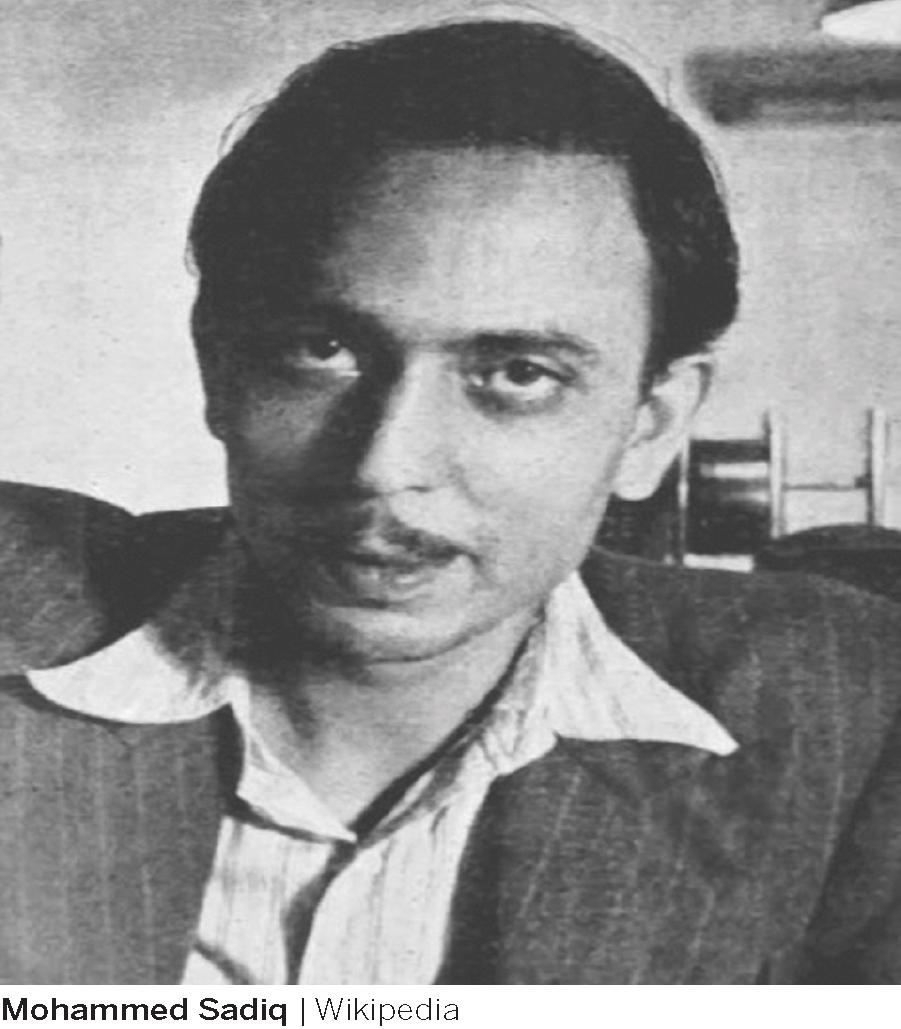
South Asian cinema has been shaped by talented directors, remarkable writers and gifted storytellers. Among them was writer, director and producer Mohammed Sadiq, who began his career in Lahore when the first talkie was being made. He later moved to Bollywood, made his mark with musical romances and historical dramas there and eventually returned to Pakistan to die with his boots still on and his camera running.
Among Sadiq’s best-known films are Chaudhveen Ka Chaand [1960, Full Moon], starring Guru Dutt, Waheeda Rehman and Rehman, the historical romance Taj Mahal (1963), the Waheed Murad-Rani hit Baharon Phool Barsao [O’ Spring, Shower Your Flowers, 1972] and Noor Jehan (1967).
Known as ‘Babu’ Sadiq, he was born in Lahore on March 10, 1910 (although other sources say he was born on March 2, 1911) into a family of modest means. After matriculating and a brief stay for work abroad, destiny brought him back to Lahore in 1930.
When the 20-year-old Sadiq joined A.R. Kardar’s United Players Corporation, little did he know that he was beginning a lifelong journey in filmmaking. As Indian cinema entered the sound era with Alam Ara (1931), Lahore produced its first talkie, Heer Ranjha (1932), where Sadiq began his career as a dialogue writer.
He soon became one of Kardar’s trusted assistants, alongside S.U. Sunny, who later directed several Dilip Kumar hits, including Mela [Festival, 1948], Babul (Father, 1950), Urran Khatola [Flying Saucer, 1955] and Kohinoor [Mountain of Light, 1960]. When Kardar moved to Calcutta, and later to Bombay in 1937, he took Sadiq along, keeping his promising protégé close.
Under Kardar’s mentorship, Sadiq learned directing, screenwriting, dialogue writing and editing. In 1943, he directed Namaste [Salutations] for Kardar, which also featured Alauddin, who later became one of the most popular actors of Pakistan.
Sadiq pursued an independent career after parting ways with Kardar during the making of Sanyasi [Hindu Mystic, 1945], and established his own production house in 1949, working as a director and writer across various genres. However, the 1950s were harsh for him and, by the decade’s end, he was struggling to make ends meet.
An unexpected opportunity arose after the commercial failure of Guru Dutt’s Kaaghaz Ke Phool [Paper Flowers, 1959]. Dutt had vowed never to direct another film again, but he wanted to produce a Muslim social drama that captured the traditions, manners and romantic culture of Lucknow.
Dutt admired Sadiq’s work and asked him to direct Chaudhveen Ka Chaand. Ravi’s music, brought to life by Mohammed Rafi’s memorable vocals, remains popular to this day. The film revived Sadiq’s standing in the industry, although major directing opportunities remained scarce for the next three years.
In 1963, he directed Taj Mahal, a historical romance about Mughal emperor Shah Jahan and Mumtaz Mahal. The film was noted for its lavish sets and memorable music, particularly the song ‘Jo waada kiya woh nibhaana parrega’ [You will have to fulfil the promise you made], rendered by Mohammed Rafi and Lata Mangeshkar.
Sadiq’s final major films in India were Noor Jehan and Bahu Begum [Daughter-In-Law], both released in 1967 and starring Meena Kumari and Pradeep Kumar. Despite their period settings and music, neither achieved the expected commercial success in India. After spending most of his working life in India, Sadiq moved to Pakistan in 1970. Despite his frail health, he remained determined to make films. With his Bombay associates, poet Shevan Rizvi and music director Nashad, he began work on Baharon Phool Barsao in 1971 under his own banner, Sadiq Productions.
Sadiq cast the chocolate hero Waheed Murad and Rani in lead roles, with Aslam Pervaiz as the villain. Drawing on the culture of Lucknow, the story of Baharon Phool Barsao reflected a world Sadiq knew well and had explored in his earlier films. A great admirer of Guru Dutt, Waheed Murad had the rare opportunity to work with the director of his idol, making the association particularly special for him. Sadiq also wrote the story and screenplay for Hasan Tariq’s Deedaar [Sighting, 1974], a film set in the familiar world of courtesans, nawabs and the mujra [a courtesan’s performance] culture.
Thinking of playing a long second innings, Sadiq established an office in Evernew Studios and took on budding director Masood Asghar as his assistant. Celebrated writer-director Syed Noor had the opportunity to meet Babu Sadiq during the making of Baharon Phool Barsao, as he was assisting Masood Asghar on the Punjabi film Sajjan Beparwah [Careless Beloved, 1972].
Talking to Icon, Syed Noor recalls, ‘Babu Sadiq was a man of few words, but he commanded everyone’s respect. [Actors] Waheed sahib and Munawar Zarif held him in great regard, while Rani too respected him. There was a sense of pride on the studio floor that a filmmaker of Sadiq’s stature, a well-known name in Bollywood, was making a film in Lahore.’
Sadly, Sadiq’s health gave in and he did not live to finish the film and he passed away on October 3, 1971 in Lahore. Following his death, Hasan Tariq put the plans of making Deedaar on hold, took over the production of Baharon Phool Barsao and completed the film.
Released in 1972, Baharon Phool Barsao became a major hit and eventually earned a place among the classics of Pakistani cinema. The song ‘Mere dil ki hai awaaz’ [The voice of my heart] by Masood Rana and ‘Yeh ghar mera gulshan hai’ [This home is my garden] by Madam Noor Jehan are still quite popular with music aficionados. Sadly, Sadiq’s work was appreciated after the death of most of the people associated with its production.
Baharon Phool Barsao enjoyed a Golden Jubilee run when re-released after Waheed Murad’s death in 1983. Similarly, Noor Jehan, the 1967 Indian production that underperformed in India, attracted considerable attention in Pakistan after receiving special permission for exhibition during Gen Ziaul Haq’s rule, and introduced Pakistani audiences to Meena Kumari years after her death.
A versatile filmmaker who moved easily between genres, Sadiq belonged to a generation of filmmakers whose careers crossed the political boundaries created by Partition. He may not be as widely remembered as some of his contemporaries, but his contribution deserves greater recognition. His story reminds us that cinema’s history belongs not only to its celebrated stars but also to the dedicated filmmakers who worked behind the camera. ■
The writer is a vintage cinema enthusiast. He can be reached at suhaybalavi@gmail.com