
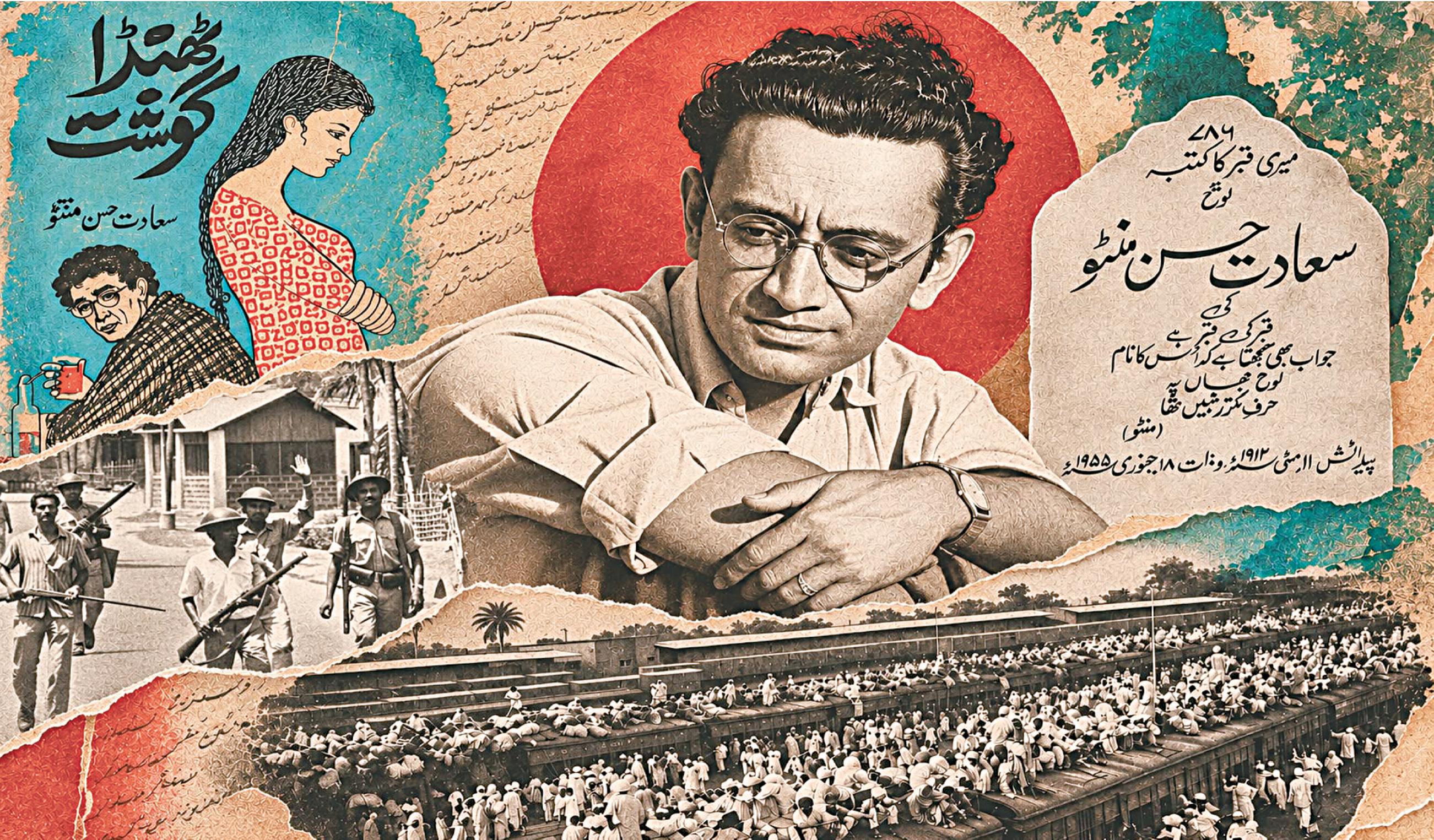
Lahore, where Manto spent his final seven years, was a place of misery and agony yet brimming with creativity. His earliest writings there, such as ‘Sawaal Paida Hota Hai’ [The Question Arises], ‘Thanda Gosht’ [Cold Meat], and ‘Khol Do’ [Open It] were considered offensive and obscene.
Despite his substantial contribution to Lahore’s literary heritage, the city’s overall cultural landscape remained unkind to him. However, now the city celebrates him and feels proud of him.
Manto’s work transcends borders and fosters cross-border dialogue, as reflected in the conference’s title, Dhaka Dialogics. Dialogism, a theory by Russian [philosopher and literary critic] Mikhail Bakhtin, posits that language, thought and human experience emerge from the continuous dynamic interaction between diverse voices.
Manto’s writings embody dialogism, constantly engaging with diversity. He wasn’t just a fiction writer; he employed various genres to avoid the label of ‘yak fana’ [master of one skill]. Manto’s diverse body of work includes stories, pen sketches, dramas, essays, letters and a novel, all embracing multiple perspectives.
MANTO’S CONNECTION WITH BENGAL
Manto’s life, though brief at just 43 years, unfolded in Amritsar, Mumbai, Lahore, Aligarh, Delhi and Karachi. Bengal and East Pakistan, though not visited, appear in two of his short stories.
In ‘Paanch Din’ [Five Days] — part of the Chughad anthology published in 1948 — the protagonist Sakina is sold during the Bengal famine of 1943 and meets an old professor with tuberculosis in Lahore. Sick of his pious life, the professor falls in love with this young Bengali woman. He lives just five days, admitting no remorse for his long early life. Sakina is infected and arrives at a Kashmir sanatorium, where she meets Manto.
‘Mauj Deen’ (Burqay, 1955) also takes place in Lahore and Kashmir. The titular Mauj Deen introduces us to his East Pakistani origins and his studies in theology at Lahore’s charity school. He travels to Muzaffarabad, Kashmir, to collect charity and meets Manto. They discuss the Kashmir jihad and resolve to fight for Kashmir’s freedom. Mauj Deen writes a letter to his parents in Bengali, but a secret agency misinterprets it as a spy letter, leading to his arrest and suicide. Writing in Bengali ultimately becomes his downfall. Poverty, love and death are common themes in both stories.
It’s worth noting that Bengali novelist Rabisankar Bal, who also translated Manto into Bengali, depicted Ghalib and Manto in conversation within his novel Dozakhnama [Conversations in Hell]. The novel, also available in English and Urdu translations, focuses on the pivotal years of 1857 for Ghalib and 1947 for Manto, both of which significantly shaped South Asian history.
In the second chapter, Manto reflects on his belief that he and Mirza Ghalib are two mirrors facing each other, observing the void between them. He questions whether they could avoid a dialogue. Manto suggests that the void itself creates the necessity for dialogue, not to eliminate it, fill it or avoid it, but to utilise it as a space for conversation. The 19th and 20th centuries of South Asia can engage in meaningful conversations through Ghalib and Manto.
WHY MANTO MATTERS
Manto’s significance lies in his rare ability to unravel complex realities in simple, ordinary language, without sacrificing aesthetics. His art doesn’t reproduce ordinariness. Instead, it collapses it to reveal its hidden conflicts, powers and weaknesses.
While he was a voracious reader of Urdu, Punjabi and world literature, including Marxism and psychoanalysis, his writings did not originate from archives, tradition or ideology. Instead, he captured the lived realities of his age, depicting the flow of life in cities such as Amritsar, Mumbai and Lahore. However, he did not adhere strictly to phenomenological or autobiographical writing.
The true theatre of existence remained his subject matter, a realm imbued with more than mere absurdity. Manto’s writings reveal that this theatre is defined by power, which dictates the script, the stage, the actors, their roles and destinies. While he acknowledges this power as the ruling elite imagined by Marxists — embodied in the state and its leaders — Manto ultimately conceives of it as fluid, constantly seeking new identities. He doesn’t merely recognise this power but questions it.
Manto understood that bluntly challenging power isn’t effective. As an artist, you must create a crisis within your characters’ lives. This crisis reveals the dynamics and intentions of power, making it vulnerable and prompting natural questions about its legitimacy.
He believed literature is not about sickness caused by power, but a reaction to it — a reaction stemming from the depths of the human soul, which is ultimately courageous. He himself faced trials with grace, expressing pain in his writings, without surrendering to power or corrupting the authenticity of his experience.
Manto sought not just defiance in his characters but a strength that challenged the power of patriarchy, social norms, institutions and tradition. He portrayed characters that sought diverse ways of confronting power, from distrust to disgust to denial to silence.
This way Manto’s significance resonates with our South Asian identity and our shared existential experiences.
QUESTIONING, POWER AND DECOLONISATION
Manto published three collections of essays: Manto Ke Mazameen [Manto’s Essays, 1942], largely humorous, and the post-Partition collections Talkh, Tursh Aur Sheereen [Bitter, Sharp and Sweet, 1954] and Oopar, Neechay Aur Darmian [Above, Below and In the Middle, 1954], which are predominantly satirical engagements with uncomfortable social and political realities.
Let’s start with Manto’s questions: where do they originate? What is their nature, scope, and both artistic and political significance?
For Manto, questioning is not just an intellectual activity. While every question involves thought, its deeper source seems to be a condition of maladjustment — a failure to fit in with the social, political or inner-existential world. Anxiety, insecurity, fear, suffering, injustice and manufactured confusion are among the affective manifestations of this maladjustment, which consequently leads to raising questions.
The realities Manto engages with are predominantly bodily, sensual, social and political. They are encountered in the courtroom, the street and the bazaars, at refugee camps and in communal violence, and due to poverty, sexuality, political authority and war. The emotions generated by these realities become the conditions from which questions arise.
Manto does not seek to resolve this maladjustment by converting it into adjustment through religious consolation, belief in destiny, promises of an afterlife, psychoanalytic explanation or political repression. His critical impulse lies precisely in refusing such easy reconciliation.
Social injustice, for Manto, cannot simply be accepted as the natural or divine order of things. It is produced and legitimised through social and political arrangements and, crucially, through the discourses of those who possess power. As he repeatedly suggests, governments and political leaders attempt to make historically produced realities appear natural, inevitable or divinely ordained.
Manto’s conception of power is more complex than a simple opposition between power and resistance. Power does not merely prohibit questions; it also produces questions of its own. It determines which questions may be asked, which questions are legitimate, and which questions must be suppressed. The political struggle consequently takes place not only over answers but over the very formulation of questions. Manto questions the questions produced by the powerful to neutralise questions arising from below.
Manto’s questions are also historically situated. Colonial India, the struggle for independence, Hindu-Muslim relations, Partition, migration, communal violence, the formation of Pakistan and the Cold War do not simply constitute the background of his writing; they generate the questions through which he interprets his historical moment.
I’d like to focus on two essays by him from the post-Partition era that raise unsettling questions.
THE QUESTION AS A DEMOCRATIC AND SUBALTERN ACT
After Partition, Manto’s questions became more immediate and politically charged. When he arrived in Lahore in January 1948, he encountered a city whose demographic and cultural structure had been radically transformed.
Lahore’s new identity was being formed through the disappearance of people, buildings, memories and cultural practices. For three months, he couldn’t write. This silence wasn’t just writer’s block; it was a crisis of representation: how can a writer represent a reality whose terms have been violently transformed?
He subsequently began writing essays in which the question itself became a literary device. In The Question Arises, Manto locates questioning in everyday social life rather than restricting it to philosophers or intellectuals:
‘Whether a man is a barber or a cobbler, a chamaar [tanner] or a sweeper, a millionaire or a pauper, questions are bound to arise in his mind. And so far, no method has been discovered by which their birth can be controlled.’
The statement has an important democratic implication. Questioning is not the privilege of an educated elite; it is an irreducible capacity of ordinary human beings. The barber, cobbler, tanner, sweeper, millionaire and pauper all possess the capacity to interrogate the world.
Manto then places these questions within institutions of authority. In the courtroom:
‘In the courtroom, the magistrate is smoking his hookah while, at the same time, reading the Diwan-i-Chirkeen. No question arises. The accused is brought before him. He does not salute the magistrate. At once, the question of contempt of court arises.’
The satire exposes the asymmetry through which institutions decide what counts as a problem. The magistrate’s conduct produces no institutional question; the accused’s failure to perform the expected gesture of submission immediately becomes one. The question, therefore, is not neutral. It is embedded in relations of power.
Manto makes this political asymmetry explicit:
‘Questions are generally dangerous. Whether they arise in the minds of rulers or in the minds of the ruled, they are dangerous. In the mind of the government, however, there is generally only one question: which Acts should be invoked so that the questions arising in the minds of the people about the government may be suppressed?’
Here the question becomes a site of political struggle. The state responds to questioning not necessarily by answering it but by regulating the conditions under which it can be articulated.
Manto’s ordinary citizens, nevertheless, continue to produce questions. A kebab seller asks: ‘Sir, I have heard that Hazrat Umar, who was the Caliph of the Muslims, used to sweep the mosque. Does Quaid-i-Azam sweep the mosque too?’
A paan seller asks: ‘I want to ask Quaid-i-Azam: is this what an Islamic government is — that rags hang from my body while you wear newer achkans [long formal jackets]?’
These questions are significant because they connect political authority with everyday material inequality. They also demonstrate Manto’s characteristic method: rather than presenting an abstract political argument, he allows a seemingly naïve question to expose a contradiction within the political order.
THE QUESTION OF A STATE WITHOUT SATAN
Manto’s 1949 essay ‘Allah Ka Barra Fazal Hai’ [Blessings of Allah Are Immense] extends this critique into a dystopian satire of totalising religious authority.
In a religious state, everything associated with the classical, modern, secular and Western worlds is systematically eliminated. Art, literature, science, museums, journals, newspapers, courts and prisons are represented as forms of moral corruption and are consequently abolished.
Manto’s satire reaches its force through the inversion of ordinary political and moral language: ‘Ever since this part of the Earth was purged of poets, the atmosphere has become completely clear and transparent.’
The absence of poetry is presented as purification; censorship becomes cleanliness.
Similarly, the elimination of progressive poets is celebrated:
‘I never told you, did I? Toward the end of the age of poetry, some poets had emerged who wrote verses not about beloveds but about labourers. In place of tresses and cheeks, they praised hammers and sickles… Praise be to God, gentlemen, that we have been delivered from those labourers. Those wretched fellows wanted a revolution, you know? They wanted to overthrow the government, the social order, capitalism — and, God forbid, religion itself.’
Science undergoes the same process of demonisation:
‘These people who called themselves scientists — may they be accursed! They dared to claim the power of creation in defiance of God. ‘We shall make an artificial Sun that will illuminate the whole world at night. Whenever we wish, we shall make it rain from the clouds.’ Just think about it: this was Nimrod’s godhood, wasn’t it?’
The satire becomes particularly pointed when medical and astronomical knowledge are represented as attempts to challenge divine authority:
‘A cure is being sought for a fatal and supposedly incurable disease like cancer — in other words, they are trying to wrestle with the Angel of Death himself. And then there is another fellow, sitting there with a telescope, claiming that he will reach the moon.’
The regime has thus succeeded in purging the world of everything it defines as profane. Yet the possibility of questioning returns through a seemingly paradoxical question: how can one live in a world in which there is God but no Satan? The questioner cites Iqbal:
مزی اندر جہانے کو رذ وقے کہ یزداں دارد و شیطاں ندارد
[Don’t live in the tasteless world/ A world that has God, but no Satan.]
Iqbal’s couplet is deliberately quoted here to demonstrate that even the Hakim-ul-Ummat [Wise Man of the Ummah] didn’t envision the world solely with God but without Satan. Satan represents an entity possessing the courage to accept a curse for its questions and disobedience. Furthermore, he embodies alterity, serving as the very thing against which authority defines itself.
German psychoanalyst Erich Fromm also argues civilisation originated with disobedience and questioning the status quo. He suggests we should consider alternative perspectives.
The essay can also be read in relation to the problem of postcolonial decolonisation. After political independence, Pakistan faced the problem of defining its cultural identity in relation to both its colonial past and the modern secular West.
In Manto’s satire, the West is represented as Satan, the forbidden other, while the new religious order attempts to construct its identity through its exclusion. Manto challenges the decolonisation process that views everything connected to modern Western culture as a burden imposed by the colonial West.
He uncovers a different kind of colonialism — local and religious — which sees all art and science as inherently Western, even Satanic and an enemy.
The Dhaka Dialogics: Manto Beyond Borders — Partition, Memory and South Asia’s Unfinished Present was a transnational literary event held on September 30, 2026, at Daffodil International University (DIU) in Dhaka
The writer is a Lahore-based Urdu critic and fiction writer. He edits Lums’ Urdu research journal Bunyad. The Journey of Ideas is his latest publication